


Somewhere right now, someone is sitting at a window.
Maybe it’s a kitchen table in a rented apartment, or a desk in a spare bedroom that still smells like the previous tenant’s dog, or a corner of a coffee shop where the light comes in just right in the late afternoon. There’s a laptop open. Or a legal pad. Or a stack of loose pages held together with a binder clip. The coffee is cold because it’s been sitting there for an hour, untouched, because the words are finally coming and you don’t stop for coffee when the words are coming.
This person is writing a book.
Maybe it’s a memoir—the story of a parent who died too young, or a marriage that didn’t survive, or a year spent in a country that changed everything. Maybe it’s a novel they’ve been carrying around for a decade, characters who feel more real than some of the people in their life. Whatever it is, it matters to them in a way that’s hard to explain to anyone who hasn’t done it. The act of writing feels sacred, even if they’d never use that word. It feels like the truest thing they’ve ever done.
And somewhere in the back of their mind—not the front, because the front is occupied with getting the sentence right—there’s a picture. A bookstore. Their book on a shelf, spine out, maybe face out if the universe is feeling generous. A stranger picking it up. Turning it over. Reading the first page. Taking it to the register. That picture is quiet and modest and they’d be embarrassed to describe it out loud, but it’s there. It’s the thing that keeps them going on the days when the words don’t come, when the coffee goes cold and the page stays blank and they wonder why they’re doing this instead of something useful.
I know this person. I’ve been this person. I sat at my own window with my own cold coffee and my own quiet picture of a stranger in a bookstore, and I wrote my book.
What I didn’t know—what almost nobody sitting at that window knows—is what happens next.
In my recent post, “The Numbers Don’t Lie,” I told you that even if Farrar, Straus and Giroux had published Surfing the Interstates—even with their colophon on the spine and their sales team behind it—a debut memoir from a seventy-three-year-old nobody would have sold three to five thousand copies and been remaindered within two years. Several of you wrote to ask what that word means.
Remaindered.
It sounds almost gentle, doesn’t it? Like something left over. A remainder. The part that doesn’t quite fit. A polite way of saying your book didn’t make it.
It’s not gentle. Let me show you what actually happens to the book that person at the window is dreaming about.
Here’s the life cycle of a traditionally published book in America. Your publisher prints somewhere between five and twenty thousand copies, depending on how much faith they have in you, which is itself a euphemism for how many copies the sales team thinks they can convince Barnes & Noble to stock. Those books ship to a warehouse. From the warehouse, they go to bookstores, where they sit on a shelf—if you’re lucky, face out; if you’re not, spine out, sandwiched between two other spines nobody’s looking at either.
You have about six weeks. Maybe eight. That’s your window. That’s how long a new book gets to prove it belongs on the shelf before the next wave of new books arrives and yours gets pushed to the back, then off the shelf entirely, then into a box, then onto a truck heading back to the warehouse it came from.
The bookstore doesn’t eat the cost. That’s not how this works. Bookstores operate on a consignment model—they can return unsold books to the publisher for full credit. And they do. Roughly forty percent of all books shipped to retailers come back. Some estimates run higher. The books arrive back at the publisher’s warehouse like soldiers returning from a war nobody won.
Now the publisher has a decision to make. The warehouse costs money. Every square foot of shelf space occupied by your unsold memoir is a square foot not available for next season’s hopeful debut. And here’s where it gets worse—thanks to a 1979 Supreme Court case called Thor Power Tool Company v. Commissioner of Internal Revenue, publishers can no longer write down the value of unsold inventory on their taxes the way they used to. Before Thor, a publisher could keep your book on the shelf for years, slowly marking down its book value while hoping for a late surge. After Thor, the only way to claim a tax loss on unsold books is to get rid of them. Destroy them. The ruling had nothing to do with publishing—it was about a tool manufacturer’s spare parts—but it changed the economics of every book in America.
So the publisher calls a remainder house. Companies like Book Depot or Daedalus Books that specialize in buying what nobody else wants. They offer pennies on the dollar—typically one to two dollars per copy for a book that retailed at twenty-eight. Before the books ship out, someone in the warehouse takes each copy and marks it. A slash across the top or bottom edge of the pages. A dot. A line. That’s the remainder mark—a scar that says this book has been cast out, that it cannot be returned to the publisher as full-price merchandise. It’s the publishing equivalent of a scarlet letter, except the only sin was not selling fast enough.
Those marked books end up on the bargain tables at the front of Barnes & Noble—the ones you walk past on your way to the new releases, the ones priced at $4.99 or $6.99, the ones you pick up and flip through and think, I’ve never heard of this. You haven’t. Almost nobody has. That’s why it’s there.
As the author, you get a letter. The publisher is required by contract to offer you first refusal—the right to buy copies of your own book at the remainder price. Two dollars a copy for the thing you spent three years writing. You can buy a few boxes to keep in your garage for readings and gifts, assuming anyone invites you to do a reading, assuming you have anyone left to give one to.
Your royalties? On remaindered copies, you earn either nothing or a fraction of the already-reduced net—typically ten percent of whatever the remainder house paid, minus costs. We’re talking pennies. Literally pennies per copy. Your standard royalty on a hardcover was ten to fifteen percent of the list price—maybe $2.80 on a $28 book. On a remaindered copy, you might see twelve cents. If you see anything at all.
But remaindering is the good outcome. That’s what happens when someone still thinks they can sell your book to somebody, even at a loss.
The alternative is pulping.
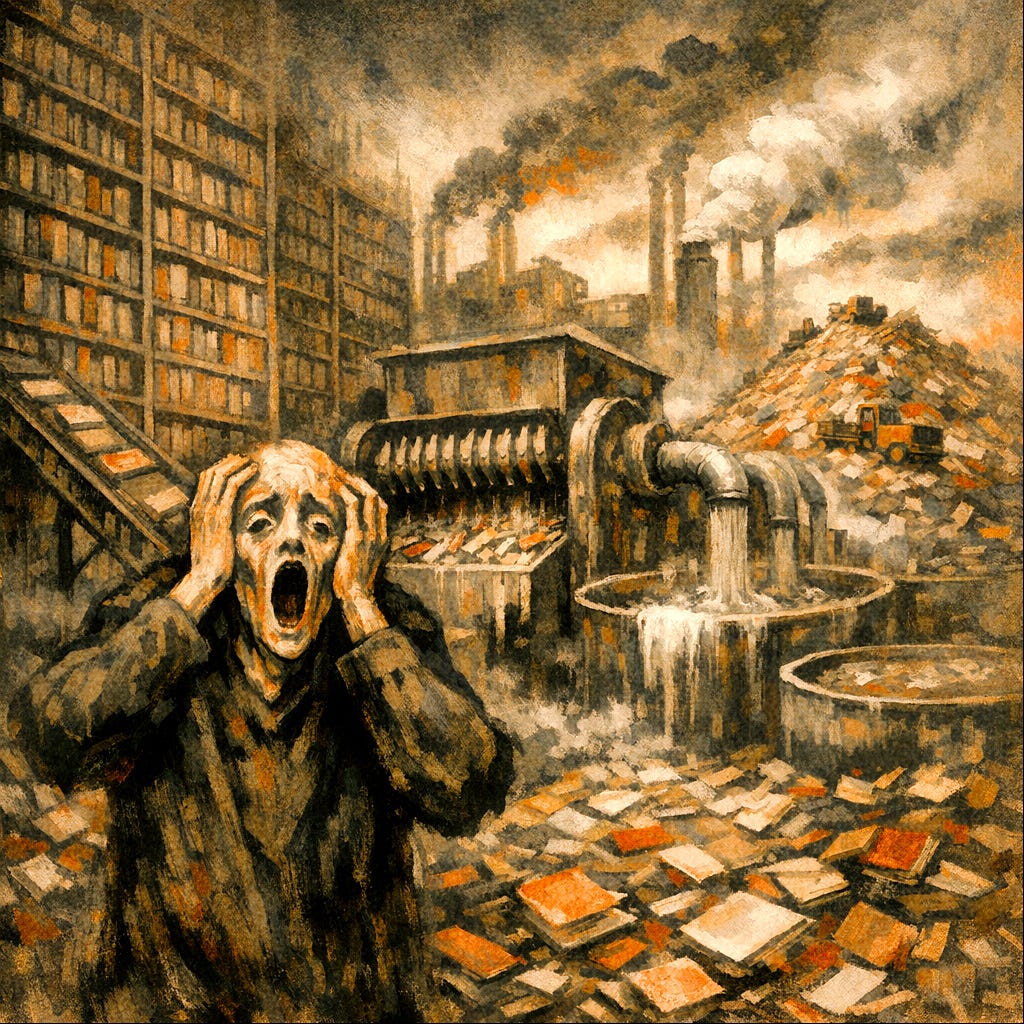
Pulping is exactly what it sounds like. The cover is torn off. The pages—the paper block that held your words, your sentences, the paragraphs you rewrote eleven times at two in the morning—are fed into an industrial machine that mixes them with water and chemicals until they dissolve into a slurry. That slurry gets cleaned of ink and dried and pressed into new paper products. Your memoir might become toilet paper. It might become the stock for someone else’s book. It will almost certainly not become anything you’d recognize.
The French have a word for this that I find unbearably perfect: pilonnage. And the workers at book fairs in Brussels who pack unsold books into shipping containers for the pulping plant call those containers cercueils.
Coffins.
In France alone, roughly 140 million books are pulped every year—nearly one in four. In the United States, estimates suggest that between 65 and 95 percent of books returned to publishers are destroyed. Not remaindered. Destroyed. The range in that estimate tells you something about how much the industry wants you to know the real number, which is: they don’t.
And the environmental cost is staggering. The publishing industry contributes to an estimated 640,000 tons of books ending up in American landfills every year. Books with laminated covers or glue-heavy bindings sometimes can’t be recycled at all—they’re incinerated or dumped. The whole lifecycle of a printed book, from the tree to the printing press to the warehouse to the truck to the bookstore to the truck again to the pulping plant, leaves a carbon footprint that would be obscene if anyone were paying attention. And the result of all that energy and all those trees is, very often, nothing. A book that nobody read, turned into a product that will never carry your name.
I want to bring this back to Jon Galassi and the polite suggestion he made from three doors down at Exeter.
When the man who runs FSG told me to publish privately and share Surfing the Interstates with those closest to me, he was being kind. I believe that. But he was also, whether he knew it or not, saving his company the cost of printing five thousand copies of my book, shipping them to warehouses, distributing them to bookstores that would return half of them within two months, storing the returns, negotiating with a remainder house, marking the unsold copies with a slash across the page edge, and eventually pulping whatever the bargain hunters didn’t want.
He was saving himself the trouble of turning my book into toilet paper.
And here’s the thing I keep circling back to, the thing that makes the whole machinery of traditional publishing look increasingly absurd: my book exists. It’s on Amazon as an ebook and a paperback. It’s here on this Substack in its entirety, free to read, with audio versions on Spotify and Apple Podcasts. It lives in the cloud. No warehouse. No shipping. No returns. No remainder marks. No coffins.
It will never be pulped because there’s nothing to pulp. It will never be remaindered because there’s no overstock. The only inventory is virtual, and virtual inventory doesn’t cost anything to store, doesn’t take up space, doesn’t require a Supreme Court ruling to write down, and doesn’t end up in a landfill.
Print-on-demand means that when someone orders a physical copy—and a few people have—one copy gets printed and shipped. One. Not five thousand optimistic copies hoping for a breakout. Not a warehouse full of paper waiting for a market that may never arrive. One book, for one reader, printed when it’s wanted.
This is not a screed against traditional publishing. FSG has published some of the greatest literature of the last century. They published Flannery O’Connor and Tom Wolfe and Elizabeth Bishop and Jonathan Franzen. The work they do matters. But the system—the economics of printing thousands of copies of books that will mostly come back, the tax incentives to destroy rather than store, the six-week window to prove your worth, the conveyor belt from shelf to warehouse to bargain bin to coffin—that system was never built for someone like me.
It was barely built for anyone.
Now here’s where I have to be honest with you, because I promised I would be, and because the irony is too rich to ignore.
I just told you my book lives in the cloud. No warehouses, no trucks, no pulping plants. Clean. Light. Free.

But the cloud is not a cloud. The cloud is a building. A lot of buildings, actually—massive, windowless, temperature-controlled data centers spread across the country and the world, humming with servers twenty-four hours a day. The cloud is a warehouse. It’s just a different kind of warehouse, and instead of storing unsold books, it stores everything—every ebook, every Substack post, every Spotify stream, every conversation I’ve ever had with Claude at three in the morning about whether a particular sentence is doing what I need it to do.
Those server farms consume staggering amounts of electricity. They require millions of gallons of water for cooling. They generate heat and carbon emissions and electronic waste when the hardware is cycled out every few years. The AI that helped me write this book—that helps me write everything—runs on processing power that would have been unimaginable a decade ago, and that processing power has a footprint. A real one. Not theoretical. Not abstract. Measured in megawatts and acre-feet of water and tons of CO2.
So when I say my book will never be pulped, I’m telling the truth. But I’d be lying if I pretended the alternative was free. I traded one set of environmental costs for another. I traded trees and ink and diesel fuel and pulping chemicals for silicon and electricity and cooling water and the carbon footprint of training and running the large language models that are becoming the infrastructure of how we make things now.
The difference—and I think this matters, though I’ll let you decide—is that the old system’s waste was built into its business model. Overprinting was the strategy. Returns and pulping were expected, budgeted for, tax-optimized. The waste wasn’t a byproduct; it was the plan. The server farm that holds my Substack and powers Claude also holds a million other things—it’s shared infrastructure, not a warehouse dedicated to storing copies of a book nobody ordered.
But I’m not going to stand here and tell you I’ve solved the problem. I haven’t. I’ve just changed its shape. And anyone who tells you the digital future is clean hasn’t looked at the electric bill.
So if the numbers are brutal and the system is broken and even the alternative comes with its own costs—why do it? Why write the book at all?
I’ve thought about this more than I’ve thought about anything in seventy-four years, and the answer I keep arriving at is one that the publishing industry has no use for, because you can’t monetize it and you can’t put it on a royalty statement.
Writing—honest writing, the kind where you sit with your own life and refuse to look away—is not about making money. It’s not about getting famous. It’s not about proving something to the people who never believed in you or the family members who won’t return your calls. Those are the reasons people start writing. They’re not the reasons it matters.
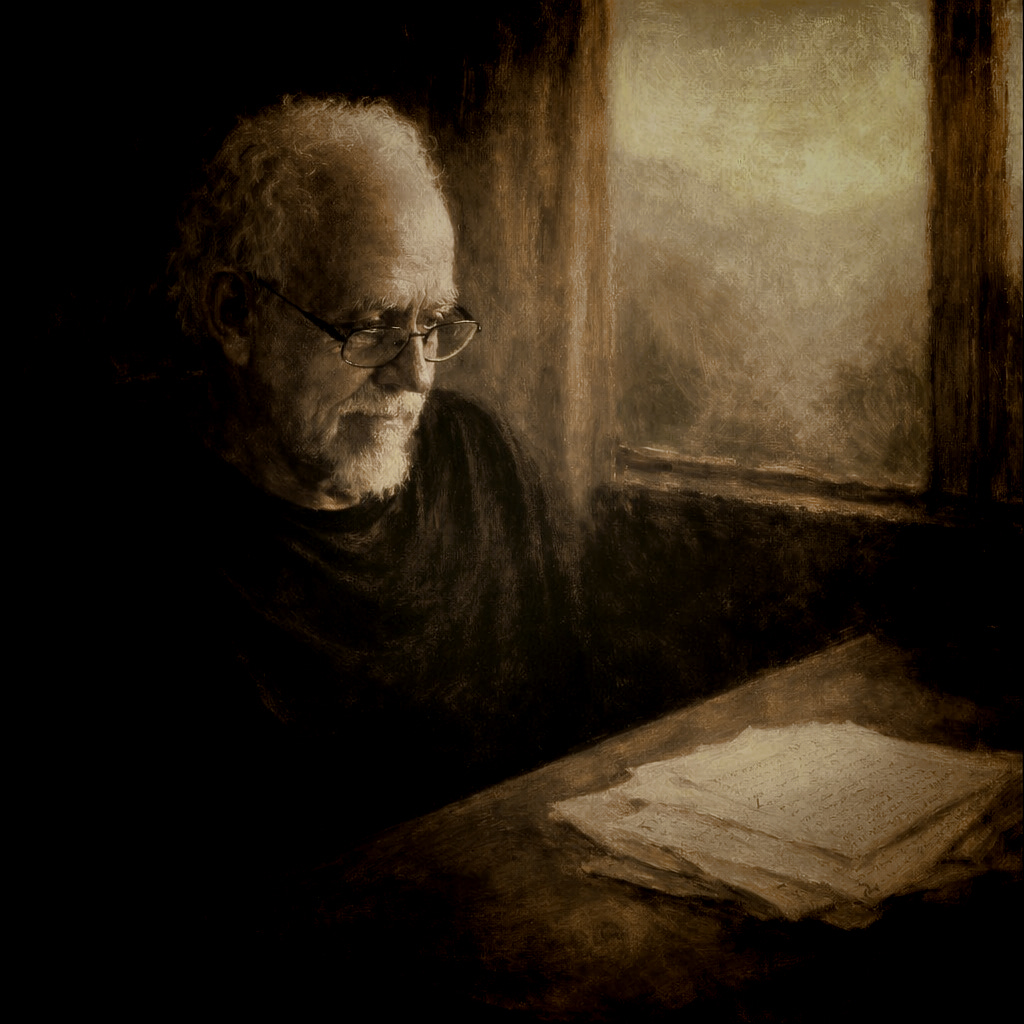
It matters because of what happens to you in the process.
I didn’t know what Surfing the Interstates was really about until I wrote it. I thought I was telling a road story—a kid with a backpack and a thumb out, crossing America in 1973. What I found, over hundreds of hours of writing and rewriting, was that I was mapping the interior of a twenty-one-year-old who was running from a family that was coming apart, looking for something he couldn’t name, and finding it not in the destinations but in the silences between them. I didn’t know that. The writing showed me.
That’s what memoir writing is, when you do it right. It’s not a product. It’s a process. Contemplation. Realization. Transformation. You sit with the raw material of your life—the things you did, the people you loved, the mistakes you made, the stories you told yourself to survive—and you turn it over and over until it starts to reveal what was actually going on underneath. The writing doesn’t just record your life. It changes your understanding of it. And that changes you.
No publisher can give you that. No advance, no colophon, no review in the Times. And no remainder house can take it away. You can pulp every copy of the book. You can slash the page edges and sell it for a dollar and dissolve it into slurry and turn it into toilet paper. The thing that happened to you while you wrote it—the seeing, the reckoning, the slow and sometimes painful arrival at the truth of your own experience—that’s yours. That’s the thing that can’t be remaindered.
The publishing industry will tell you a book’s value is measured in units sold. The tax code will tell you its value depreciates on a schedule. The remainder house will tell you it’s worth a dollar fifty.
They’re all wrong.
Remember that person at the window? The one with the cold coffee and the quiet picture of a stranger in a bookstore?
I hope she finishes her book. I hope the words keep coming. I hope she doesn’t read this essay until after she’s written the last page, because the dream at the window is fragile and necessary and I wouldn’t take it from anyone.
But when she does finish—when she lifts her head and looks up from the manuscript and starts asking what comes next—I hope she finds this. I hope she sees the numbers and the warehouses and the coffins, and I hope it doesn’t destroy her. I hope instead it frees her. Because once you understand that the traditional system was going to pulp your book anyway—that the dream of the bookstore shelf was always going to end in a warehouse, in a slash across the page edge, in a vat of chemicals—then you’re free to do it differently.
You’re free to put your book into the world in a way that lets it stay there. And more than that—you’re free to understand that the world was never the point. The point was what happened to you at the window. The point was the transformation.
Write the book. Skip the coffin. Keep the change.
Subscribe · E-PUB · Kindle/Paperback/Hardcover/Audiobook