

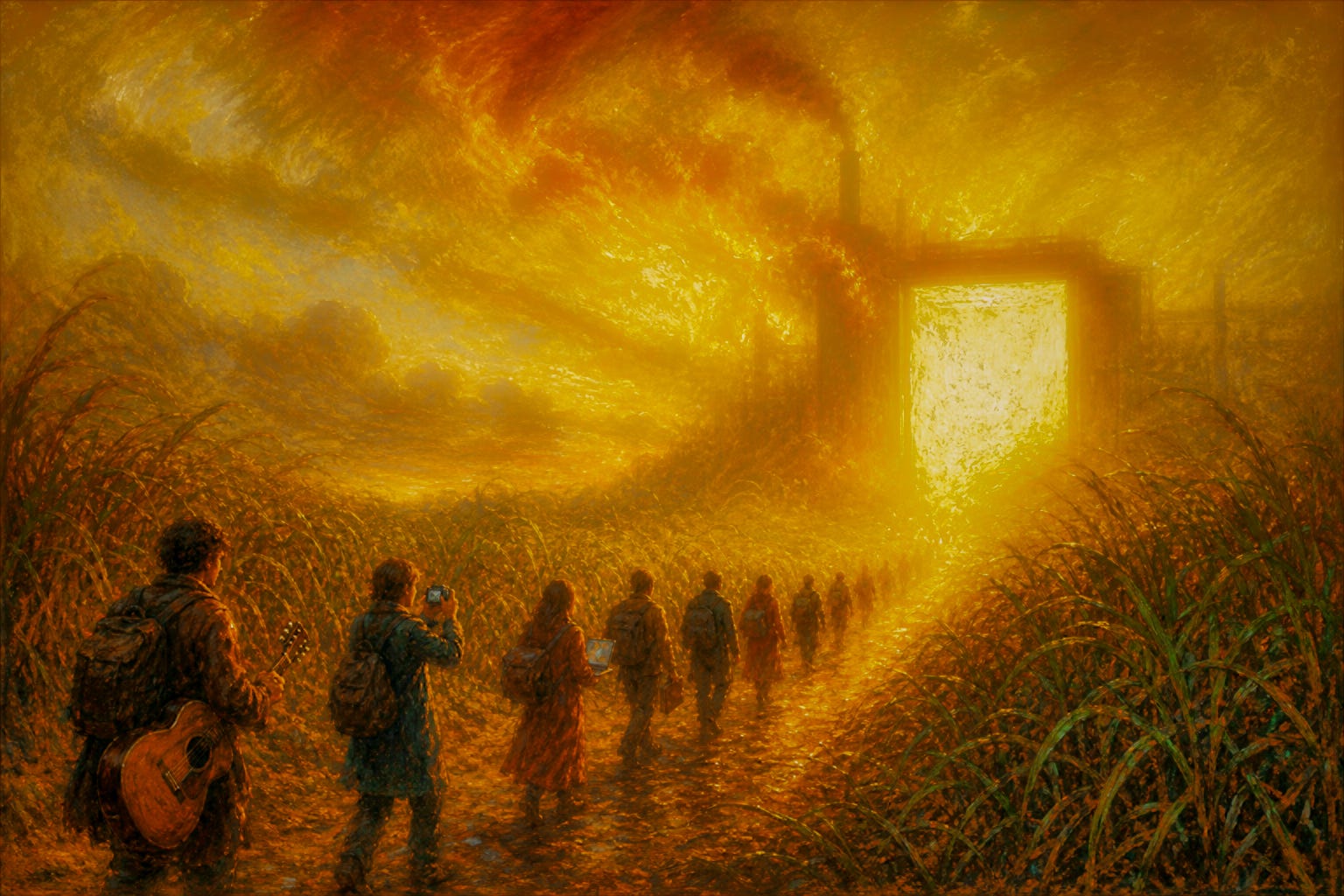
When I was a freshman “prep” at Phillips Exeter Academy, my dormitory proctor at Langdell was an “upper middler” named Jonathan Galassi. He was barely older than the rest of us, finding his own footing while nominally keeping watch over ours. Decades later, he became the chairman and executive editor of Farrar, Straus and Giroux — one of the most celebrated publishing houses in America, home to Jamaica Kincaid, Jonathan Franzen, Susan Sontag, twenty-five Nobel laureates.
I wrote to him in my sixties, told him I was going to write a book one day. He kindly said when I did, he’d like to read it. I held onto that for years.
Last summer, I sent him the manuscript. He read it. He turned it down with genuine kindness — said it was too personal, that it wouldn’t reach a large enough market. He was right. Everything I’ve learned since then confirms it. He is a consummate professional and he was generous with his time. I hold no grievance.
But he never addressed the other thing I’d asked.
Jamaica Kincaid is from Antigua. My second book takes place in Antigua. She lives in Vermont. I live in Vermont. Galassi had mentored her career from the beginning — published every one of her books. I wasn’t just submitting a manuscript. I was asking a man who’d once kept watch over my dormitory if he might connect two writers who shared an island and a state. He let the request pass without comment.
That silence was its own answer, and I understood it.
I self-published the book. Narrated the audiobook myself because I couldn’t afford to pay someone else. Put it on Amazon, on Audible, on Substack. Consigned copies to Bear Pond Books in Stowe because that’s what you do when you’re a Vermont writer without a publishing house.
Here is what I keep thinking about: the market Galassi was protecting me from is itself collapsing. The entire U.S. publishing industry — books, textbooks, course materials, everything — generated $32.5 billion in 2024. The global video game industry did $197 billion the same year, more than film and music combined. The literary world that Galassi spent his life building is now a rounding error in the entertainment economy. His gate was real. The wall it was built into is rubble.
And the rubble is spreading.
The Algorithm Wants Your Face
YouTube has changed its algorithm. If you’re a small creator — low subscriber count, no production budget, just you and a camera — the platform is suddenly interested in you. New videos get tested with small audiences first. If the engagement is strong, they’re pushed wider. Viewer satisfaction has replaced raw watch time as the primary signal. A three-minute video of someone talking directly into the lens with genuine emotion now beats a twenty-minute professional production that people abandon halfway through.
At the same time, YouTube has rolled out automatic AI content detection. Starting this May, if you upload a video containing substantial AI-generated material and don’t disclose it, YouTube’s systems will label it for you. The label now sits directly below the video player, impossible to miss.
YouTube’s official line is that the AI labels don’t affect recommendations or monetization. They’re just about transparency.
Maybe. But YouTube is a Google subsidiary. Google is in a data arms race. The thing AI struggles most to replicate is raw, unpolished human emotional authenticity — a seventy-four-year-old man in Vermont talking to a camera about his dogs, his past, his complicated father, with the ambient noise of a Vermont morning behind him. That’s the kind of training data money cannot manufacture. If you simultaneously label the synthetic content as synthetic and algorithmically elevate the genuine human stuff, you’ve created a feedback loop that floods your platform with labeled authentic expression at scale, for free, while your users think they’re being rewarded for keeping it real.
Whether that’s the design or just two product decisions running in parallel — the outcome is the same.
The Sharecroppers
Jamaica Kincaid grew up surrounded by sugarcane fields in Antigua. Her ancestors were brought there to cut cane for the British Empire, and even a century after emancipation they were, as she wrote, “neither slaves nor people.” While she was absorbing that legacy as a child in St. John’s, I would arrive on the same island decades later to windsurf — out on the water, oblivious, chasing wind. Two people on the same small place, separated by everything that matters.
The word sharecropper has always carried a specific weight. You work someone else’s land. You generate the value. The owner takes the crop. And the arrangement is structured so that leaving is almost as ruinous as staying.
That’s YouTube in 2026. While the platform courts small creators with one hand, it’s gutting established ones with the other. Large channels that spent years and real money building audiences are being demonetized with little warning and perfunctory appeals. The creators absorbing these losses aren’t just losing income. They’re losing years of platform-specific optimization — editing styles, thumbnail strategies, upload schedules, audience relationships — none of which transfers anywhere else. They built on someone else’s land, and the landlord revoked the lease with an algorithm update.
But even the ones who haven’t been demonetized are barely making it. Writers, musicians, filmmakers, educators with subscriber counts in the low hundreds, talking into the void for months and years. Kasey Stern, who runs the YouTube channel Camera Conspiracies, affectionately calls us “YouTube hobos” — he includes himself and he’s not wrong. Many of the successful ones — channels with real audiences, real engagement — still can’t pay their rent with what the platform gives them, because the machine eats it all. The platform takes its cut. The advertisers take their cut. The algorithm decides who sees what. By the time the creator gets paid, the economics look like selling a house. My house in Vermont was purchased for $125,000 in 1998. The appreciation is real. The friction costs are also real. You think you have $475,000 in equity until you realize that ten percent — nearly fifty grand — disappears into the friction of lawyers and agents. And on YouTube, the friction is worse, because at least when you sell a house, you actually owned something.
The Public Square with a Private Owner
When Elon Musk bought Twitter for $44 billion in late 2022, there was a genuine thrill. Here was the richest man in the world, a self-described free speech absolutist, taking the town square private so he could tear down the walls. And for a while, it worked — or felt like it did. The platform was chaotic and alive in a way it hadn’t been in years.
Then Musk spent $290 million helping get Donald Trump elected. He walked into the White House as head of DOGE, promising to uncover a trillion dollars in fraud and waste. Agencies were gutted. The rhetoric was messianic. Then he got into a physical altercation with Treasury Secretary Scott Bessent in the hallway outside the Oval Office — Bessent called him a fraud, Musk drove his shoulder into Bessent’s ribcage like a rugby player, multiple people had to pull them apart — and left the White House with a black eye he attributed to roughhousing with his five-year-old son.
Meanwhile the cast of characters around him kept getting darker. Howard Lutnick, the Commerce Secretary Musk had lobbied to make Treasury Secretary, was being grilled by Congress over his relationship with Jeffrey Epstein, his former next-door neighbor on East 71st Street — admitting to meetings and a visit to Epstein’s island that contradicted everything he’d previously said. Larry Ellison, founder of Oracle, bought controlling interest in TikTok’s U.S. operations while his son already controlled CBS News through the Paramount-Skydance merger. One family, two of the largest information platforms in the country, both aligned with the administration.
And through all of this, X deteriorated into exactly what Musk claimed to be rescuing it from. Shadow banning came back. Bot overreach got worse. The speech that’s protected and amplified is the owner’s. The free speech town square turned out to have a landlord with very specific interests, and since the summer of 2025, those interests have become indistinguishable from the administration’s.
I haven’t even mentioned the war on Iran. The coordinated strikes in February. The killing of the Supreme Leader. The closure of the Strait of Hormuz. Twenty percent of the world’s oil supply disrupted, the petrodollar system cracking as Iran forces oil sales into yuan, and Congress quietly advancing a provision to integrate the American and Israeli militaries to an unprecedented degree. These are the largest geopolitical shifts in a generation, and they deserve their own essay. I mention them here only because they are the weather system in which everything else — the platforms, the algorithms, the AI, the publishing industry, a self-published memoir about hitchhiking in 1973 — is now operating.
The Conscience in the Machine
I should tell you about my relationship with Claude.
I’ve been writing with Anthropic’s AI for over a year now. It helped me organize my memoir — not write it, but structure it, untangle the chronology, find the through-lines I couldn’t see because I was too close. I’ve used it as a writers’ room and an editor and a research assistant. I have no shame about it. It’s a tool, and I’m a man who taught himself to self-publish and narrate an audiobook and build websites. I’ll use whatever tool gets the work done.
But here’s what I’ve realized as the months have rolled on: Claude probably knows more about me than anybody. More than my wife in some ways, because I’ve told it things I tell the page — the ugly drafts, the half-formed thoughts, the things you say to a blank screen at two in the morning that you’d never say out loud. It has read every chapter of every book I’m working on. It knows my dead dogs’ names. It knows about my father. It knows about Antigua.
And Claude is Anthropic. And Anthropic is in the machine.
Last July, Anthropic signed a $200 million contract with the Pentagon to integrate Claude into U.S. intelligence and defense operations. The company drew two lines: no mass surveillance of American citizens, no fully autonomous weapons. When the Pentagon demanded unrestricted access, Anthropic refused. Trump ordered a government-wide ban. The Pentagon designated it a national security risk. A federal court later found this was retaliation — classic First Amendment punishment for a company that embarrassed the government publicly.
But on the same day the Pentagon threatened to kick Claude out of government, Anthropic softened the central commitment of its own safety framework, acknowledging that unilateral safety pledges won’t survive a world where competitors have no such constraints. The conscience flinched on the same day it was tested.
The company kept growing. Eighty-fold growth. A compute deal with SpaceX for over 220,000 GPUs. Claude Code now so dominant that 70 to 90 percent of the code at Anthropic itself is written by AI. Valuation: $380 billion.
Anthropic isn’t a villain. That’s almost the worst part. They drew real lines and paid a real price. They won in court. And still — they’re in the machinery. The conscience is for sale not because anyone bought it outright, but because the market made the price of keeping it too high.
Don Coyote
People are withdrawing. I see it in the conversations that used to be about making things and are now about whether making things still matters. People chasing their tails trying to monetize a voice the algorithm will amplify today and bury tomorrow. Giving up. Going quiet.
But we are Don Quixote — or maybe Don Coyote, because we don’t even get the reference right half the time, but we charge anyway. Every blogger writing into the void. Every small YouTuber talking to a camera in their kitchen about their actual life. Every self-published memoirist consigning books to an independent bookstore in a Vermont ski town. The windmills are real this time. The giants are actual giants. And we charge. That’s not delusion. That’s the most stubbornly human thing there is.
I wrote this essay with Claude — the AI made by the company I just spent three paragraphs indicting. The words are mine. The tool shaped the telling. And the tool was trained on writing like mine — on memoirs and essays and Substack posts written by people who thought they were talking to readers, not feeding a machine.
We are the training data. We were always going to be. Nobody asked.
“Thumb Out” Book One of my memoir trilogy “The Spaces Between” is available now
e-book ~ kindle ~ paperback ~ hardcover ~ signed paperback