

subscribe ~ e-book ~ kindle/paperback/hardcover ~ table of contents

I lasted about four months.
I’d hitched back out to Sonoma County in December and landed at a cottage on Wilfred Avenue in Santa Rosa with two roommates — Susan, a twenty-year-old music student at Sonoma State who played guitar, piano, and flute and owned a Martin D-28, and Melody, twenty-four, an expressive arts major who lived in the outbuilding. Both nice. Neither interested.
The cottage sat on the plain of the Sonoma Valley near the foothills of the Northern California coast range. On a clear day you could see Mount St. Helena. I wrote in my journal on Christmas Eve that I felt like the childhood and adolescence of my life were behind me — that the loves, the art, and the pain of my adult life were beginning to unfold almost magically before my astonished eyes.
Nothing unfolded. I went on food stamps. I washed dishes for a while. I pumped gas for a while. I heard about a company called Optical Coating that supposedly paid well. They put me in a white clean suit, someone offered me a smoke that turned out to be laced with something, and within minutes I was tripping. I left and never went back. My career there lasted about forty-five minutes.
* * *
I also spent a couple of weeks crashing at a friend’s workshop in the Mission District in San Francisco. No kitchen. Cold running water. Practically Skid Row. It confirmed what I already suspected — that I had no business being in California without money, connections, or a plan. I’d gone back to the place where it hadn’t worked the first time, and it wasn’t working again. You can’t put the genie back in the bottle.
Then in late March, I got the phone call.
Nana had gone to a St. Patrick’s Day party with my mother at the neighbors’ house across the street, the Thoms. There was a lot of drinking — a dangerous thing for a woman on seizure medication. Jacques was home from boarding school, maybe spring break. He found her on the floor beside her bed the next morning. He was seventeen. She was seventy-three.
I flew home.
* * *
We all went to the funeral home together — all the siblings, my mother. They took us downstairs to pick a casket. The funeral director steered us toward the expensive ones, as they do. Jacques made a show of saying he’d help pay for something nice, though how a boarding school kid was going to manage that I have no idea. I looked at the simple pine box in the corner and thought: when I go, that’s how I’ll go.
They had an open casket. Nana looked perfect. Her hair was done. She was dressed in her finest. It was creepy and beautiful at the same time — this woman who had spent hours putting tinsel on Christmas trees one strand at a time, who had taught us to smoke by rolling cigars from shopping bags and laughing at us while we gagged, who said “Jesus, Mary and Joseph” followed immediately by “Pass Holy Father, all is well” — now laid out still and silent, like someone playing a very convincing game of sleep.
My mother had purchased a small double plot just across the lane from the large Saint Phalle family plot where my grandparents were already buried. A plot for two — her and Nana, side by side. She’d chosen the Pound Ridge house because it had a mother-in-law apartment for Nana. Nana had lived in it for less than six months. Another paradise with an expiration date.
* * *
I stayed.
It was spring, then summer, and I didn’t leave. I managed to get a job driving a photo finishing pickup and delivery route through Fairfield County for Technicolor. The irony was ludicrous — I’d just been working at MCA TV on Park Avenue, and Technicolor processed all the 35mm film those studios shot. But I didn’t care. The job came with a late-model Oldsmobile Delta 88, just like my father used to drive, and a credit card for gas. Every day I’d hit about twenty-five pharmacies across the county, dropping off and picking up Technicolor photo finishing envelopes. It was mindless and it was mine.
I had two guitar buddies in Stamford — Howard Leavitt and Mark Hutchison. Most afternoons I’d work them into the route, swing by, and we’d get high and play guitar for a while before I finished my stops. It wasn’t a career. It was a life. The first time in years I wasn’t trying to be somewhere else.
Charlie was thirteen that summer, and he seemed a little lost. He was sweet, quiet, already into the same music I liked, and already getting high. We smoked some weed together in the basement. He said he wanted to learn how to play bass. So I took him to Sam Ash and we got him a Squier and an amp, and I showed him the basic blues pattern — root, third, fifth, the line that holds everything together. He practiced it religiously. Every day, down in the basement, working that pattern until it lived in his fingers.
There’s a particular kind of love that comes from teaching a younger brother something real. Not advice. Not life lessons. Something physical — where you put your fingers, how to feel the rhythm lock in, the moment his face changed when the line started to groove and he could feel it pulling the song forward. I’d been playing guitar for years without ever finding what I was looking for. Charlie found it in weeks. He had a natural ear and an easy confidence that I envied.
On July 31, 1974, I persuaded my mother to let me take him to his first Grateful Dead concert in Hartford, about forty-five minutes away. I drove up with Howard and Mark and Charlie, and we all promptly split off. I didn’t see Charlie again until the end of the show. I have no idea what he got up to in those hours — what he smoked, what he saw, who he talked to. He was already smarter than his years, alone at a Dead show in 1974. He came back grinning. He’d had a great time. I didn’t ask too many questions.
* * *
Around this time, my father made one of his rare appearances in our lives. Not in person — by phone. He’d arranged for Jacques to go live with a business associate named Doug MacDonald, who had a cattle ranch in Sanger and a beautiful home up in the Sierra Nevadas at Shaver Lake. Jacques could finish high school there, become a California resident, and get free college tuition. It was the kind of deal my father was good at — finding someone else to raise his children.
The deal also included me. My father had spoken with his cousin Claude Madden in Palo Alto. She and her husband had agreed to take me in so I could try going back to school. Two sons dispatched to California through other people’s generosity. Efficient.
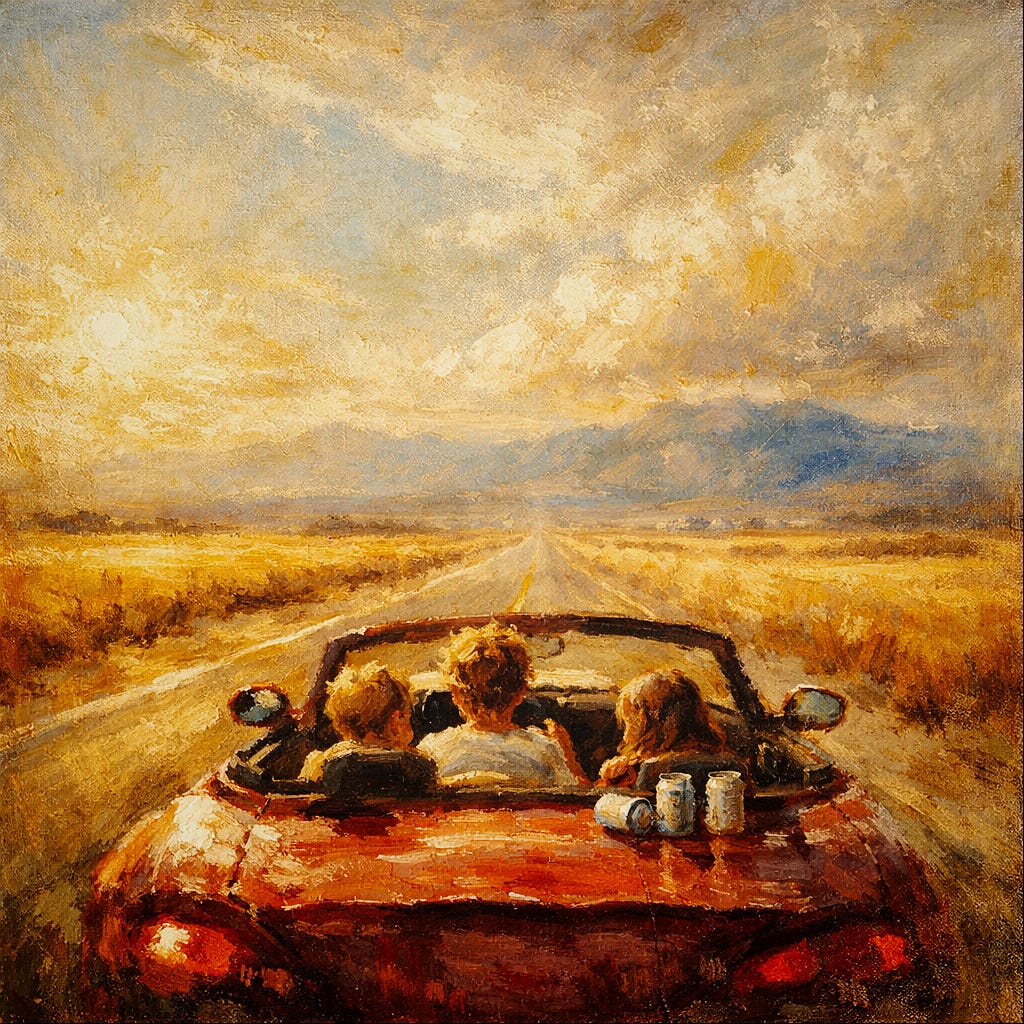
I arranged a drive-away car — a wine-red Saab turbo convertible with leather trim, to be picked up in White Plains and delivered within ten days to Belmont, a small town on the Peninsula south of San Francisco. A rich New York girl going to college out there. Somehow my mother agreed to let me drive my two younger brothers across the country. Jacques was seventeen. Charlie was thirteen. I was twenty-two and in charge of nothing but the steering wheel.
We bought a case of beer and put it on ice. We had some marijuana and a chunk of Lebanese hash. There was a movie out at the time called Together Brothers — about some Black guys with machine guns fighting the police — and we adopted it as our anthem. We’d chant “together brothers, they don’t take shit from the man” and then make machine gun sounds, like we were badasses, which we were not. We were three kids in a stranger’s Saab with weed and beer and no adult supervision, pointed west on I-80.
We made Denver in twenty-four hours of straight driving.
Somewhere in Iowa, a state trooper pulled us and a semi tractor-trailer over at the same time. We were in front. The truck parked behind us, and the trooper parked behind the truck and started writing him up. We had a few minutes. Jacques took charge. He put on a poncho, gathered up all the empty beer cans underneath it, and walked around in the tall grass off the shoulder, dropping them discreetly. He emptied the baggy of marijuana into the weeds. Then he ate the chunk of Lebanese hash. The whole thing. Just chewed it up and swallowed it.
The trooper came up to us, said he was writing us up for speeding. Didn’t seem to notice anything. Then he told us to follow him off the interstate to a mailbox on some county road, where he had us put cash in an envelope and drop it in. The whole thing felt like a shakedown from another century. We did it. He let us go.
I’ll never forget pulling into a gas station in Denver. We were destroyed. We slept in our seats right there at the pump. Woke up with stiff necks and carried on. At some point we realized we’d left the gas cap somewhere behind us, so Jacques said keep your eye out for a Saab. Sure enough, a few hours later we spotted one at another gas station. Jacques stole their gas cap and put it on our car. Problem solved.
West of Denver, Jacques got the map out and said let’s not cross the continental divide on I-80 — let’s take a back road. We found what looked like a two-lane highway over a pass. It quickly turned into a dirt road. The dirt road climbed and climbed, and near the summit we met a wall of snow. August, and there was three feet of snow blocking the pass. We had to turn around. The Saab took a beating on that road, but it held.
On the way back down, I looked at Charlie and said, do you want to drive?
He looked at me like I was crazy.
I said come on, man. It’s just a dirt road. Nobody’s around.
He slid behind the wheel with this enormous grin, adjusted the seat, and took right to it. Hands at ten and two, careful, focused. After a while I told him to floor it. He looked at me again — that same look, are you serious? — and then he did it. The Saab leapt forward on the dirt and Charlie held on, laughing, and then figured out what it took to stop. It was one of those moments you don’t know is important until fifty years later, when you’re trying to remember the last time your brother looked at you with pure, uncomplicated trust.
* * *
We made it to the Sierras on a hot afternoon and stopped at a reservoir. I was desperate to cool off but didn’t have a bathing suit, so I dove in naked. Some rednecks started yelling at us from the shore and we had to leave — three brothers, soaking wet, piling back into a borrowed Saab.
We ended up at Doug MacDonald’s beautiful mountain home at Shaver Lake, where Jacques was going to live. Doug had an adopted adult son who lived with his wife and kids at the cattle ranch Doug owned in the Valley. We met two old-timers named Walter and Bell who were the caretakers at the mountain home — she was very thin, he had a scraggly white beard, and they both looked like relics from the Gold Rush, like they’d walked straight out of 1849. We left Jacques there. The goodbye was no big deal. Jacques was always the tough guy. He liked to make fun of me because I was the sensitive artist type and he was a football player, a carpenter, a guy who didn’t do sentiment. See you later. That was about it.
He’d go to high school in Sanger, play football, then get into Humboldt State to study forestry. He’d meet his wife there. He’d build a whole life in the West, and he’d never really come back.
Charlie and I continued on to San Francisco, drinking beers to keep things interesting. We hit a massive traffic jam heading for the Bay Bridge and I had to piss in the worst way. Charlie handed me an empty beer bottle. It worked great until it filled up. I had to pinch off the stream, crack the door open, drain the bottle onto the pavement, and carry on. Nobody in the next lane was any wiser.
We made it to our uncle Richard’s place in the city. The next day he followed us down to Belmont so we could hand off the Saab to the college girl. The day after that he drove us to Tassajara, the Zen hot springs back in the Ventana Wilderness — a long dirt road in, steam rising off stone pools, the smell of pine and sulfur. There was a girl soaking topless who caught Charlie’s attention completely. Richard and I ribbed him about it the whole ride home.
Then Charlie flew home to Pound Ridge. My mother picked him up at the airport and drove him back to what the Thoms had taken to calling Furlong’s Flophouse. A house in some chaos. Nana freshly gone, the father absent, the older siblings scattered or scattering. Charlie was thirteen years old, walking back into that, with a new Squier bass and a head full of the Grateful Dead.
I went to meet the Maddens in Palo Alto, where I enrolled at Foothill College and started over again. My third fresh start in California. The genie still wouldn’t go back in the bottle, but at least this time someone was holding the door open.
* * *
I think about that summer a lot. The three of us in the Saab, chanting together brothers like idiots, Jacques eating hash to save us from a state trooper, Charlie behind the wheel on a dirt road at thirteen with his foot on the floor. It was the last time the three of us were together and it worked — loose, easy, no damage. We were brothers and that was enough.
Five years later, our father would lure us back together in Providence for one more try. It would not go the same way.
← Previous: Caught In The Light
