


Here’s what I know about what’s happening right now in Iran: almost nothing. And neither do you.
I know this in the way you know the weather from inside a windowless room — by rumor, by inference, by what someone else decided you should see. A week into a full-scale U.S.-Israeli war against Iran, the information environment isn’t just murky. It’s been engineered to be murky. Deliberately, by every side, for reasons that range from operational security to naked propaganda to the simple hustle of gaming social media monetization.
The war began on February 28th, when the United States and Israel launched coordinated strikes on Tehran, Isfahan, Qom, and other cities. Ayatollah Khamenei was killed in the opening salvo. Over a thousand people have been killed in Iran. Hezbollah has fired missiles at Israel. Iran has launched retaliatory strikes across the Gulf — at U.S. bases, at Israel, at Kuwait, Bahrain, Qatar. A U.S. submarine sank an Iranian frigate in the Indian Ocean, killing 87 sailors. The conflict has spread to at least fourteen countries.
That much we can piece together from the shrapnel of reporting that makes it through the various filters. But the picture has enormous holes in it, and those holes aren’t accidental.
The Blackout, from Every Direction
Iran has blocked access to the global internet for its citizens since the war began. For six days and counting, ninety million people have been funneled toward state-run news channels that broadcast IRGC missile launches and damage to civilian neighborhoods hit by American and Israeli ordnance — but omit any mention of the strikes obliterating their own police stations and paramilitary bases. One journalist described spending six hours testing fifty-nine different VPN configurations just to send a single tweet.
On the Israeli side, the suppression is different in mechanism but similar in effect. Israel’s military censor — a holdover from British Mandate emergency law, now nearly eighty years old — has been operating at unprecedented levels. In 2024, the censor blocked 1,635 articles entirely and redacted portions of 6,265 more, averaging twenty-one interventions per day — triple the peacetime rate. Since the current war began, they’ve expanded the net: foreign journalists are prohibited from filming missile impact sites, from using drones or wide-angle cameras near strike zones, and from sharing any imagery on social media without prior written approval from the military censor. Photographers in Haifa were arrested at dawn for setting up cameras on a hotel balcony overlooking the port.
And the kicker? Media outlets are forbidden from even telling you that something has been censored. You don’t know what you’re not seeing, and you’re not allowed to know that you’re not seeing it.
Meanwhile, on X
Then there’s the third layer of fog, which is the social media platforms themselves — and this is where it gets truly disorienting. X, formerly Twitter, is facing a tidal wave of AI-generated war footage. Their head of product reported finding one individual in Pakistan who was running thirty-one fake accounts, all rebranded to variations of “Iran War Monitor” in the days before the war started. The content wasn’t ideologically consistent — there were fake videos of Tel Aviv burning alongside fake “IDF Girl” accounts, all manufactured by people gaming the platform’s monetization system.
A fake AI video purporting to show airstrikes on Tel Aviv was viewed millions of times. AI-generated images of Khamenei’s body being recovered circulated widely and were even shared by a UN special rapporteur, who, when confronted with the fact that the image was fabricated, responded that the picture wasn’t the point — the facts were. Think about that for a moment. A United Nations official defending the use of fake imagery to illustrate what she considers real atrocities.
Old footage is being recycled too. A massive explosion labeled “THIS IS TEL AVIV” was actually a 2015 chemical warehouse explosion in Tianjin, China. Video compilations claiming to show Iranian bases under attack turned out to be AI-generated clips from December 2025, identifiable by warped door frames and bodies that moved wrong.
So the authentic footage of Israeli damage is suppressed by the military censor. The authentic footage of Iranian damage is filtered through state media with the internet shut down. And into the void rushes a river of fabricated content, some of it ideologically motivated, much of it created by grifters chasing engagement payouts. X is cracking down, but by definition they’re chasing the problem rather than ahead of it.
The Instant Replay We’ll Never Get
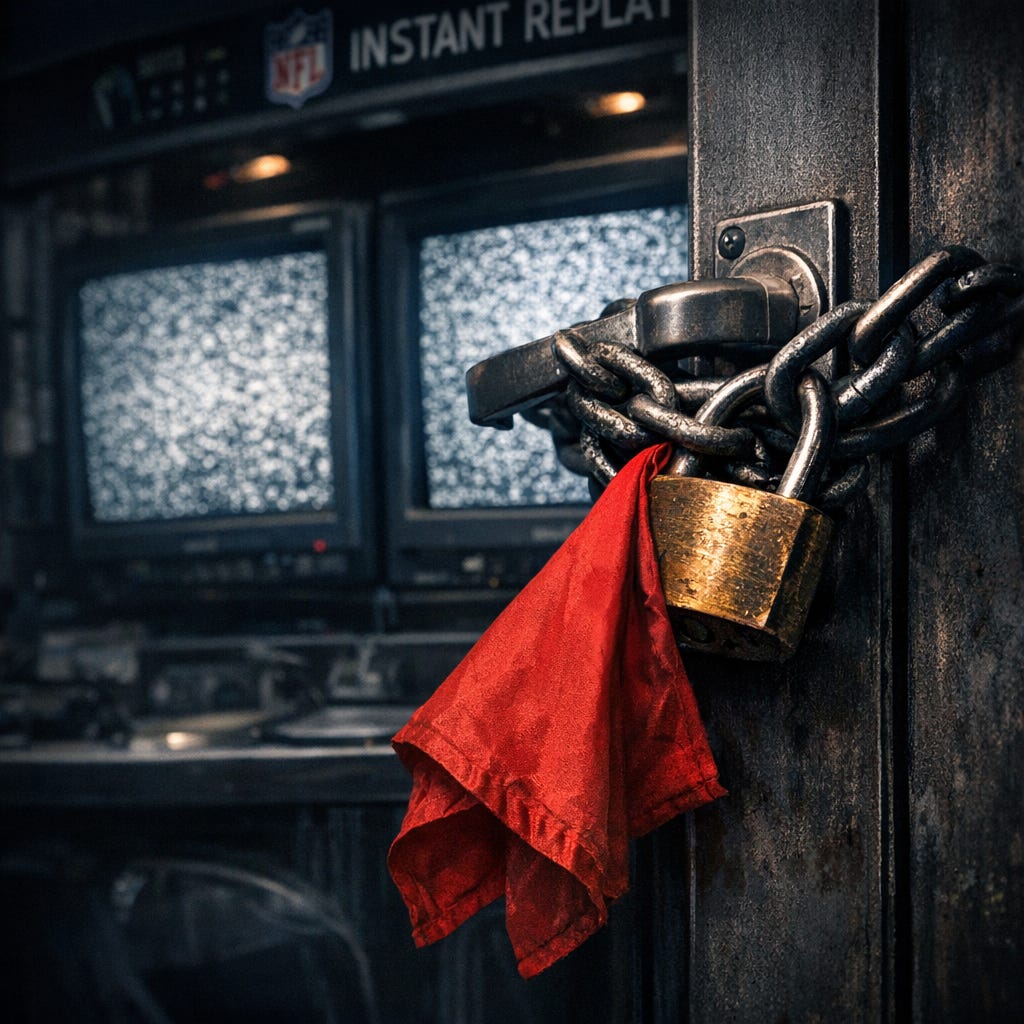
In the NFL, when a call on the field is contested, the coach can throw a red challenge flag. Play stops. The referees go under the hood. They review the footage from every available camera angle — the broadcast cameras, the pylon cams, the sky cam. The evidence is shown on the stadium’s jumbotron. Sixty thousand people in the stands, plus millions watching at home, get to see the same footage the officials are reviewing. They form their own opinions. They boo or cheer. And then the referee walks to the fifty-yard line, clicks on the microphone, and tells everyone what they’ve decided — and you can agree or disagree, but at least you’ve seen the same tape.
Now imagine applying that principle to what’s happening right now in the Middle East.
A missile hits a neighborhood in Haifa. Under the current rules, you can’t see the footage. The military censor has to approve any images before they’re broadcast. Foreign photographers are arrested for pointing cameras at the port. Israeli media cannot even acknowledge that censorship has occurred. The coach has thrown the flag, but the replay booth is locked, the jumbotron is dark, and the PA system announces only that the call on the field stands.
Or: a girls’ school near Minab, Iran, is hit in an airstrike. Iranian state media says 180 children were killed. Israel denies responsibility. CENTCOM says they’re investigating internally. The Washington Post and the New York Times have verified footage from the immediate aftermath, but the school was sixty meters from a major IRGC naval base. What happened? Who hit what? Was this a legitimate military target with catastrophic collateral damage, or something else? Where’s the replay? Where’s the camera angle from the other side of the field?
It doesn’t exist. Or rather, it exists but you’re not allowed to see it. That’s the fundamental difference between the fog of war and the fog of football. In football, the replay system was designed to bring transparency to contested calls. In war, every party with the power to control information has an interest in keeping the fog exactly where it is.
What the Viewer Is Left With
So here we are, a week into a war involving the world’s most powerful military, a nuclear-armed regional power, and at least fourteen other countries caught in the crossfire, and the average person trying to understand what’s happening is navigating a landscape where:
Iran has cut its own citizens off from the internet entirely. Israel’s military censor is blocking journalists from filming impact sites and arresting those who try. Social media is flooded with AI-generated fakes, recycled footage from old disasters, and content manufactured by engagement farmers in Pakistan. And a UN official is defending the use of fabricated images because she believes the underlying narrative is correct.
This is the information environment of 2026. This is the stadium with no jumbotron, no cameras, no replay, and sixty thousand people being told to trust the call on the field — by referees employed by the teams.
I’m a memoirist. My work is the preservation of memory, the honest reconstruction of what happened and what it felt like to be there. I have a deep professional and personal investment in the idea that the truth of lived experience matters, that getting the details right matters, that the difference between what happened and what people say happened is worth fighting for.
And I’m sitting here in Vermont, thousands of miles and oceans away from any of this, watching the fog roll in from every direction, and I don’t know what’s real. Nobody’s throwing the flag. Nobody’s going under the hood. The play continues, unchallenged, unreviewed, while the bodies are counted by people who have every reason to lie about the numbers.
In football, the replay system isn’t perfect. Calls still go wrong. But at least the principle is embedded in the game: that the people watching deserve to see what happened with their own eyes, and to form their own judgment. War has no such principle. War has the opposite principle — that the people watching must be managed, directed, shown only what serves the interests of those doing the fighting.
Throw the flag. Go to the tape. Let us see.
We won’t, of course. But at least we should know that the replay exists and that someone decided we couldn’t watch it.