

I’ve written about this before. In the spring I wrote about the Shy Girl fiasco, where Hachette pulled a horror novel based on an AI-detection score from a company whose sales rep helped feed the story to the press. Then I wrote about Anthropic’s text watermarking tool and the loyalty-oath atmosphere it invites — have you now, or have you ever, let a machine touch your prose?
I thought I was done. Then Jerry Falade happened, and I realized I’d been circling the real argument without landing on it.
The facts first. Falade is a PhD candidate at Southern Methodist University in Dallas. His academic work is on contemporary literature — Black masculinity in writers like Ta-Nehisi Coates and Marlon James. He lives inside sentences for a living. He wrote a crime thriller called Call Me, I’ll Hide the Body, and fourteen publishers went to war over it. Macmillan’s Minotaur Books won with a $2.4 million bid that included a second book. HarperCollins secured UK rights. Hollywood was circling.
Then on July 29th, his own agent pulled the manuscript. Marc Gerald of Europa Content said he could “no longer substantiate” that it was entirely human-written. Everything evaporated. The deal. The UK rights. The film interest. All of it.
Falade says he used AI for research — an open-source model he ran locally because he didn’t want his search history full of queries like “how to dissolve a body” raising flags with law enforcement. He says he has time-stamped drafts, handwritten notes, dated WhatsApp messages documenting the book’s development. He says he didn’t use AI to write it.
Maybe he did. Maybe he didn’t. That question is a dead end, and I want to talk about something else.
I want to talk about what we think writing is.
I spent decades as a photographer. In photography, the tool layer between the artist and the finished work has always been visible and accepted. The darkroom was a tool. Photoshop was a tool. Now computational photography — the AI inside your phone that composites exposures, adjusts depth of field, enhances resolution before you even see the image — is a tool. Nobody pulls gallery shows. Nobody rescinds prizes. We absorbed it and moved on.
In film, every major studio uses AI in post-production. In music, Auto-Tune has been reshaping vocal performance for nearly three decades, and a Sound on Sound survey from this year found that the majority of producers see AI tools as inevitable. Only 3.6 percent called them a fad.
But writing. Writing is where the accusation alone ends careers. Where the question of whether a machine might have contributed to the work is enough to collapse a $2.4 million deal. And the reason, I think, is that we’ve built a mythology around writing that we never built around any other creative medium.
The mythology goes like this: writing is the purest art. It requires nothing but a mind and a blank page. No camera, no instrument, no crew. Just a soul pouring itself into sentences. The tormented genius in the garret. The lone artist wrestling with the angel of language. And anything that disrupts that image — any tool, any collaboration, any mechanical assistance — is a contamination. A cheat.
It’s a beautiful story. It’s also a lie. And publishing knows it’s a lie, because publishing has never worked that way.
Here’s what actually happens when a writer signs a traditional deal.
An acquiring editor reads the manuscript and decides it has commercial potential, but it’s not there yet. It needs work. The editor sends notes — sometimes pages of notes. Restructure the third act. Cut this character. This chapter drags, compress it. The emotional arc doesn’t land, find another way in. The writer revises. The editor reads again. More notes. This goes back and forth, sometimes for a year or more, until the editor is satisfied that the book is ready. Ready meaning marketable. Ready meaning shaped for the audience the publisher has in mind.
Then a developmental editor gets involved. More structural notes, more revision. Then a line editor goes through the prose sentence by sentence, reshaping rhythm, tightening language, flagging clichés, sometimes rewriting passages. Then a copy editor cleans everything up. Then a proofreader. Then the marketing team weighs in on the title, the cover, the jacket copy, the positioning.
By the time a traditionally published novel reaches a bookshelf, it has been touched by a dozen hands. It has been pushed, cajoled, restructured, and polished by an entire team of professionals whose job is to make the book better — and more profitable. The acquiring editor is, in every meaningful sense, a creative collaborator. Sometimes a dominant one. Maxwell Perkins carved tens of thousands of words out of Thomas Wolfe’s manuscripts and is widely credited with making Wolfe publishable. Gordon Lish rewrote Raymond Carver’s stories so aggressively that scholars still argue about who actually authored them.
Nobody has ever called this cheating. Nobody has ever pulled a book because an editor’s fingerprints were all over the final draft. Nobody has ever run a manuscript through a detection tool to determine what percentage of the prose belongs to the writer versus the developmental editor. The collaboration is not only accepted — it’s the entire business model. It’s what a publishing deal buys you.
So. What happens when a writer doesn’t have that?
What happens when you’re writing alone — no agent yet, no deal, no editor on salary, no developmental notes, no line editor reshaping your sentences at 10am on a Tuesday? What happens when you’re a solo operator trying to produce work that can compete with books backed by the full institutional machinery of a Big Five house?
You improvise. You find your own version of that support structure. Maybe it’s a writers’ group. Maybe it’s a workshop. Maybe it’s a freelance editor you pay out of pocket. Or maybe — and here’s where the pearl-clutching starts — maybe it’s AI.
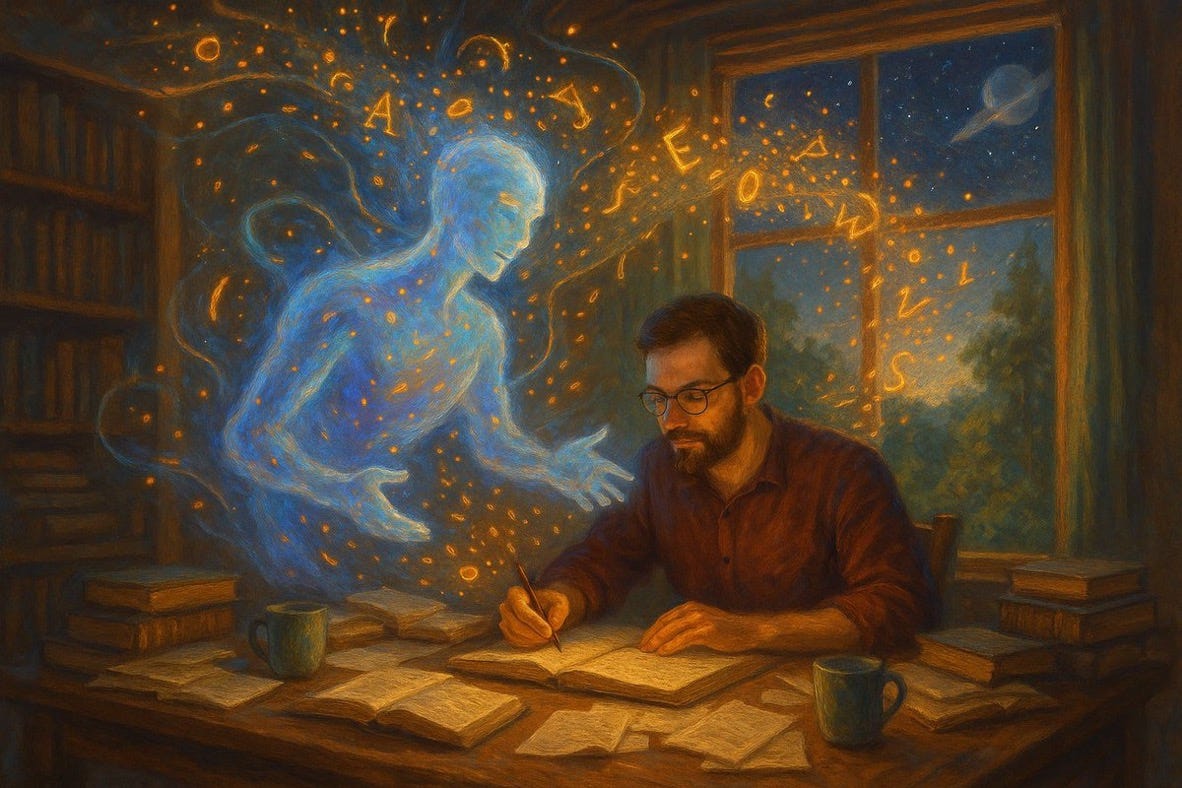
I use AI. I’ve said it before and I’ll keep saying it. I partner with Claude to write my memoir. Not to generate text. Not to produce prose I pass off as my own. I use it the way a traditionally published author uses an editor — as a sounding board, a brainstorming partner, a reader who’s available at two in the morning when I’m stuck on a transition and there’s no one else to talk to. I use it as a writers’ room of one.
I lived the life. I carry the memories. I make every decision about what goes on the page. The voice is mine. The experience is mine. The architecture of the book is mine. But I use every tool available to me to make the work as good as it can be, the same way a photographer uses Lightroom, the same way a filmmaker uses DaVinci Resolve, the same way a musician uses Pro Tools. The same way a traditionally published author uses the editorial team that their advance pays for.
The difference is that when a Big Five editor reshapes a manuscript, it’s called publishing. When a solo author uses AI to pressure-test a chapter, it’s called fraud.
That’s not a standard. That’s a monopoly on collaboration.
Think about what Falade is actually being accused of. Not of producing bad work — everyone agrees the book was extraordinary. Not of plagiarism — nobody claims the story belongs to someone else. He’s being accused of potentially using a tool during the creative process. A tool that, even if he used it exactly the way he says he did — for research — crosses a line that publishing has drawn in the sand. A line that doesn’t exist in any other creative field. A line that doesn’t even exist within publishing’s own historical practice.
And he can’t defend himself, because you can’t prove a negative. He can produce every draft, every note, every message. It won’t matter, because the detection tools that might clear him are the same broken instruments that have already destroyed careers — the same Pangram software that flagged a New York Times column as AI-generated, the same apparatus that scored H.M. Wolfe’s Daggermouth at 60 percent AI while Simon & Schuster shrugged and kept the seven-figure deal. The tools are unreliable. The accusation is unfalsifiable. The mythology fills in the rest.
I keep coming back to this: the process was never pure. The finished novel — the one you hold in your hands in a bookstore — has always been a collaboration. The question was never whether a writer used help. The question was always whose help was sanctioned.
Publishing sanctioned its own. The editor. The line editor. The copy desk. The agent who says “this won’t sell, try it this way.” All of that help was invisible to the reader and perfectly acceptable to the industry, because it happened inside the machine, inside the system, inside the business.
What publishing can’t tolerate is a writer finding that same help outside the machine. Because if a solo author can assemble a writers’ room with AI — can pressure-test structure, can workshop voice, can brainstorm plot, can get developmental feedback at scale and at speed — then what, exactly, is the publishing house selling? If the editorial infrastructure is the value proposition, and a writer can build a version of it independently, the entire leverage shifts.
That’s not a purity problem. That’s a business problem dressed up as an ethics crisis.
Jerry Falade says he’ll keep writing. He says his next book will make the bidding war on this one “look like child’s play.” I hope he does. I hope every writer who’s ever sat alone at a desk at midnight, trying to make a sentence work without a team behind them, reads this story and understands what’s actually happening.
They’re not protecting literature. They’re protecting a gatekeeping model that just discovered the gate can be walked around.
Have you now, or have you ever, used AI?
The question is a trap. The honest answer, for anyone who’s ever worked with an editor, a workshop, a critique partner, a developmental reader, is: I’ve always used help. The tool just changed.
“Thumb Out” Book One of my memoir trilogy “The Spaces Between” is available now
e-book ~ kindle ~ paperback ~ hardcover ~ signed paperback
This was extraordinarily informative and educational. You point out undeniable similarities between AI editing and the traditional old guard which heavily vets (to put it mildly) very publishable novel.