

subscribe ~ e-book ~ kindle/paperback/hardcover ~ table of contents

I got a job at Westwood Camera and enrolled at UCLA, taking film courses at night. Always film. Always the credential.
Brentwood was a wonderful quiet oasis from the madness of most of Los Angeles. A fresh breeze off the ocean, palm trees, greenery. Santa Monica was close. It felt almost livable. But my night classes at UCLA were the same frustration I’d had at Penn, at Foothill, at SF State — theoretical. We talked about film. We studied film. We never made any film. The hamster wheel kept spinning. The wheel was just in a nicer neighborhood now.
Phil invited me to his wedding — the first time a friend had ever invited me to a wedding, which tells you something about my life at twenty-six. It was a Jewish ceremony. I carried him in the chair dance — the whole room roaring, Phil up on the chair laughing, the music going. It was a lot of fun. Phil was a good man. He stayed in the system, climbed the ladder, eventually became a vice president at Panavision. Later he would get divorced and die at 63 of a massive heart attack. I couldn’t stomach the system. That was the difference between us.
* * *
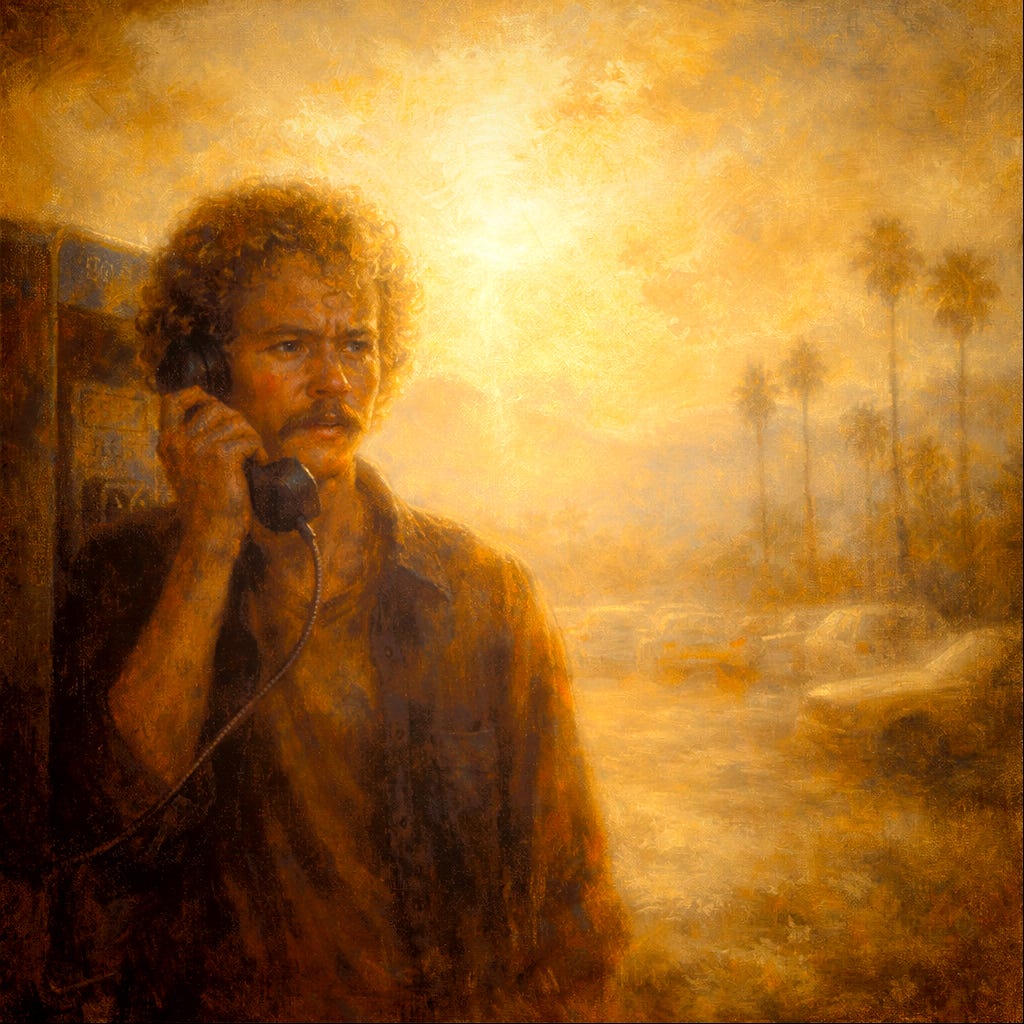
Los Angeles was an easy city to be lonely in, and I succumbed. I felt like a stranger in a strange land.
The city was just too many people and nowhere to go to meet any of them. Randy had always had a girlfriend — a sweet Chinese-American girl, who came and went from the apartment while I sat in the other room with a textbook. Randy was having a hard time finding work as a steadicam operator. When he did find work, sometimes he’d have to pull eighteen-hour days and sleep in a tent on location. I could never imagine myself doing that kind of work.
One night a couple was having sex in the apartment across the alley. It went on for a long time. The girl sounded like she was auditioning for an Academy Award. I lay in my bed listening to it like a radio broadcast from another planet. That was my love life in Los Angeles.
I did get laid once. A girlfriend of the bass player in the band that my sister was dating happened to be passing through LA. That’s not a love life. That’s a six-degrees-of-separation accident.
I passed George Carlin in the parking lot of the Ralphs in Brentwood one afternoon. Ponytail, sardonic smile. We locked eyes for a second. He looked like he knew exactly how absurd everything was. I was starting to agree with him.
The smog was its own kind of assault. Stage two alerts were frequent — days when the sky over the San Fernando Valley turned so brown you couldn’t see the mountains. Schools canceled outdoor exercise. You could feel it in your lungs. I’d come from San Francisco, where the air tasted like the Pacific, and now I was breathing poison.
One bright spot: Randy had a friend who worked at the Record Plant, and we got to tour it one day. The lounges, the couches, the sound stages, the equipment — it was otherworldly. Famous albums had been recorded there. It seemed like a place where creative people actually did creative work, which was more than I could say for anywhere I’d been.
* * *
But I was getting closer. That was the thing about chasing the credential — it kept giving you just enough to keep running.
I completed my sophomore year at UCLA with a B average. I applied to USC Film School.
USC was the school. Not a school — the school. George Lucas had gone there. John Milius, who wrote Apocalypse Now. Randal Kleiser, who’d go on to direct Grease. Walter Murch, Caleb Deschanel, Robert Zemeckis. They called themselves the Dirty Dozen — a handful of students who came out of that program in the late sixties and early seventies and essentially reinvented American cinema. Star Wars, American Graffiti, Apocalypse Now, Back to the Future — all of it traced back to the hallways of that one building on the USC campus. Spielberg hadn’t even gotten in — he’d been rejected three times and went to Cal State Long Beach instead. But he hung around the USC crowd, and they adopted him, and together they became the most powerful generation of filmmakers in history.
In Hollywood there’s a line — not a metaphorical one, a literal line on every production budget. Above the line are the creatives: directors, writers, producers, lead actors. Below the line are the technicians: grips, gaffers, editors, camera operators, the people who build the thing but don’t get to shape it. A degree from USC was a ticket to work above the line. It meant you were a filmmaker, not a film worker. It meant you had a voice, not just a pair of hands.
Without it, I was below the line. And below the line is where I’d stay.
* * *
Two extraordinary things happened almost simultaneously. I was accepted to USC Film School — the dream I’d been chasing since I was seventeen. The degree I could have earned five years ago when instead I ended up thumb out on 684. And I was offered a job at Universal Studios through my IATSE union card, the one I’d gotten almost as an afterthought when I was a nineteen-year-old projectionist at MCA’s New York headquarters in 1971.
I called my father.
He’d made me a promise back in 1972 — get the grades, get into a school, and he’d pay for it. That was the deal. But something had soured him in the years since, and looking back there was another possible reason beside the poetry class incident. My sister had gotten pregnant on spring break her senior year at Rye Country Day School and had dropped out just as she was about to enter Union College. He’d already paid her tuition in full for the year. By coincidence, I had applied in 1969 to Union as a backup. He negotiated a deal to transfer her credit to me if I would agree to go there in her place.
I took it as a slap. Union College was my backup. My safety school. And here I was, years later, having finally gotten into USC — the place I’d been working toward since I was seventeen — and my father reneged. It was bitter. It was rude. It told me everything I needed to know about where I stood.
He was in West Palm Beach now, having racehorses professionally trained, with his insufferable, slipper-bearing second wife. I told him I’d met his requirement. The B average. The acceptance. I’d done everything he’d asked. He said he couldn’t afford it.
My GPA was 2.9. The scholarship required a 3.0. One tenth of a grade point. I’d been close enough to taste it and now it was gone. The rug — the one my father had been laying out in front of me my entire life, the one that said follow this path and I’ll be there at the end of it — got pulled out cleanly, the way a magician pulls a tablecloth. Everything still standing on the table. Just nothing underneath it anymore.
* * *
I took the Universal job. What else was I going to do? It might be “below the line” but it was better than selling cameras in a retail store. I was finally going to work in “the industry!”
The union card from 1971 — a formality from a projectionist gig I’d taken at nineteen because the office was on Park Avenue and I lived on Park Avenue — turned out to be the only door still open. Apprentice film editor, IATSE, Universal Studios, Studio City, California. Twelve dollars an hour. The most I’d ever made in my life.
I told myself it was the next best thing. I was inside the gates. I’d learn the craft from the inside, the way I’d always wanted to — hands on film, not talking about film in a classroom. I’d been complaining for years that nobody would let me touch the equipment. Now I’d be touching it every day.
I was wrong about almost everything, but I just didn’t know it yet.
→ Next Chapter: Hitting The Big Time
