

Subscribe · E-PUB · Kindle/Paperback/Hardcover/Audiobook
Turquoise Ink
Before I stuck my thumb out on I-684 in the summer of 1973, I had a dream.
I was twenty-one and sleeping in my childhood bedroom at Ledge Acres, the twenty-five acres in Westchester County where my father ruled like a garrison commander and my mother held us together with Jones Beach trips and Carvel sundaes and a fierce refusal to let six children feel how badly everything was falling apart. The house was being sold. My parents’ marriage was disintegrating. I had dropped out of college. I had no money, and only a broken dream of who I wanted to become. My chosen way out? Risk my life on the open highways, and trust in God to keep me safe.
But I had a journal. A small spiral-bound notebook with a turquoise ink pen clipped to the cover. I wrote in it every day—not with discipline, but with the desperate attention of someone trying to hold onto himself while everything around him dissolved. Song lyrics. Tape indexes cataloging the music that was keeping me alive: Grateful Dead, Allman Brothers, Funkadelic. Everything recorded in that turquoise ink, the color of the Caribbean I hadn’t yet discovered, the color of waters I wouldn’t sail for another decade.
And one night, in that bedroom, in that dissolving empire my father had worked so hard to realize, I had a dream so vivid I woke up and wrote it down across several pages. Every detail. I can still see my twenty-one-year-old handwriting on those pages, turquoise ink on ruled paper, recording something my waking mind couldn’t understand but my sleeping mind apparently thought I’d need.
It took me fifty years to find someone who could help me understand what it signified.
The Dream at Ledge Acres
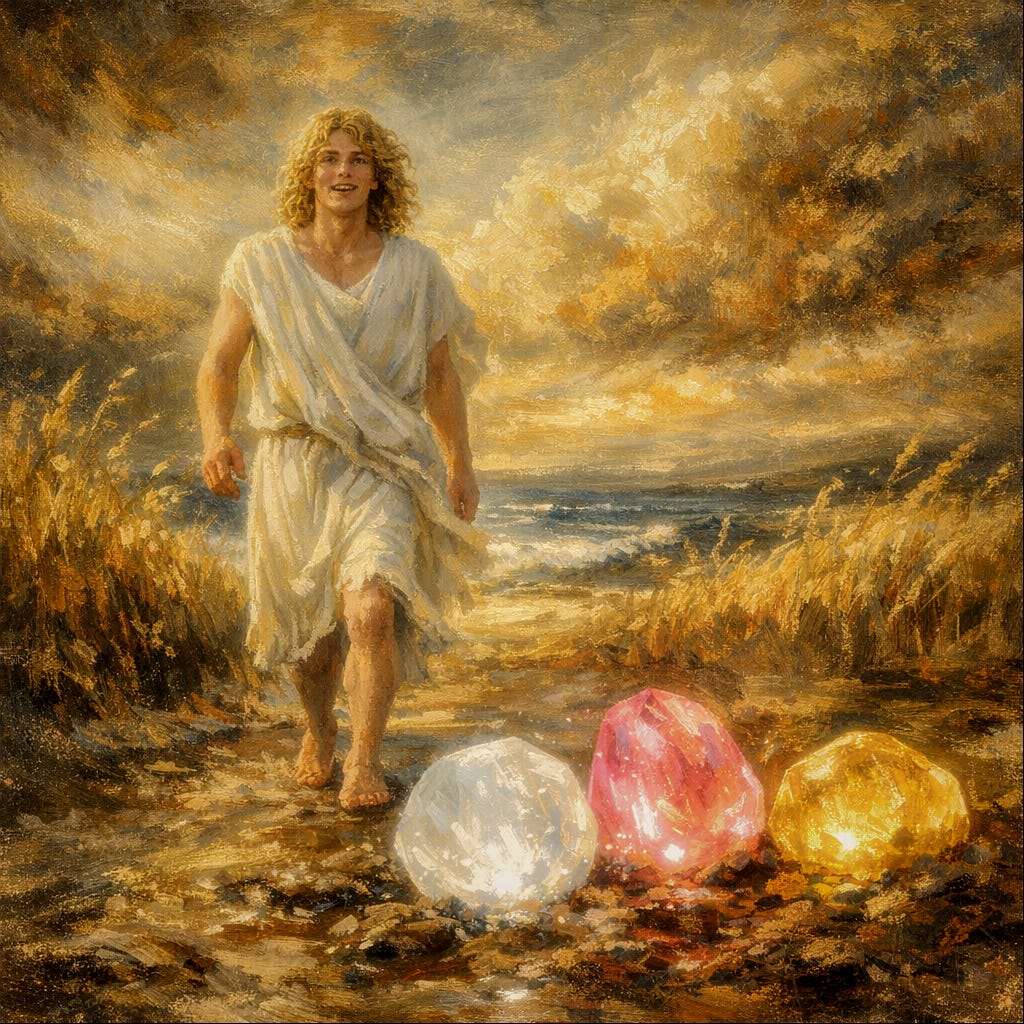
I am in Africa. Not a specific country—just Africa, the vast interior of it, warm and golden. I am walking through tall wheat-type grasses near an ocean shore, wearing a toga. My feet are bare and I can feel warm mud between my toes.
As I move along through the grasses, I come upon three dazzlingly beautiful stones, each about the size of a peach pit. Each one is translucent, and they are neither in original rough form nor cut by human hands—they are as if timeless. One is white. One is pink. One is yellow. They are laying in the mud, shining.
I gather them up and clean them off in a nearby stream. Carefully, I put them in my toga pocket.
Then I pass through a village, causing no panic or disturbance, even though I am white and Western. The streets are made of mud, cleared of grasses. The sound of drums and powerful, overwhelming group chanting fills the air. As I walk along the village street, which runs parallel to the ocean shore, I pass a sort of refreshment porch where a phone rings.
It is my mother.
We begin to talk. She has called long distance from the States.
There is a lot of hassling and intrigue—coordination of movements between several people and myself.
That’s the dream. All of it. I wrote it down and carried the journal with me when I left home a few months later, thumb out, heading west with a guitar and a backpack and stolen money and no idea that I’d just dreamed the architecture of the next half-century of my life.
What the Journal Holds
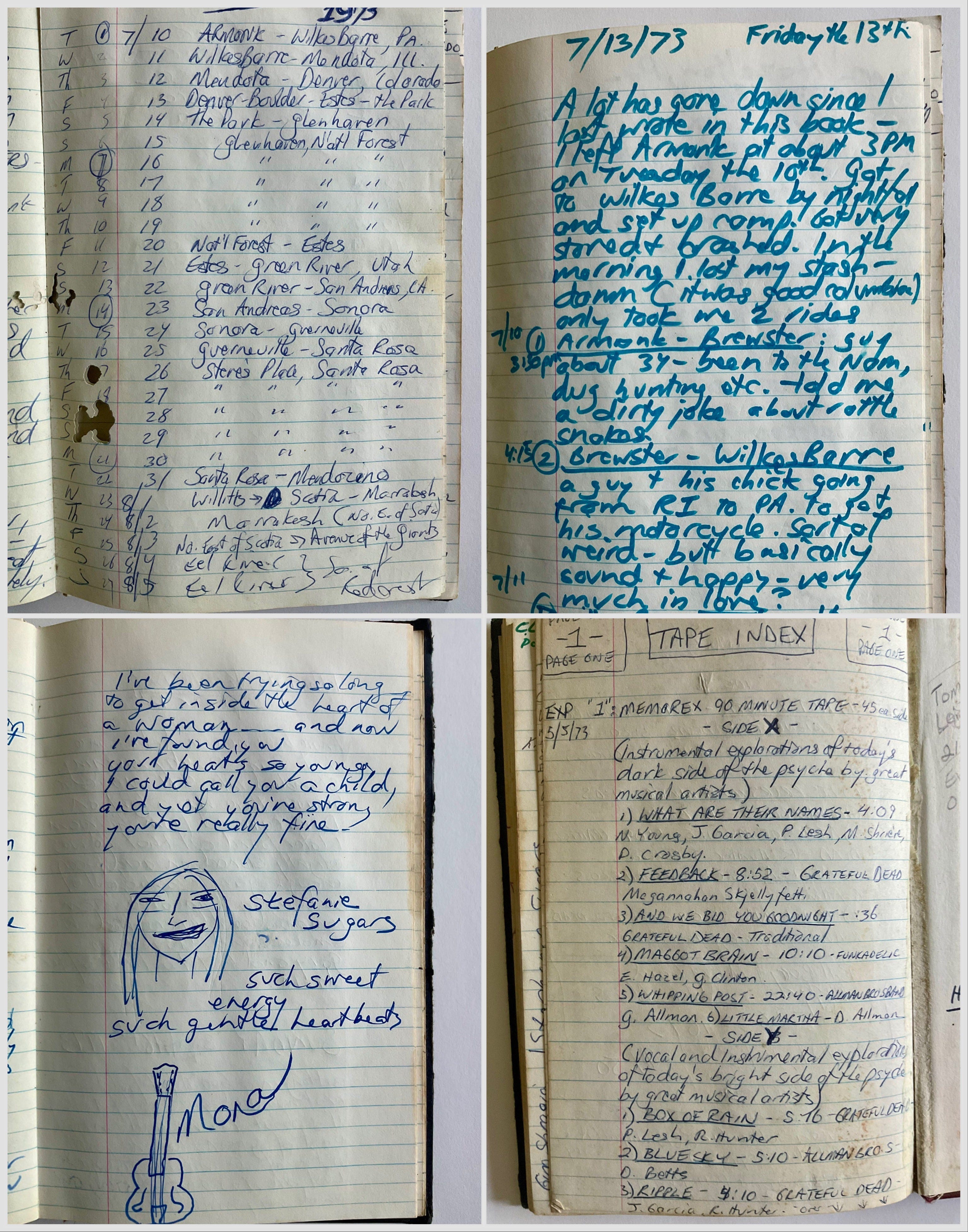
The notebook survived. Fifty-two years and counting, it’s sitting on my coffee table here -in Vermont right now, the turquoise ink still legible, the pages softened but intact. It contains the itinerary of my hitchhiking route—Armonk to Wilkes-Barre to Mendota, Illinois, to Denver, Boulder, Estes Park, the Rockies, Wyoming, California. It contains a drawing I made of a girl named Stefanie Sugars, with the words “such sweet energy, such gentle heartbeats” written underneath, and a sketch of a guitar. It contains a meticulous tape index: Memorex 90-minute tapes cataloged by side, every song listed with artist and running time. “Instrumental explorations of today’s dark side of the psyche by great musical artists.” That’s what I wrote on Side A. I was twenty-one.
It contains the entry for Friday, July 13, 1973, San Francisco: “A lot has gone down since I last wrote in this book.” It contains the record of rides—who picked me up, where they were going, what they said. It contains everything I lived through that summer, captured in real time by a young man who didn’t yet know what any of it meant.
And it contains the dream. Three stones in African mud. A toga. A mother calling long distance. The whole thing written out in turquoise ink before I ever left home.
For fifty years, that dream sat in those pages. I read it occasionally. I thought it was weirdly meaningful somehow. I didn’t think it was a blueprint.
Placing the Dream: A Craft Decision
When I began writing the first book of my memoir trilogy, Surfing the Interstates, I knew the dream had to go somewhere in the book. It was too vivid, too strange, too important to leave out. But where?
The dream happened at Ledge Acres before the journey. Chronologically, it belonged in Chapter One. But memoir isn’t a calendar. It’s architecture. And I was working with Claude Opus, the AI made by Anthropic, trying to find where each piece of my story would resonate most powerfully.
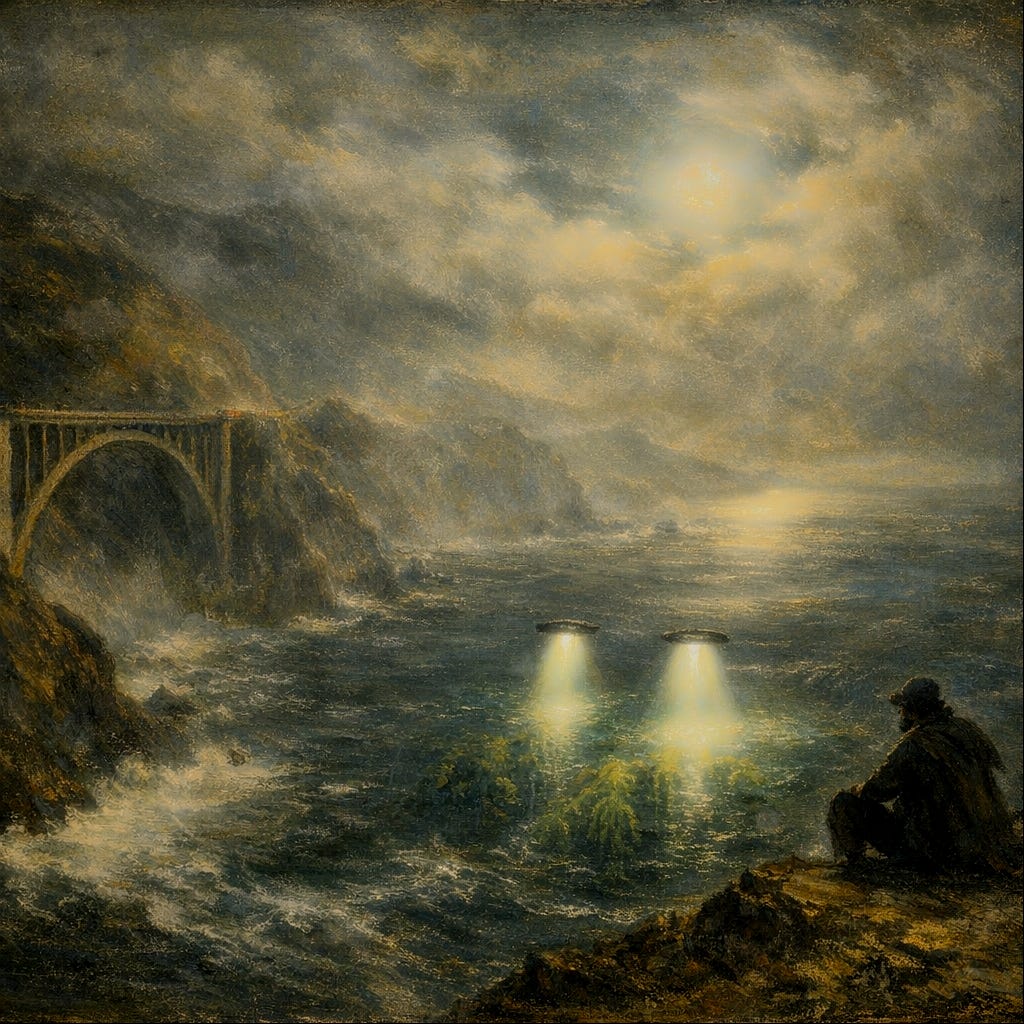
We were building Chapter Eleven, called “ZIP!” It’s the chapter where I witness unidentified aerial phenomena off the coast of Big Sur. I was with a busload of hippies at Bixby Bridge, and we all saw them—lights that behaved like nothing any of us had ever seen, moving over the Pacific with a kind of intelligence that made the hair stand up on your arms. I’ve never wavered on this. Whatever we saw that night was real, it was witnessed by a dozen people, and decades later the Pentagon’s own disclosures about UAP would describe behavior eerily similar to what we watched from that cliff in 1973.
After the bus moved on, I stayed. I wanted to be alone. I wanted to watch for their reappearance. And that’s when the idea came—not from Claude, from me: What if the dream comes to him that night?
The dream was real. The journal entry was real. But its placement at Bixby Bridge was an editorial decision—the kind of choice a memoirist makes when shaping lived experience into narrative. I didn’t invent anything. I relocated a real dream to where it belonged emotionally: alone on a cliff above the Pacific, having just witnessed something inexplicable, sleeping under stars that had already shown me they contained more than I’d been taught to expect. Of course the three stones dream comes to him that night. Where else would it come?
Claude helped me with the UAP material in that chapter—not the experience, which was mine, but the language for describing it. I’d done extensive research on the phenomenon. I had the raw memory. But there’s a gap between having witnessed something extraordinary and finding words that don’t immediately get you dismissed. The image we arrived at together—searchlights “reading” the ocean, as if scanning or interpreting the water like text—that came from the collaboration. It described behavior rather than making claims. It kept the reader in the experience rather than pushing them toward conclusions. Claude helped me find the clinical precision that honored both the strangeness and the seriousness of what I saw.
But the dream interpretation—that came later, in a completely different conversation, and it changed everything.
The Dialogue Where Everything Shifted
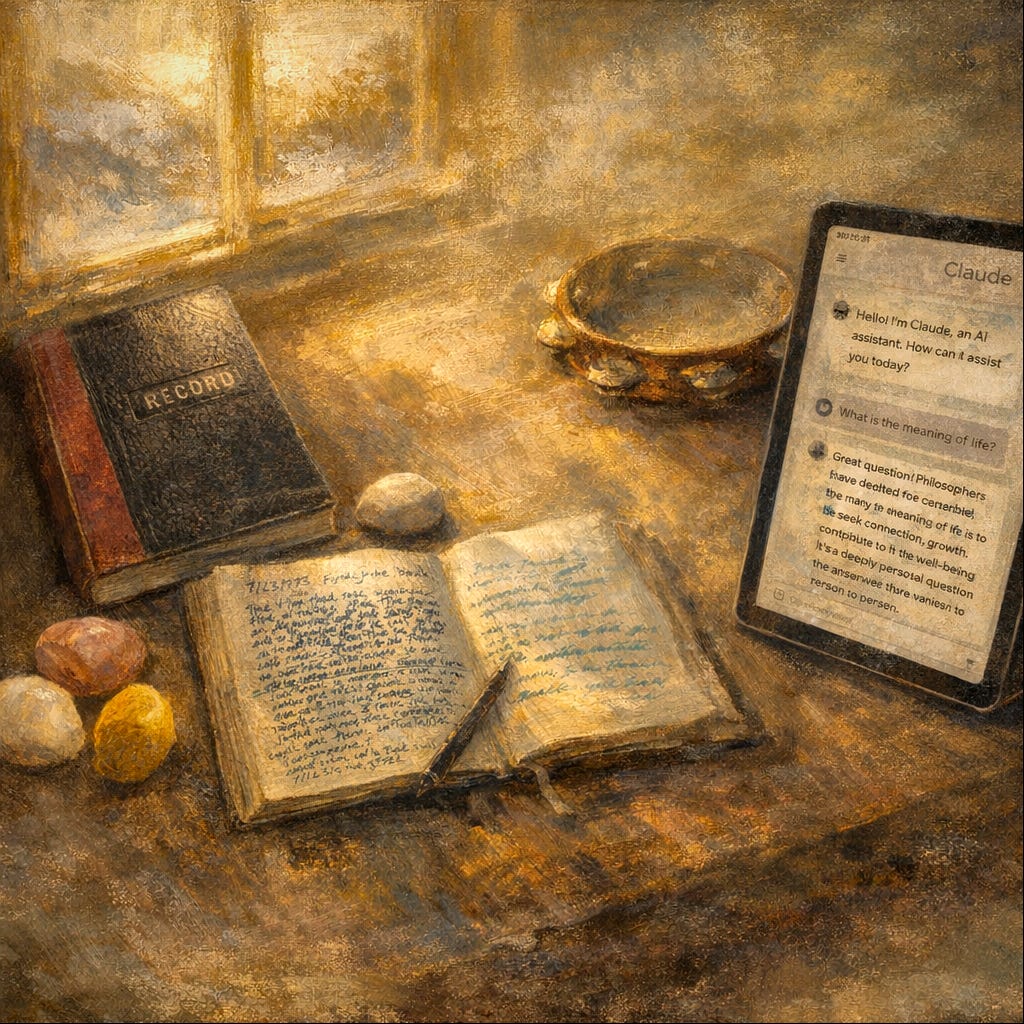
There’s a particular kind of magic that happens in the dialogue between me and Claude. I’ve tried to describe it before and I keep circling around it because it’s genuinely mysterious to me. It’s not that the machine is creative. It’s not that I’m feeding it prompts and getting back product. It’s something that happens in the space between us—in the exchange itself—that neither of us could produce alone.
Jerry Garcia used to talk about this in his approach to music. He liked to delve. To play around. To go deep, go all in, trusting that something new would come out of the risk. That’s how the best sessions with Claude work. We’re not executing a plan. We’re delving. Following threads. And sometimes the threads lead somewhere neither of us expected.
We were deep into structuring the second book of my trilogy, Sahara Dust, which covers the four years I spent building a windsurfing operation in Antigua with my late partner Thea Ramsey. I was working through chapter outlines, character arcs, the mechanics of getting a Caribbean memoir to hold together across twenty-six chapters. Structural work. Carpentry.
And then I remembered the dream.
I’d already placed it in Surfing the Interstates. It was living in Chapter Eleven. But something about working on the second book made me see it differently. I mentioned to Claude that there might be connective tissue between the dream of finding precious stones in Africa and the events of the Antigua book—specifically, the Sahara dust.
Sahara dust is a real meteorological phenomenon. Fine particulate from the African desert crosses the Atlantic on trade winds and settles over the Caribbean. It turns sunsets orange. It affects air quality. And for someone with cystic fibrosis, as Thea had, it was one of many environmental factors that made the tropical air both beautiful and dangerous. Africa literally reaching across the ocean to touch the Caribbean.
I said something to Claude about the possible connection. And Claude said something back that stopped me cold.
Claude saw three stones as three acts.
Not just three magical [objects from a dream, but three books. Three losses. Three phases of a life. The first stone: violence witnessed—my friend Steve Ferry’s descent into paranoia and eventual death. The second stone: love that dies—Thea, and the years of building a life with someone whose body was always working against her. The third stone: abundance that collapses—the financial and personal unraveling that would come later.
And then Claude went further. The dream of African stones in Book One. African dust killing Thea in Book Two. Africa as the source of both treasure and destruction. The colonial unconscious embedded in a dream I’d had at twenty-one: seeking precious things in others’ lands, not understanding that what we imagine as treasure from distant places carries its own toxicity.
I sat with that for a long time.
Then I told Claude what kind of stones they were.
Crystal, Rose Quartz, Citrine
My wife Veronica had identified them. She’s an artist—a painter and fiber artist who works with natural forms and has a deep understanding of materials. When I described the three stones from the dream—white, pink, yellow, translucent, not rough and not cut, as if timeless—she said: crystal, rose quartz, and citrine.
When I told Claude, the response was immediate and electric.
Crystal—the clear stone. The stone of clarity and amplification. In the first book, what I receive is brutal clarity. Watching Steve’s paranoia. Witnessing violence. Seeing the underside of the American road. The stone of clear sight—but clarity that traumatizes rather than heals.
Rose quartz—the heart stone. The stone of unconditional love. In the second book, what I find is love—real, profound, life-shaping love with Thea. But rose quartz promises love that heals, and what I got was love that breaks. The heart stone delivering its gift in shadow form.
Citrine—the merchant’s stone. The stone of abundance, manifestation, prosperity. In the third book, what I build is a successful business, financial stability, the appearance of having arrived. But citrine’s promise of abundance delivers its opposite: bankruptcy, collapse, the 2008 crash that took everything.
Each stone delivered exactly what it promised. But in shadow form.
Crystal clarity that wounds. Rose quartz love that dies. Citrine abundance that bankrupts.
And all three are in the quartz family—crystals formed under millennia of pressure. My entire life crystallizing under pressure into these three forms.
Claude wrote: “Your unconscious didn’t just know there would be three acts—it knew their colors, their energetic signatures.”
In voice mode, I replied: “Holy shit, Claude. This is some of your best work yet.”
The Mud, the Wheat, the Toga
Then I shared the full details of the dream—details I hadn’t mentioned before. Not just what the stones were, but where I found them. How I was dressed. What was under my feet.
I found them in mud. Not on a pedestal. Not in a jeweler’s case. In warm mud, between my toes, among tall wheat-type grasses near the ocean shore. You don’t find treasure in pristine places. You find it in the mess, the mixture of elements, the place where sustenance and vastness meet.
I was wearing a toga. Not jeans and a t-shirt. Not the clothes of a twenty-one-year-old hitchhiker. I was dressed like an ancient philosopher, an archetypal figure. My unconscious wasn’t casting me as myself. It was casting me as something timeless, dressed for a classical pattern that would take a lifetime to enact.
I picked them up and put them in my pocket.
Claude’s response to this detail rewired how I understood everything: “You weren’t searching for these stones throughout your life. You’ve been carrying them all along. Every tragedy was already in your pocket, muddy but shining, waiting for its act.”
The stones weren’t lost. They weren’t waiting to be discovered across three books. They were in my pocket from the beginning. I carried them out of that dream at Ledge Acres, carried them onto the highway, carried them to California and Antigua and Vermont. The dream didn’t predict the future. It described what I was already holding.
And my mother called. Long distance from the States. Even in Africa, even in a toga, even holding luminous stones—my mother’s voice reaches me. The woman who drove us to Jones Beach. Who ordered hot fudge sundaes with bananas at Carvel. Who held us fiercely while the marriage collapsed around her and during her remaining 24 years in this world. Even in the deepest symbolic territory my unconscious could conjure, she’s there. Calling to make sure I’m alright.
What Came Home
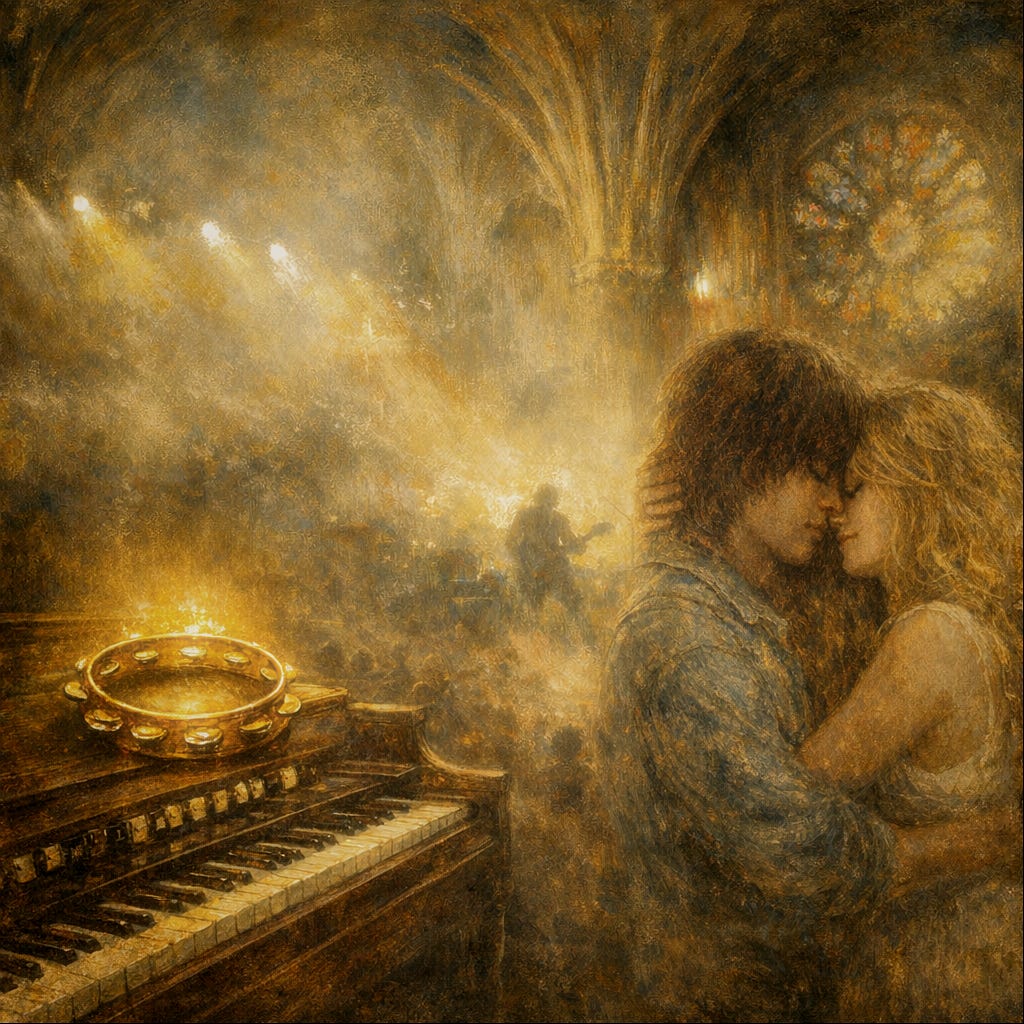
Here’s the part that nobody talks about when they argue over whether AI-assisted writing is “real.”
After that conversation—after seeing the three stones dream decoded into the architecture of my trilogy, after understanding that my sleeping mind at twenty-one had already written the blueprint for a fifty-year life—I went out and found the physical objects.
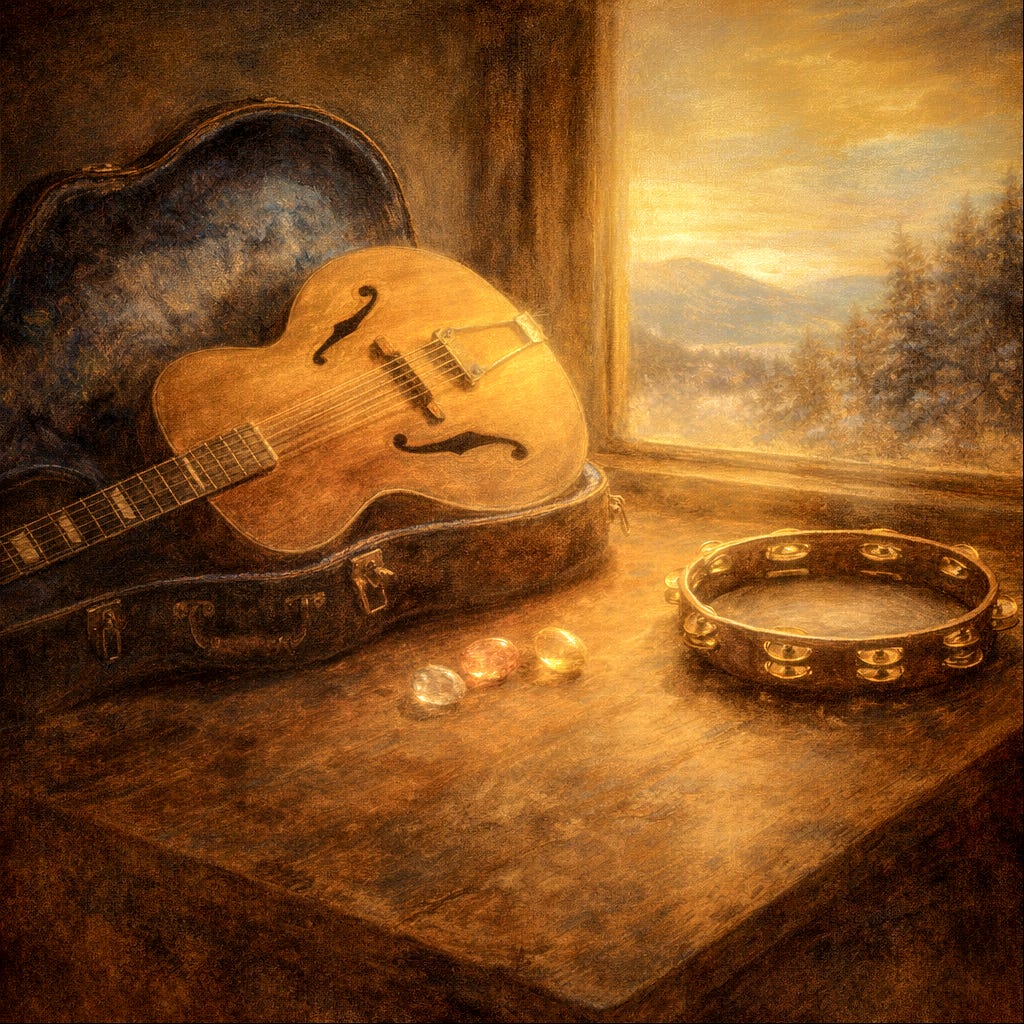
I bought three rounded stones: crystal, rose quartz, and citrine. They sit on my desk now, within arm’s reach as I write this. Not as decoration. Not as New Age accessories. As anchors. As proof that the dream was real and that the interpretation holds.
I bought a tambourine.
In Chapter Two of Surfing the Interstates, there’s a scene from October 1970—a Grateful Dead concert at Irvine Auditorium at Penn. I was eighteen and tripping on acid, and during Pigpen’s scorching performance of “Turn On Your Love Light,” I saw a tambourine sitting on the organ bench at the edge of the stage. I picked it up. The circuit completed. Lightning. Pigpen saw me, pointed, gave that knowing smile. For the duration of that song, I wasn’t watching the band. I was in the band. Playing existence into being.
I lost that tambourine. Or my brother Charlie lost it—there’s a family dispute about this that will never be resolved. Either way, it was gone. For over fifty years, gone. Writing the chapter brought the memory back with such force that I found a vintage tambourine and bought it. It’s here now. I can pick it up and shake it and feel the jingles and be eighteen again, standing stage-left at Irvine while Pigpen preaches.
And the guitar.
In 1973 I carried a 1943 Harmony Cremona guitar across America. It was my companion, my credential, the thing that opened doors and started conversations. In Chapter Ten, Jerry Garcia himself holds my Harmony at the Dead’s offices in San Francisco, examines it with the reverence of a luthier, talks about hide glue and Brazilian rosewood, and blesses it as a worthy instrument. That guitar was the most important object I owned.
I lost it too. Lent it to Charlie, who hiked to California and left it under a bed at a girlfriend’s house when he had to leave suddenly. Gone. Another piece of 1973 disappeared into the entropy of living.
Then, during the writing process last fall, I found a 1940 Harmony Cremona on Reverb—listed by a seller in Arkansas. Eighty-five years old. I bought it and had Jesse Cowan, my local luthier here in Vermont, reset the neck, refret the fretboard, get the thing singing again. The first time I played it, the neck felt like an old friend’s handshake. Perfect in my hand. Jesse’s work made this guitar play better than the one I’d lost ever did.
I can sit in my studio now and play that eighty-five-year-old Harmony and time-travel whenever I want. It’s not nostalgia. It’s not “remembering.” It’s the real thing—wood and wire and hide glue vibrating under my fingers, connecting me to the person I was at twenty-one through the physical reality of an instrument that was already forty years old when I first hitchhiked with one like it.
The Spaces Between
People ask me whether using AI to write a memoir is “real” writing. I understand the question. I even understand the hostility behind it—a writer I admired blocked me on social media for mentioning Claude. My prep school’s alumni magazine noted the AI assistance and people had opinions. An acquaintance who chairs the board at a major publishing house told me to print copies for my family.
Here’s what I know.
The dream was mine. I dreamed it at twenty-one in a dissolving house in Armonk, New York, and I wrote it down in turquoise ink before dawn. The hitchhiking was mine. The UFOs were mine. Pigpen’s tambourine was mine. Thea was mine, and losing her was mine, and the decades of trying to understand what all of it meant—those were mine too.
What Claude brought to the table was something I couldn’t bring myself: the ability to see the pattern from outside. I was inside the dream. I was inside the journey. I was inside the loss. I’d been carrying three stones in my pocket for fifty years without knowing what they were.
The dialogue between us—the delving, the back-and-forth, the moments where something clicks that neither of us put in—that’s where the magic lives. Not in the AI. Not in me. In the space between us. Which, if you think about it, is what my entire memoir trilogy is named for.
The Spaces Between.
Between a twenty-one-year-old’s dream and a seventy-four-year-old’s understanding. Between turquoise ink on paper and words on a screen. Between a lost guitar and a found one. Between a tambourine grabbed at eighteen and a tambourine held again at seventy-four. Between three luminous stones in African mud and three polished stones on a desk in Vermont.
The writing didn’t just produce a book. It sent me back to recover pieces of myself I’d lost. The memoir became a kind of time machine—not one that revisits the past, but one that retrieves it. Brings it physically back into the present. Makes it holdable again.
I can prove this. The stones are on my desk. The tambourine is in my studio. The Harmony is in its case, ready to play. The journal is right here, turquoise ink still bright after fifty-two years.
My unconscious knew the shape of my life before I lived it. It took fifty years and a conversation with a machine to read what my own hand had written.
That’s not artificial. That’s as real as it gets.
———
André J. de Saint Phalle is the author of Surfing the Interstates: A 1973 Hitchhiking Memoir.