

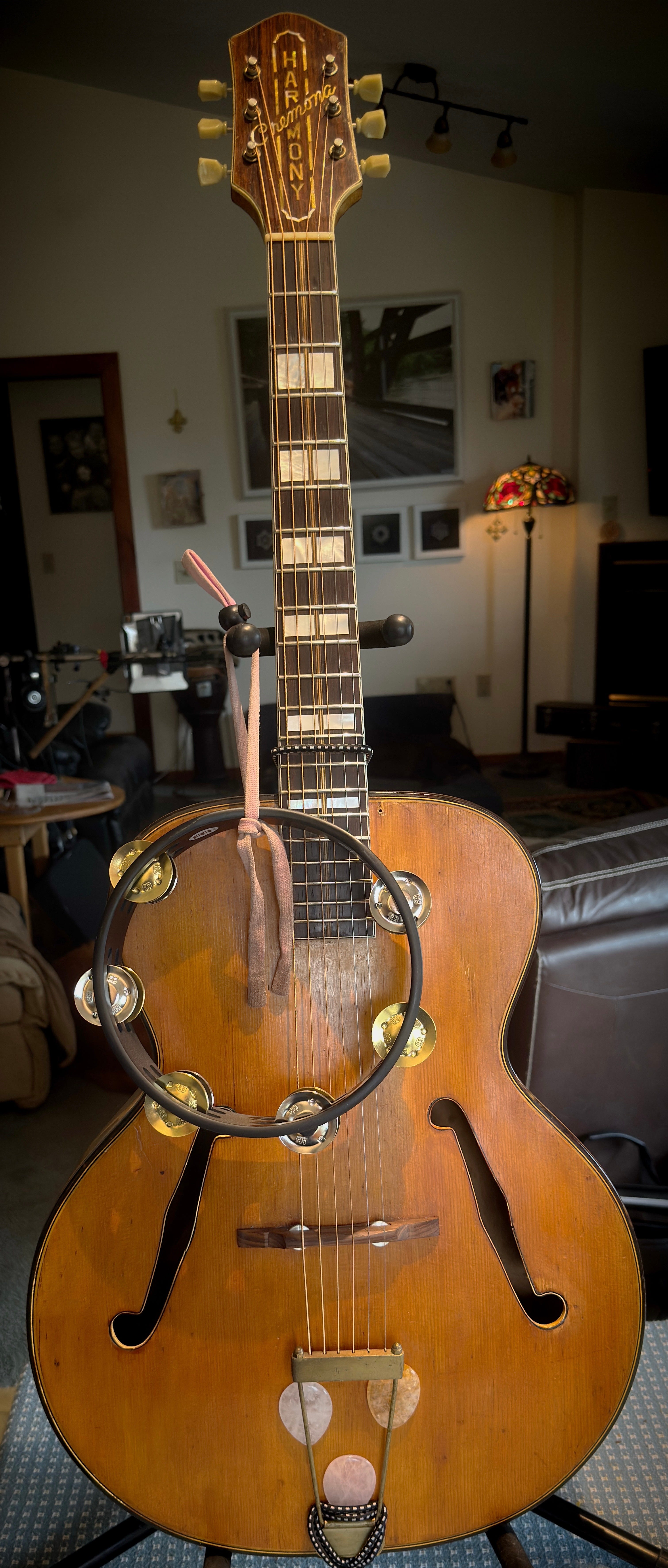
A few weeks ago I published Thumb Out, Volume One of The Spaces Between — the story of the summer I was twenty-one, when I dropped out of college, stuck out my thumb on the side of Route 22, and headed for California with a backpack and a 1943 Harmony Cremona archtop guitar. The book covers seventy-two days on the road in 1973. It also reaches back into earlier years, because that’s how memory works — the road keeps unlocking doors you didn’t know were there.
Three objects from that journey ended up shaping the book.
A guitar I bought for eighty-five dollars at Manny’s on 42nd Street. A tambourine that came down off the stage from Pigpen’s hands at a Grateful Dead concert. And three translucent stones — white, pink, and yellow — that I found in a dream on a bluff above the California coast and wrote down in my journal the next morning.
I lost the first two. The third never existed in the first place.
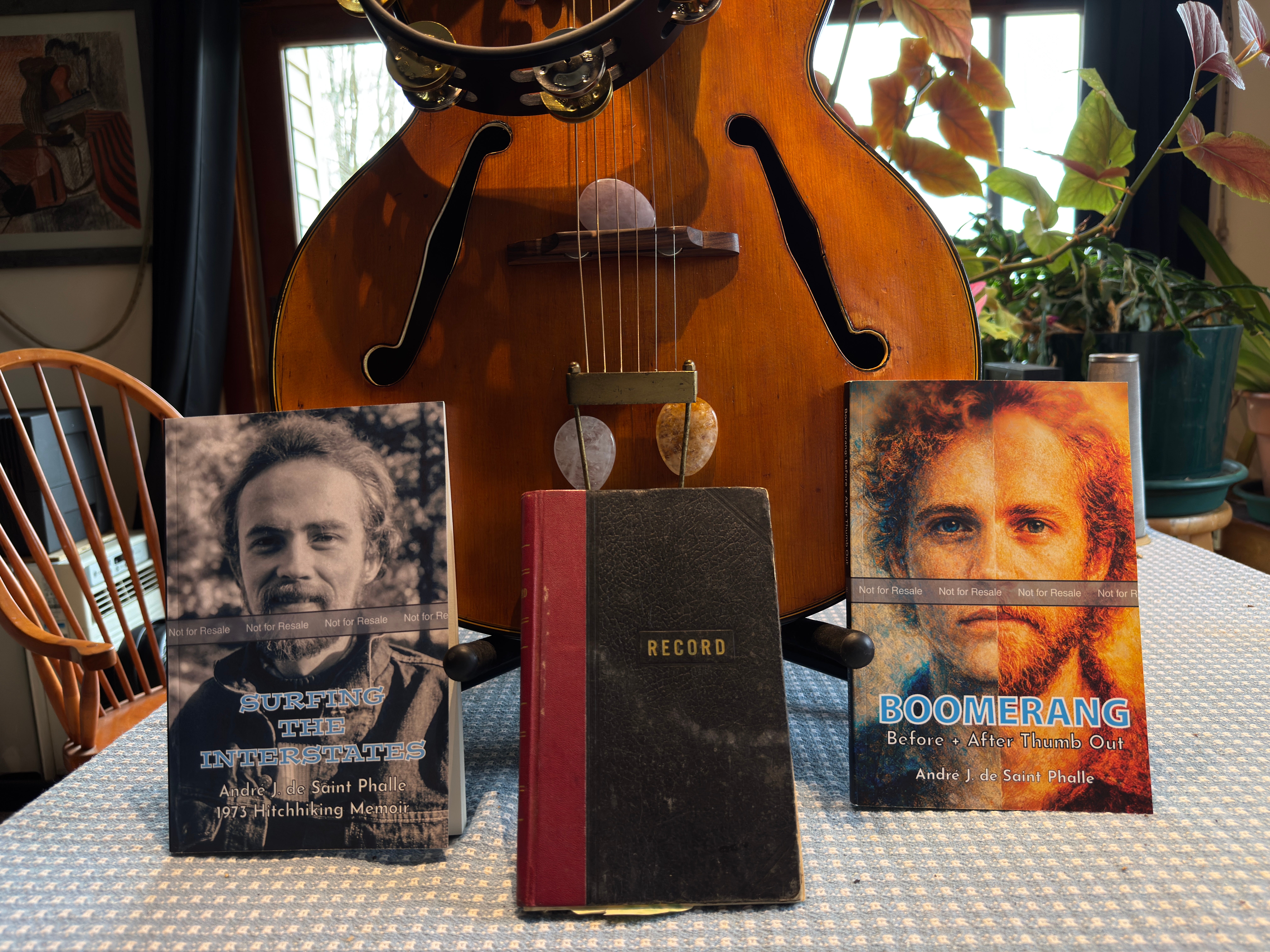
This week I gathered the stand-ins I had collected over the last 6 months for all three of them, set them up on a table in my house, and took the photograph above. This is a post about why.
The guitar in the photograph is not the guitar.
The original was that 1943 Harmony Cremona archtop. It went four thousand miles with me. Through Pennsylvania rain, Colorado mountains, redwood fog, the desert. Jerry Garcia held it once at the Grateful Dead’s office in San Rafael, sat on an amp, played a few bluesy bars, and called it a cannon. These old ones, they’ve got songs already inside them. The wood remembers everything. He pointed out the Brazilian rosewood fingerboard and the wooden trapeze tailpiece — wartime build, metal scarce, needed for bullets.
Not long after Jerry held it, it was stolen out of my campsite in Santa Elena Canyon while I slept. I woke up to a depression in the dust where it had lain all night, and footprints — not mine — leading to the road.
That guitar carried Jerry’s hands. It carried Pigpen’s tambourine in the same backpack. It carried every campfire and every silence and every song I tried to learn in the dark. And then it was just gone, the way things go when you live on the road.
The guitar in the photograph is a 1940 Harmony Cremona, the exact same model, purchased last fall on reverb.com, since fully restored by a professional luthier. Same headstock. Same F-holes. Same Brazilian rosewood fingerboard. But this one is pre-war, so it has the original metal tailpiece — not the wooden one they switched to in ‘43, when metal went to bullets. Not the original. A stand-in.
The tambourine is also a stand-in.
The original came from Pigpen’s hands at Irvine Auditorium on October 16, 1970 — Bob Weir’s birthday, my freshman year at Penn. Acid on my tongue, ten thousand organ pipes overhead, the Dead playing electric communion. Ron McKernan handed it down off the stage. I carried it home that night to a yellow room I’d painted on cocaine, and the tambourine sat there on the floor catching light while everything else in my life rearranged itself.
I lost it somewhere in the years that followed. I don’t even remember where. That’s the worst kind of losing — not a dramatic theft, just slow attrition, the way objects slip out of your life when you’re moving too fast to notice.
The tambourine in the photograph is black plastic with brass jingles. It doesn’t have Pigpen’s fingerprints on it. But when I set it on the table next to the guitar, something in me recognizes it anyway.
The crystals never existed.
I dreamed them on a bluff above Bixby Creek in October 1973, three months into the road. In the dream I was barefoot in warm African mud, walking through golden grasses toward a village where everyone had grown up together. I came upon three translucent stones, each the size of a peach pit. One is white, one is pink, and one is yellow. I gathered them, cleaned them in a stream, and put them in my pocket.
I wrote the dream down in my journal the next morning. White for clarity. Pink for the heart. Yellow for what I could not yet name. The three stones traveled with me for fifty-three years inside that journal, never as objects, only as words on a page.
The crystals in the photograph are the first time they have ever existed in the physical world. Citrine, rose quartz, clear quartz. They are stand-ins for objects that were never lost because they were never real to begin with — and yet they were the most real of the three, because the dream survived when the guitar and the tambourine did not.
Here is the part I didn’t expect.
I wrote most of Thumb Out before I went looking for any of these objects. The book was already done. The guitar was on the page, the tambourine was on the page, the three stones were on the page. The writing didn’t need them.
But the writing pulled them into the world anyway.
I went and found a 1940 Harmony Cremona and had it restored. I bought a black tambourine. I bought three crystals — citrine, rose quartz, clear quartz — and arranged them on the table where I write. Not because I needed them to remember. Because the act of writing for two years had made them necessary in a different way. They had become real on the page, and the page wanted them in the room.
That is something I didn’t know about memoir until I was deep inside one. The book doesn’t just record what happened. It calls things back. Sometimes it calls back the original — Jerry’s exact words from a 1973 afternoon in San Rafael, surfacing unbidden after fifty-three years. And sometimes it calls back something close enough to stand in for what was lost, because the loss itself has become part of the story.
On May 23 I’ll be signing books at Bear Pond Books in Stowe. The guitar will be there. The tambourine. The three crystals. Talismans, all of them — not the originals, but truer than nothing, and the only kind of evidence a memoirist gets to bring.
The wood remembers everything, Jerry said. Even when the wood is different wood.
“Thumb Out” Book One of my memoir trilogy “The Spaces Between” is available now
e-book ~ kindle ~ paperback ~ hardcover ~ signed paperback