

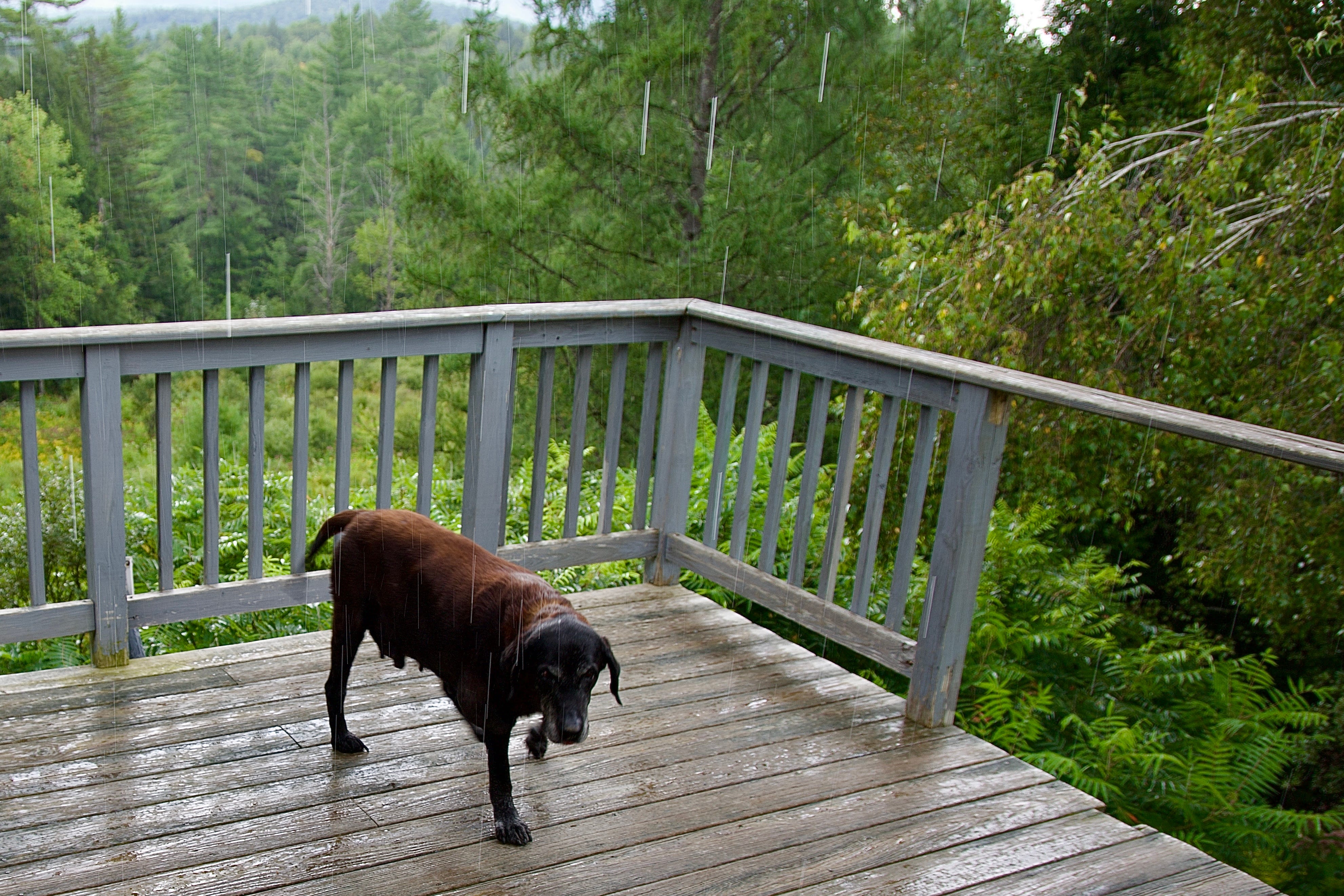
Ten days ago Blue tried to get up on the couch. His couch. The one he’s slept on for thirteen years, the one that holds the shape of him in its cushions like a fossil of better days. He stood in front of it, shifted his weight, considered it the way a man considers a ladder he’s not sure about anymore. Then he turned away and lowered himself onto the bed we’d put on the floor a few months ago, when we first started realizing that the geometry of his life was changing — that the distances he used to clear without thinking had become negotiations.
His back right hip had gone tender. Veronica said he’d slipped on the deck — maybe caught a Charlie horse, tweaked something in that hind leg that was already carrying more than its share. He was already somewhat frail, half blind, fully deaf. Over the next few days he got worse. Not a little worse. He stopped eating. He could barely stand, and when he did stand, he shook. He wouldn’t go outside. He lay on his floor bed and didn’t move, didn’t lift his head, didn’t want anything.
Veronica and I looked at each other across the room, that look married people develop over decades that says everything without a sound. This was it. We both knew it.
For days he was like that. Mostly still. I’d find him in the mornings on his floor bed, eyes half-open, not interested in getting up. Not interested in much of anything. I’d sit with him and put my hand on him, and he’d close his eyes. There’s a particular quality to the stillness of a very old dog who might be dying — it’s not the same as sleep. It’s heavier. It has a finality that sits in the room with you like another presence.
And sitting there with my hand on him, I remembered the chain of events that led us to him.
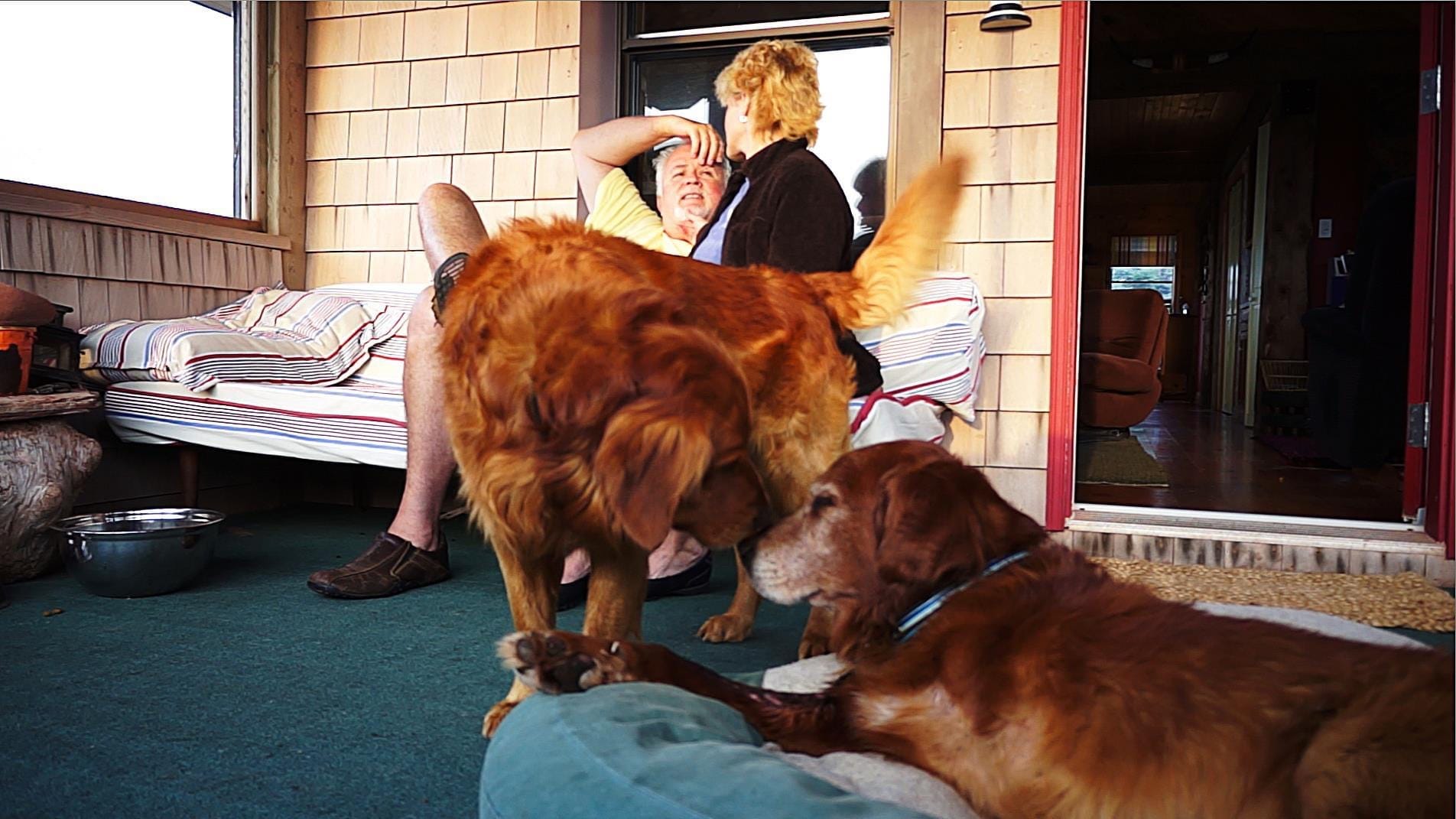
Buio, our 14 year old golden retriever died in January of 2013. What followed was a winter of absence. Izzy, another golden retriever, — seven years old then, was still with us — but a house that has held two dogs knows when it’s down to one. There was a shape missing from the rooms. A rhythm gone from the floors. Izzy felt it too; he’d look at Buio’s spots, the places where his friend used to lie, and then look at us, as if we might have an explanation. We didn’t. Grief in a house with animals is a shared condition — everybody carries a piece of it, and nobody can talk about it.
Veronica and I lasted two months. Some people wait years after losing a dog. Some people can’t ever do it again — the ending costs too much. I understand both. But for us the question was never whether, only when, and by late April the when had arrived. You don’t replace a dog. Anyone who’s lost one knows that. What you do is make room for the next soul, and trust that the love doesn’t divide — it multiplies.
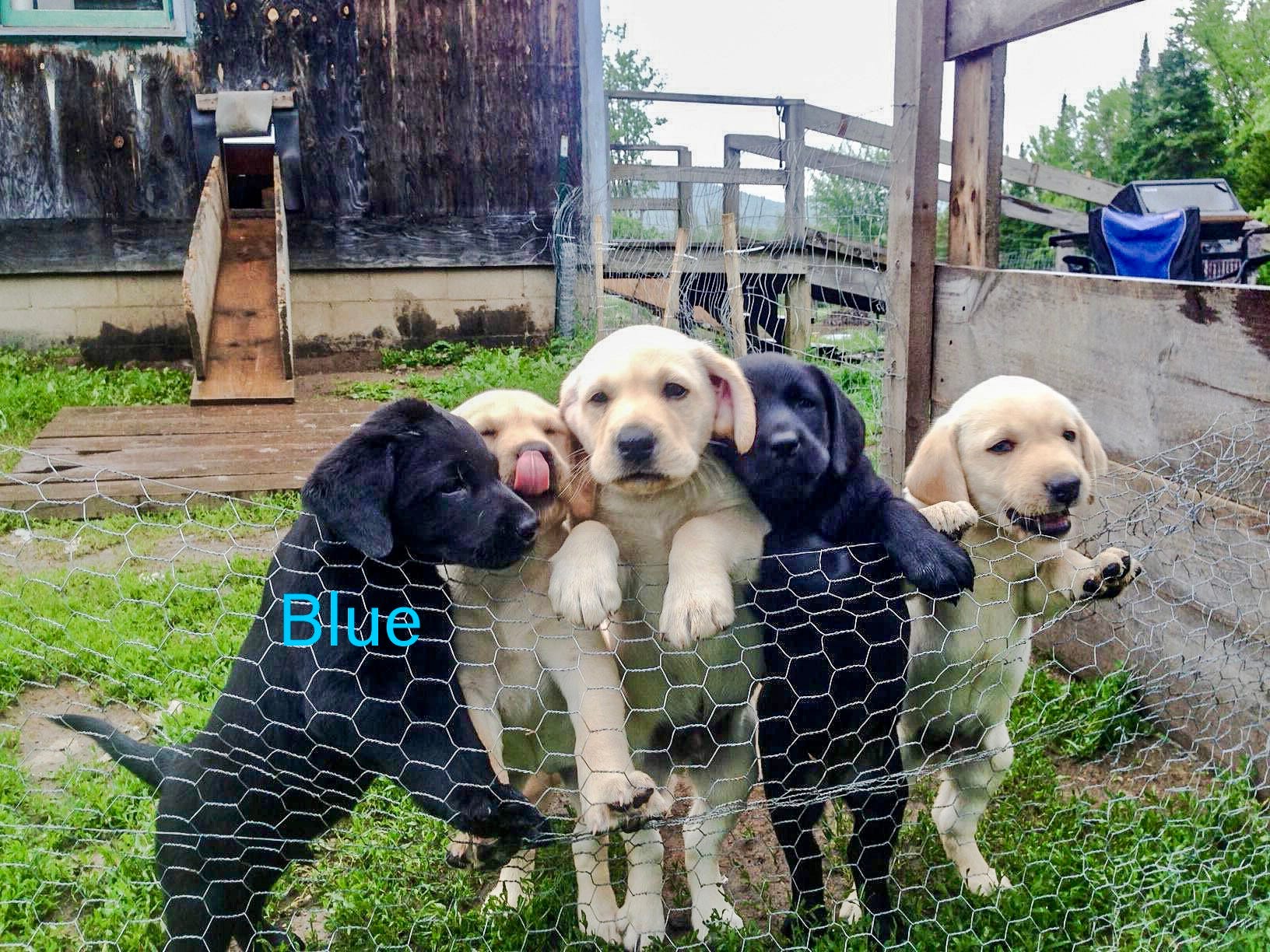
So on a beautiful spring day we drove to a local breeder’s place. Thirty six Labrador retrievers were running around — three litters, black and yellow puppies everywhere. I was drawn to a yellow lab, something in his face. But while I was crouched down looking at that one, this black puppy walked up and looked at me. Not the way puppies look at you — upward, pleading, pick me pick me. This was a level gaze. An adult gaze in a puppy’s body. I’m the one. It wasn’t a request. It was a statement of fact. You don’t argue with a dog who’s already decided.
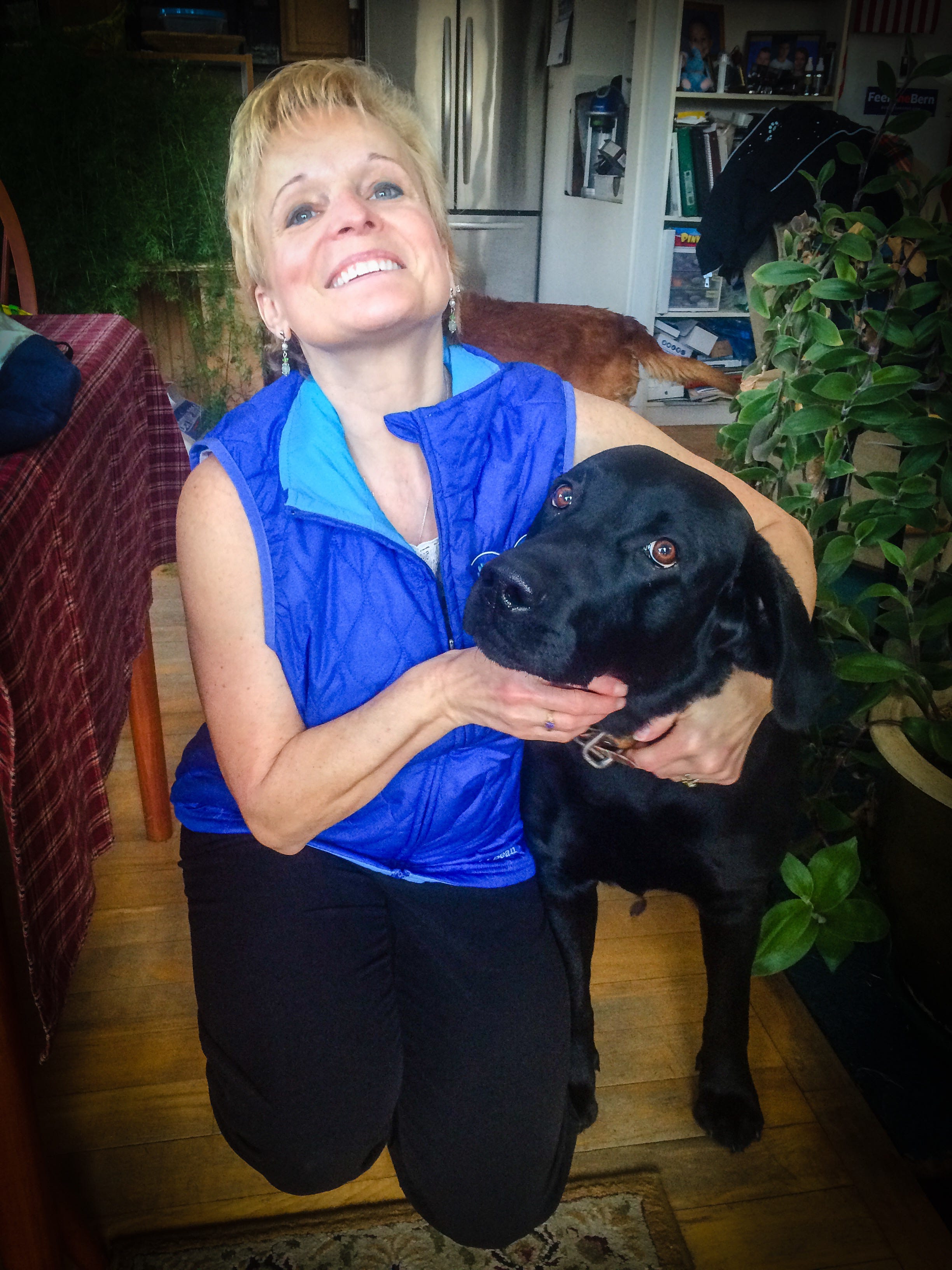
We named him Blue. My favorite color, and in those first years, when the sun hit his coat at the right angle, you could see it — a deep mineral blue hiding inside all that black. About four years ago, when the gray started creeping across his muzzle, a friend said he looked like an old bluesman. Distinguished. Weathered. The name shifted its meaning right then — from the color to the music, from the sheen to the soul.
And the thing about Blue, the thing that separates him from every dog I’ve had: his sensitivity. He has spent thirteen years monitoring the emotional weather of this household with a precision that borders on the supernatural. If I was ever down — not dramatically, just quietly down, sitting in a chair carrying something I hadn’t talked about — Blue knew. He’d cross the room and put his head in my lap and just stay there. No fuss. No whimpering. Just the weight of his head and the message: I’m here. I know. Same with Veronica. He was tuned to both of us, calibrated to our separate frequencies, and he never got it wrong. Not once in thirteen years.
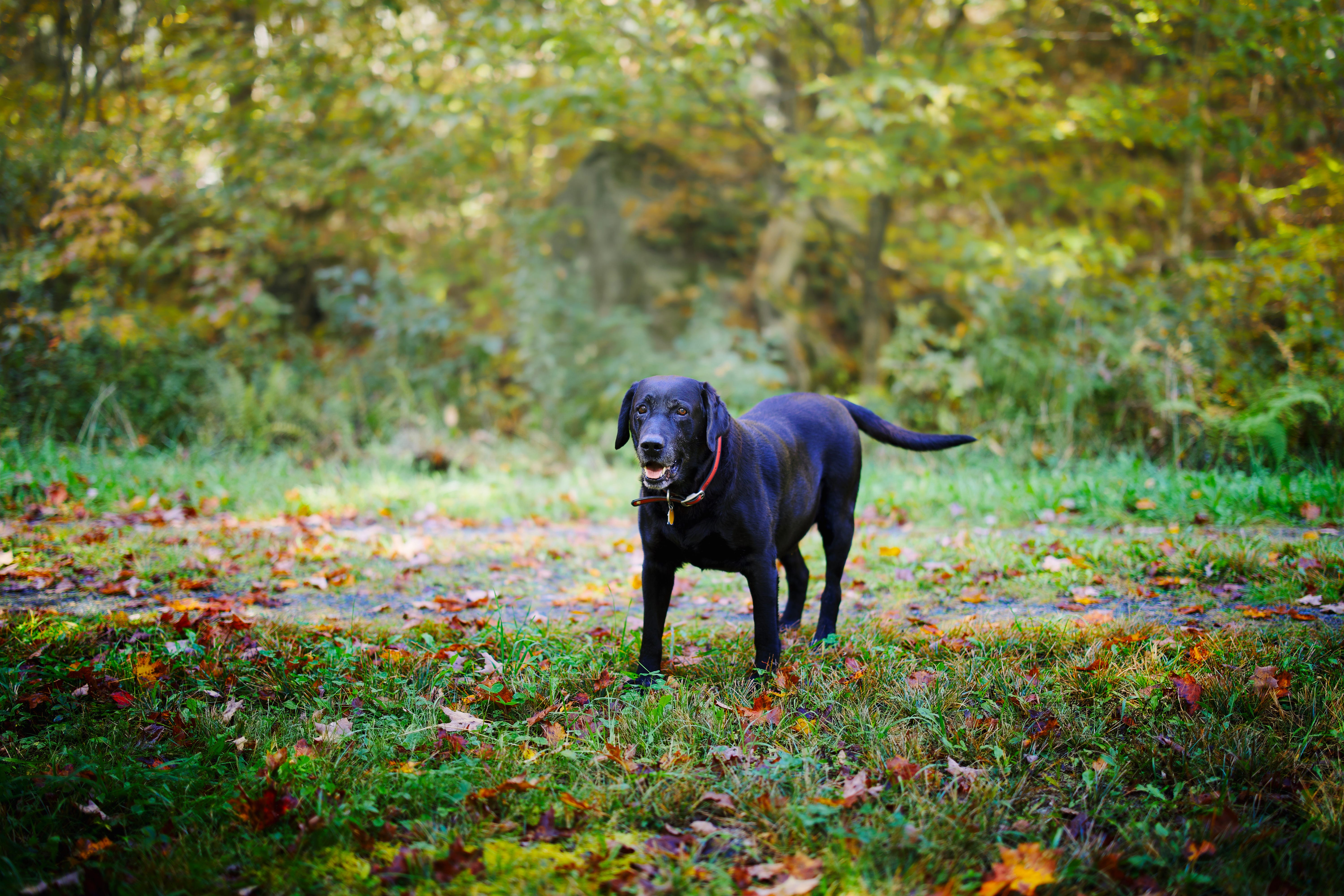
So that’s what I was thinking, sitting on the floor with my hand on a dog who wouldn’t eat: he consoled us for thirteen years, and now the only thing I could do was reverse the arrangement. My hand where his head used to be. My turn.
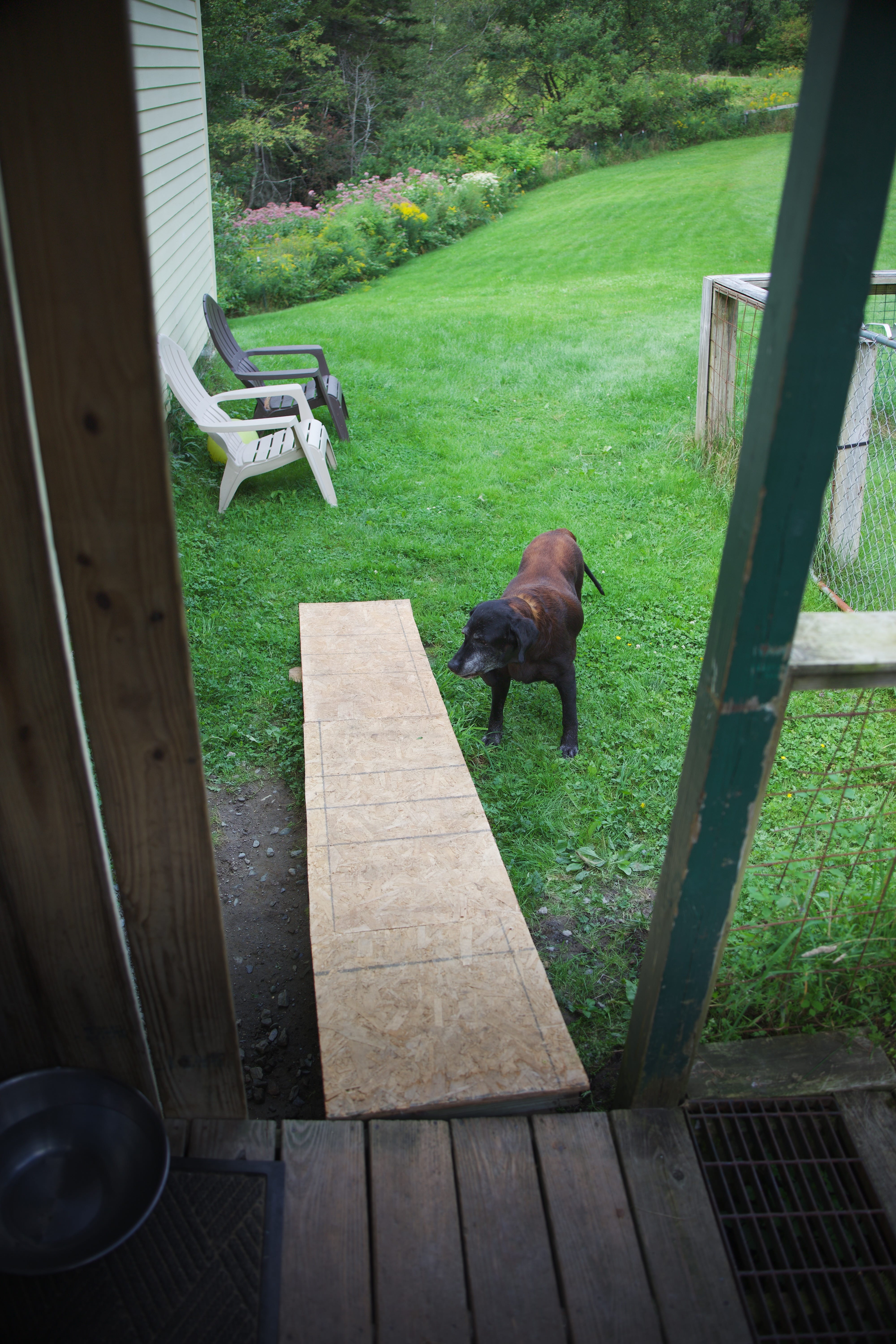
We have no money for a vet, and Blue hates the vet anyway, so you do what you can with your hands. I started rubbing a CBD salve into his right hip and leg twice a day, working it into the muscle with my fingers, feeling for the heat, the tightness, the places where he flinched. We added CBD to his mornings, not just his nights. I hauled out the ten-foot ramp I’d built a while back and reinstalled it, widened it to eighteen inches, screwed asphalt roof shingles down for grip so his paws wouldn’t slide.
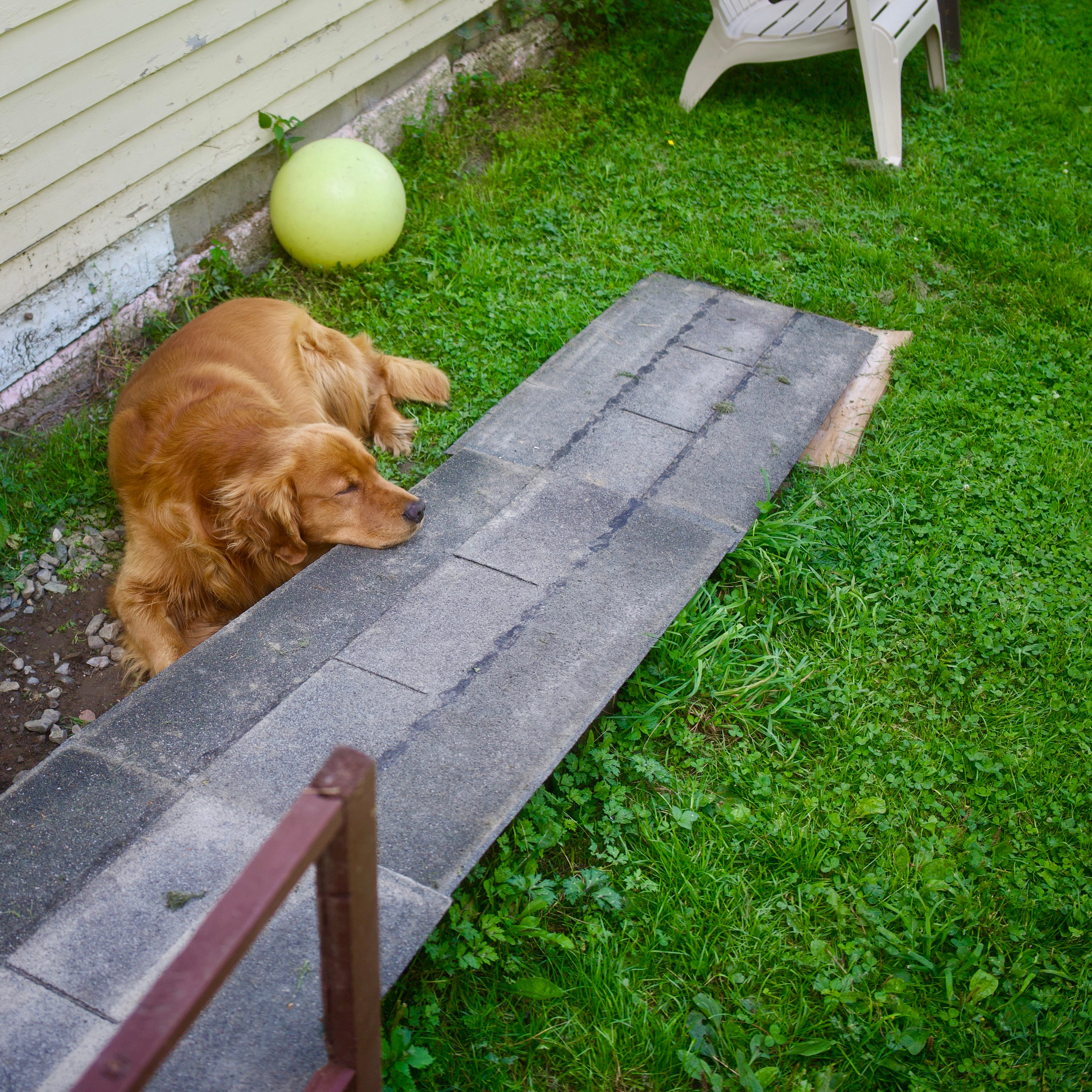
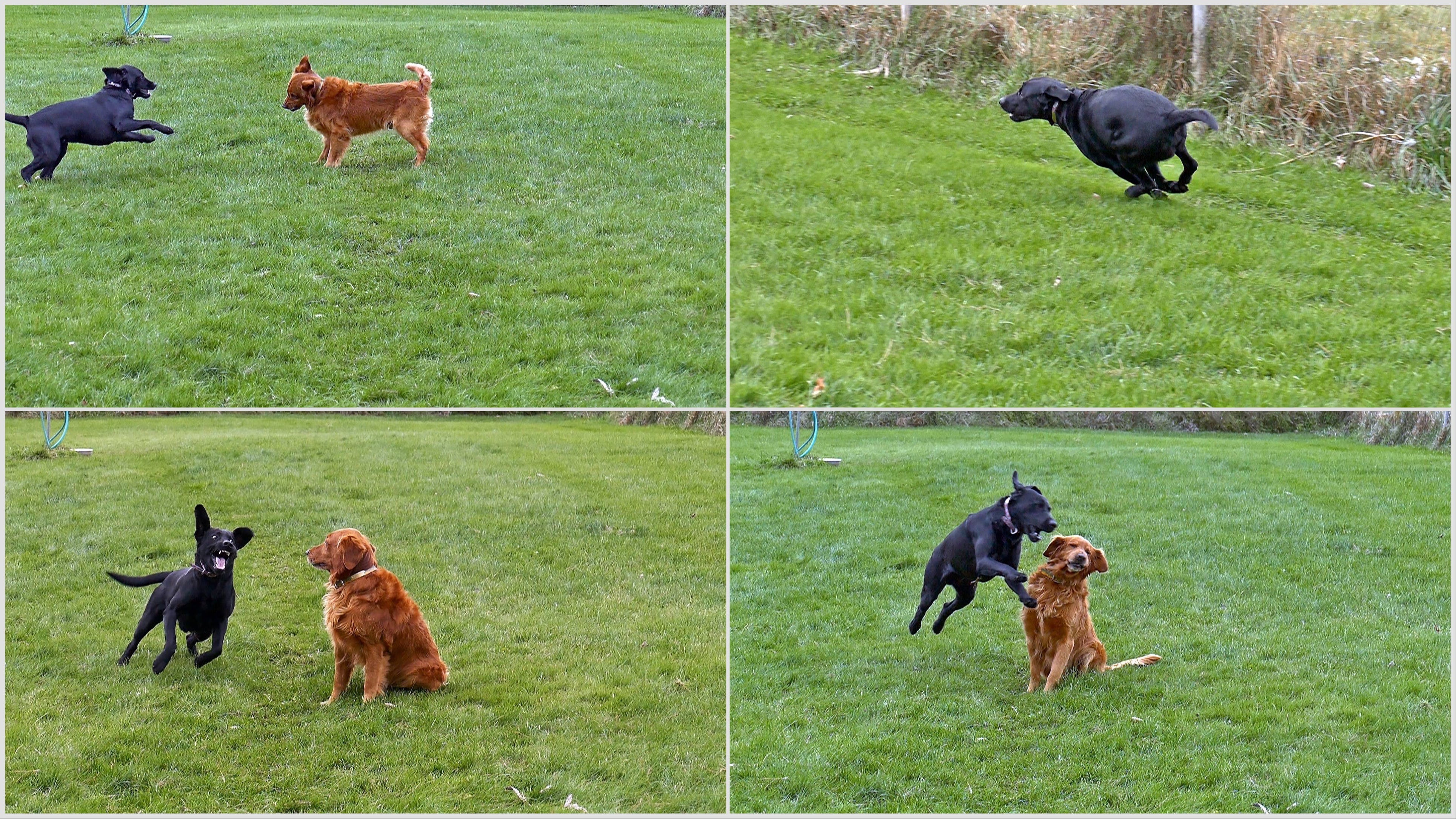
Blaze — our seven-year-old golden retriever — wanted nothing to do with the new surface. I trained him on it with cookies over the course of an hour, and now he doesn’t think twice. Blue hadn’t tried it yet. I stood out there after I finished, looking at what I’d built, and thought: this is what love looks like at the end. Not grand gestures. Plywood and shingles and waiting at the bottom.
And then, while Blue was still down, while I still didn’t know which way this was going, I went up the hill and dug the grave.
It took me two days. I paced myself because of my hernia — dig a while, rest a while, lean on the shovel and look at the view. The weather was beautiful. The spot is up by the log landing, and from there the Green Mountains unroll to the horizon, a view worth a million dollars from any angle. It’s the best real estate on the property, and it belongs to the dead.
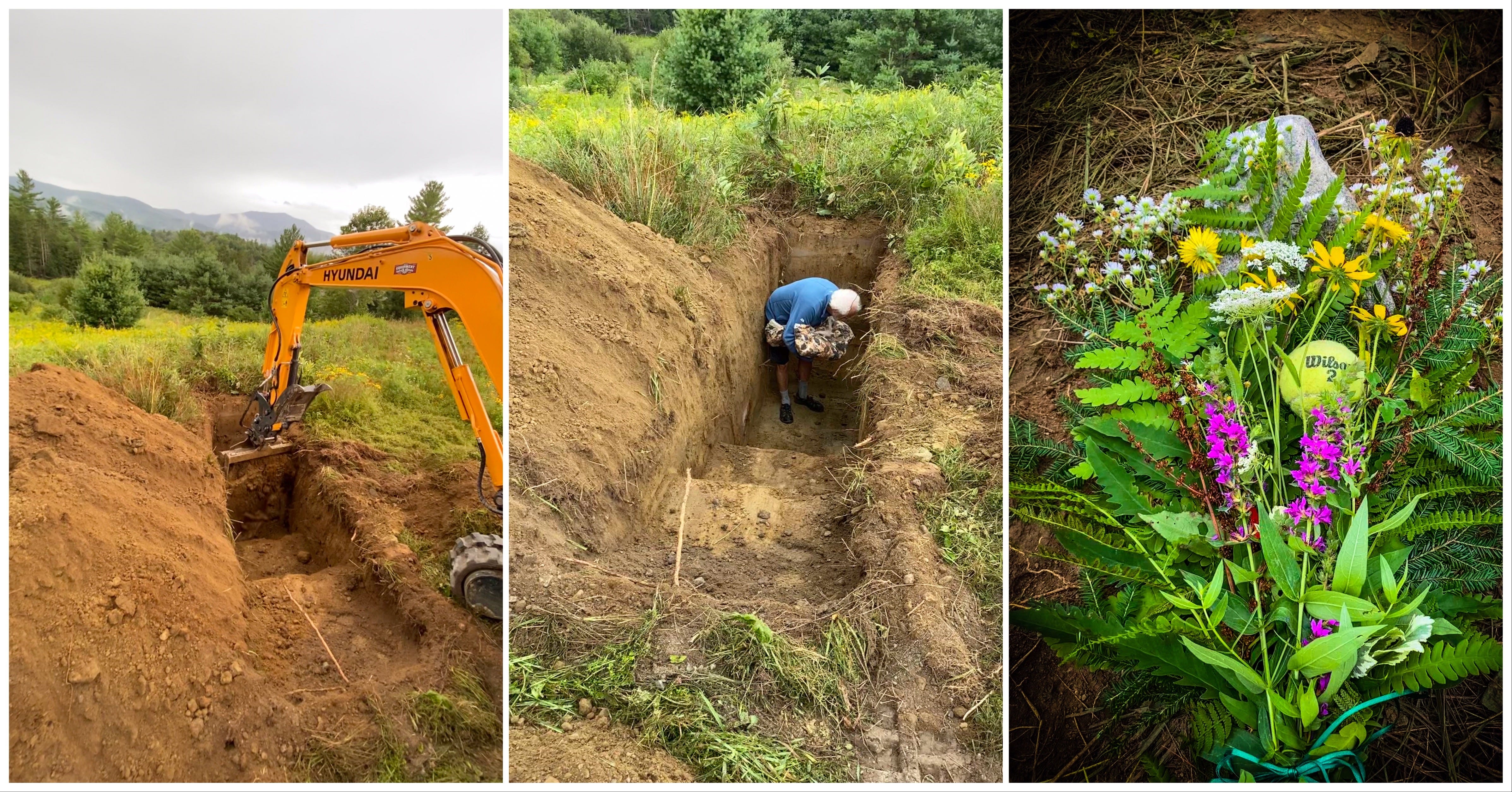
Izzy is up there. Our golden retriever, Blue’s best friend. When he died six years ago, a friend showed up with an excavator and went down twelve feet — a ridiculous, magnificent depth, a pharaoh’s grave. Which is why I could do what I did now: dig four feet down directly above him, into ground that had already been worked, and know that Blue will rest in the same column of Vermont earth as his best friend, six feet of clay between them. Like bunk beds.
Digging a grave for a dog who is still alive is a strange occupation. Your body does the work and your mind goes wandering, and mine wandered where it always goes on that hillside — back through the dogs, back through the deaths, back through how I came to do things this way.
I got my first dog in 1960, an Irish setter named Rusty. I was eight. I loved him the uncomplicated way children love animals — totally, without philosophy. But over sixty-six years and half a dozen dogs — Rusty, Brer, Buio, Izzy, Blue, and now Blaze — I’ve arrived at one truth, and I know how it sounds, and I don’t care: dog is God spelled backwards. These are beings with souls. They arrive with a kind of moral equipment most humans spend their whole lives trying to develop — loyalty, forgiveness, presence, an inability to hold a grudge. They deserve to be met on their terms, not managed on ours.
I learned the cost of getting that wrong in a parking lot in 2013.
Buio was a beautiful dark red golden retriever, our first dog in Vermont. He’d been hit by a car in our front yard at two years old — my fault, a story that lives in a part of me that doesn’t have a lock on it — and lost a front leg to it. The amputation was the right call. It saved his life and gave him eleven more years on three legs. But by 2013 he was blind, couldn’t walk, and was in pain, and we made the decision to have him put down. Veronica made him blueberry pancakes with syrup that morning — his favorite — and he ate them. I held him in my arms in my La-Z-Boy and rocked him. Then we drove to the vet.
They agreed to do it in the back of our hatchback, in the parking lot, which I thought was as close to dignity as the situation allowed. I was wrong. When the moment came — the vet holding the needle, Buio’s eyes on me — the billing department pulled Veronica inside to settle the account. Right then. Right as the needle was going in. So my wife was walking away toward the building, confused, looking back, while I tried to hold my dog’s gaze and the vet pushed the plunger, and the whole sacred thing collapsed into a transaction between parked cars.
When it was over they offered to take him. I said no. I’ll carry him. And I picked him up and he was just weight. A sack of warm nothing. The shape of him was there but he wasn’t. I’ve carried heavy things in my life. Nothing has ever felt as heavy as carrying something that used to be someone.
I made a decision walking across that parking lot. No more vets at the end. No more needles, no more billing departments. From now on, my dogs would die at home, on their own time, in their own way. I would stay with them. I would wait.
Izzy proved it could work. At fourteen he wound down over two months — a dimmer switch, one click at a time, no crisis, no collapse. He died at home, peacefully, on his own terms. We wrapped him in a blanket Veronica had made for him and buried him up here, looking at the mountains. The way we handle the end matters as much as anything we do in the middle. Maybe more.
I’m not judging anyone who chooses differently. Not everybody has the time I have, being retired. Not everybody has the land. Not everybody has the stomach for what it means to stay with a dying animal until the dying is done. But I’ve learned more from caring for two dying dogs than from almost any other experience in my life.
So I dug. Two days, a few feet at a time, resting my hernia, thinking my thoughts, looking at that view. When it was done — two feet by three feet, four feet deep — I laid a sheet of plywood over the hole and weighed it down with rocks, so the rain stays out and nobody falls in.
The grave was ready. I walked back down the hill to see whether the dog was.
He wasn’t. He was coming back.
The climb was slow. It didn’t happen all at once and it didn’t happen overnight. First he’d lift his head when I came into the room. Then he stood up on his own. Then one morning he made it outside — tentative, uncertain, but outside. He took a leak. He walked a slow loop around the yard, head low, tail barely moving but moving. He came back inside and ate.
That’s the rhythm now. You steel yourself for the end and then the end doesn’t come, and you’re left standing there with all the grief you’d already started spending and nowhere to put it. So you fold it up, put it away, and tell yourself: not today.
A few days ago I took him for a walk on lead, up toward the hillside. We visit that spot often — the view alone is worth the walk. But about a hundred yards short, Blue stopped. He just stopped and looked at me. Not distressed. Not tired. He had a kind of smile on his face, the way Labs do when they’re communicating something they want you to understand. I’m good, his eyes said. I don’t need to go there.
I waited. We stood together and looked out at the mountains. Then I started walking again, and he followed. At fifty yards he stopped a second time. Same look. Same calm refusal. I’m good. We stood a while longer, the two of us, and then we walked the rest of the way to the site. And when we got there, Blue had no interest. He turned around and walked away.
I don’t know what he smelled — the freshly turned earth, the ground that holds his best friend — or what he sensed in me as I approached the place I’d prepared for him. I only know that he told me something, twice, clearly, without a sound. And that he followed me anyway, because that’s what he’s done for thirteen years. And that when he got there, he decided he’d seen enough, and he left.
Today he is back to himself — or some version of himself that accounts for the mileage. His mood has lifted. He goes outside on his own. He’s taken a renewed interest in mounting Blaze, which Blaze finds outrageous. He still eats his one meal a day, but he does it shifts. Half in the morning and the rest in the afternoon.
Then yesterday Veronica noticed something: one of his toenails was missing on that right hind leg. Gone. We looked at the deck boards, the gaps between them, and it made sudden, simple sense. He’d caught a nail and ripped it out. A torn toenail on a thirteen-year-old dog is agonizing — but it’s an injury, not a verdict. And it reframed everything. The days of bracing for the worst, the grief spent in advance, the grave dug on the hillside — all of it may have been about a toenail.
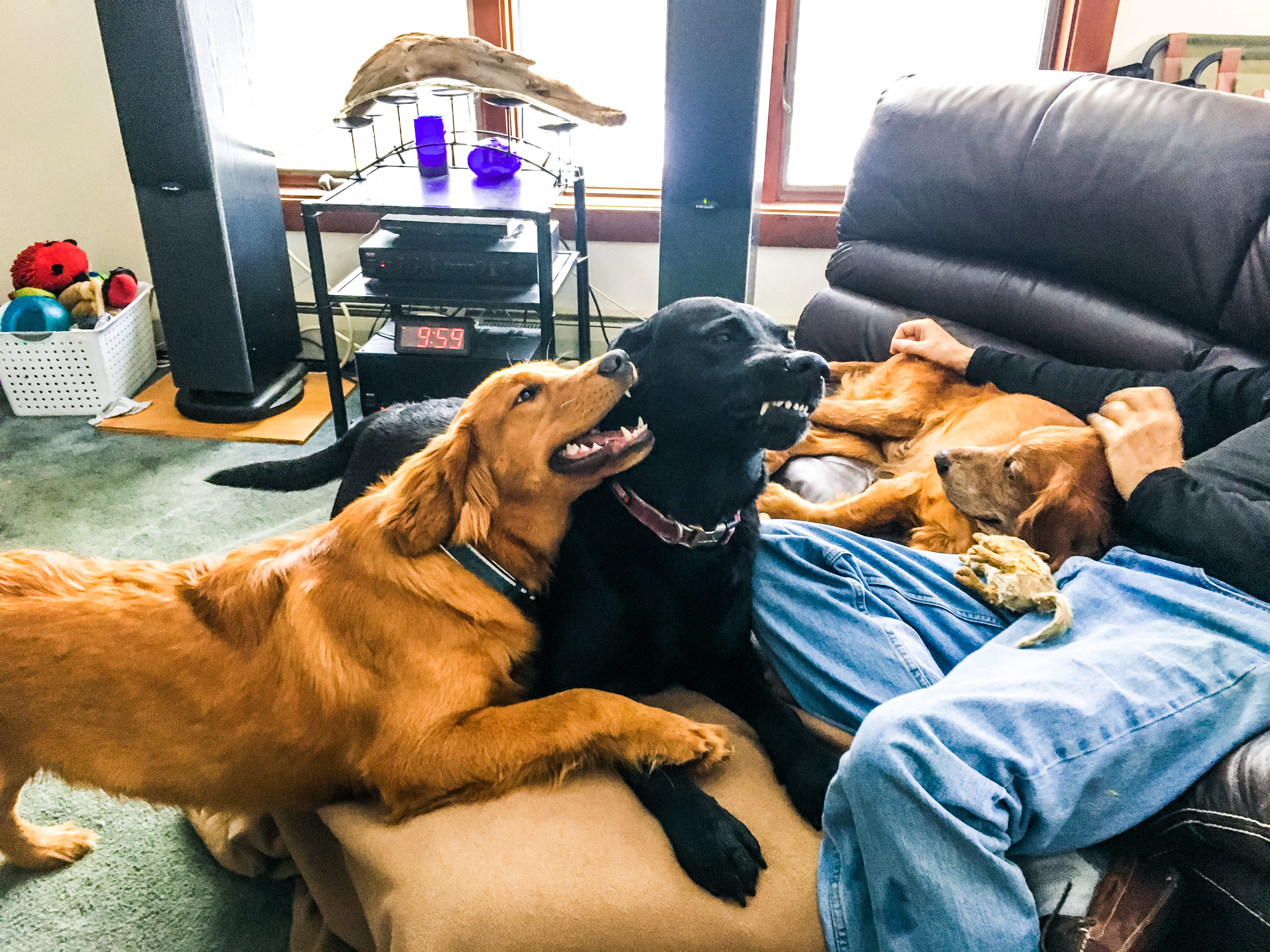
And last night, Blue got up on the couch. His couch. The one I opened this piece by saying he couldn’t reach anymore. He stood in front of it, shifted his weight, and this time he made it. He settled into the shape of himself in those cushions and closed his eyes.
The grave is ready. Blue is not.
“Thumb Out” Book One of my memoir trilogy “The Spaces Between” is available now
e-book ~ kindle ~ paperback ~ hardcover ~ signed paperback
Extraordinary writing. Remarkable story!!