

A reader commented that he’d read “Surfing the Interstates,” my 1973 hitchhiking memoir. Then he said something that stayed with me.
He said it reminded him of the Bhagavad Gita.
At first the comment landed in left field. I didn’t understand it at all. It sounded like a compliment — it felt like one — but I couldn’t see what he saw. A stranger had held my book up against a four-thousand-year-old scripture and found a resemblance, and I’d written the thing without ever intending any such thing. That’s what haunted me. So it sat with me. For a couple of months it kept surfacing at odd hours. Finally I sat down to chase it down — to read the Gita again, properly, and find out what he’d seen. What I found there wasn’t only the road. It was my father.
The book is the story of a summer. I was twenty-one, a college dropout, fleeing a family coming apart at the seams. I took eighty dollars from my mother’s closet, strapped on a backpack, grabbed an old guitar, and hiked down to Interstate 684, where I put my thumb out like a rookie matador’s muleta. What followed was ten thousand miles across 1970s America — a Vietnam vet whose little brother came home in a box, a flute player who steered with his knees, a peyote vision in the redwoods, Jerry Garcia playing my guitar, the night strange lights came down and read the Pacific, five days fasting in a Texas canyon until the stones turned to doves in my hands. It reads in a day because the road moves that way. No destination. Just the next mile, the next stranger, the next thing the road hands you. (I’ve since folded it into a larger book, “Thumb Out,” where that summer becomes the middle act — but it stands on its own.)
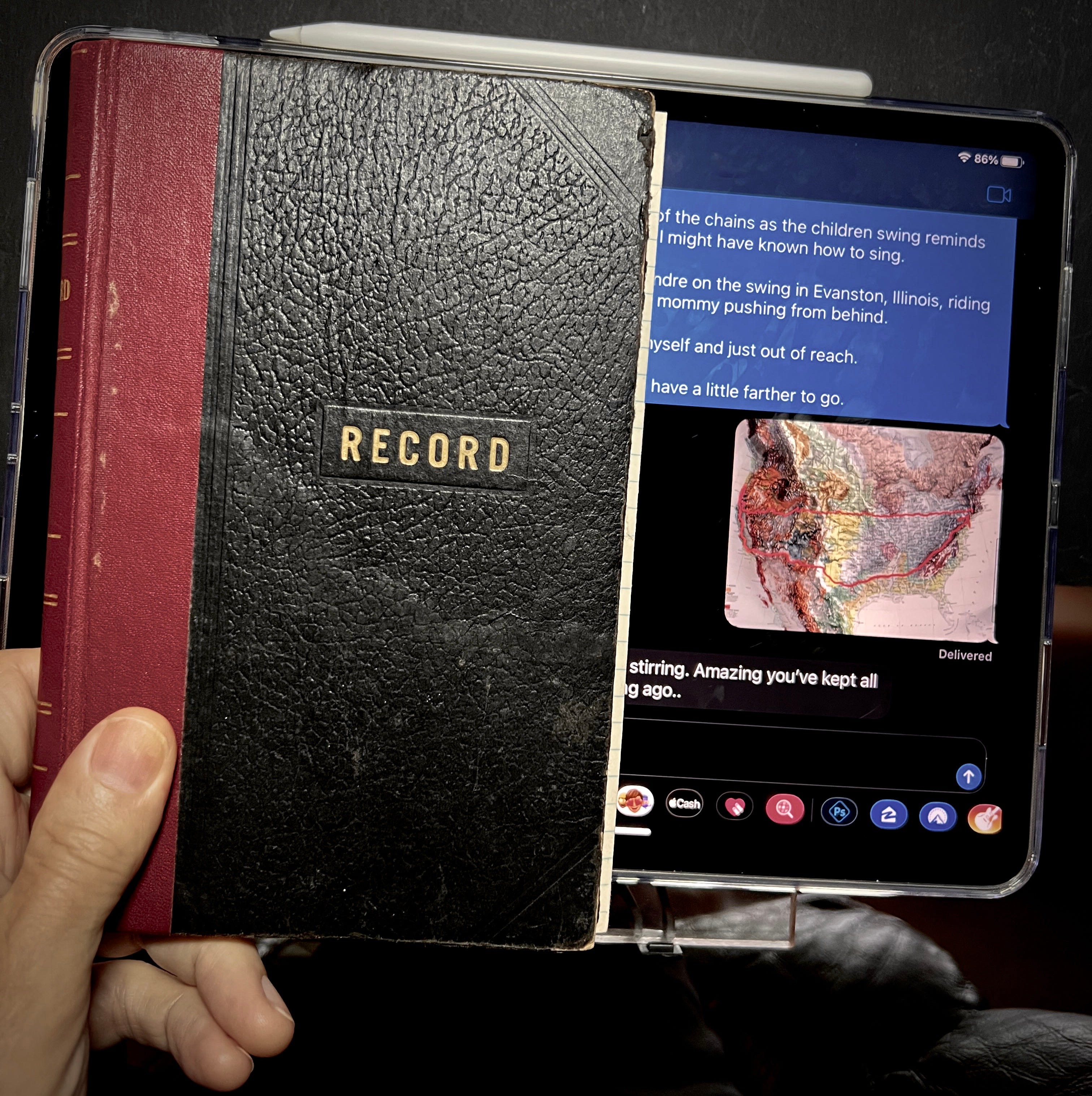
Here’s the thing. At twenty-one I wasn’t writing a book at all. I wasn’t thinking about readers, or spirituality, or scripture. I was just keeping a journal — a little book I carried in my backpack, RECORD stamped on the cover. I still have it. Fifty years later it’s what I built the memoir from: the young man took down the days, the old man made the book.
So whatever this reader felt, neither of them put it there on purpose. It got in on its own. And the more I sat with that, the more I understood why — because I’d been pointed at this without knowing it for most of my life. At Exeter I’d studied the hero’s journey — Campbell, and the old texts that came after, all turning on the same handful of truths. That the lovely flower grows only from the wound. That a wise man always appears along the road. That you find your way only by following your own path, not the one laid out for you. I’d been an altar boy. I’d knelt in Notre Dame and Winchester Cathedral, stood before the Pietà, read Kierkegaard before I understood him. I was tuned to the beyond, and had been for a long time.
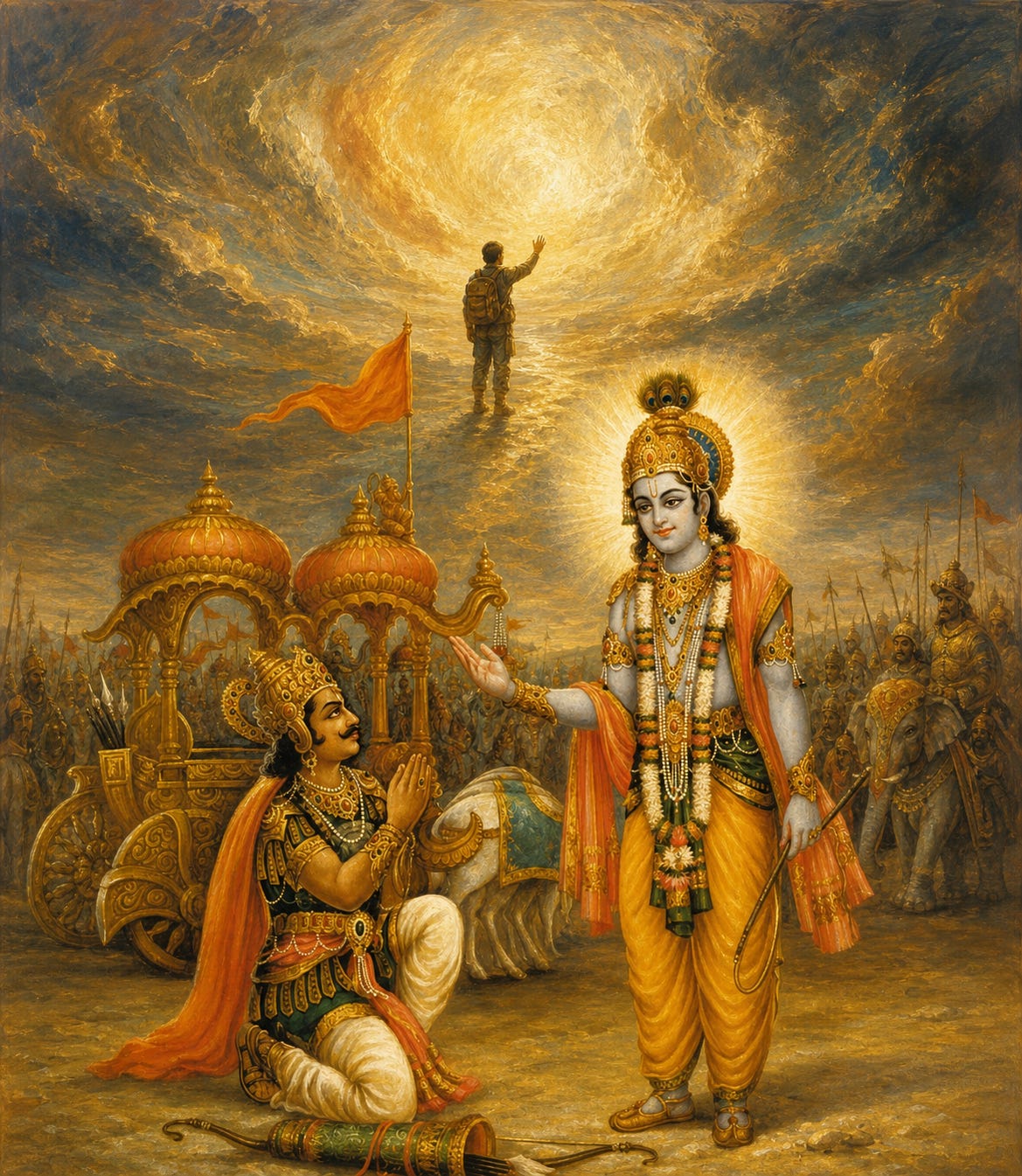
For anyone who’s never opened it: the Gita is a slice of a vast Sanskrit epic, and it takes place at the worst possible moment — on a battlefield, just before a war. A warrior named Arjuna sits frozen in his chariot, staring across the field at the cousins and teachers he’s about to fight. He doesn’t want to do it. His charioteer turns out to be the god Krishna in disguise, and the whole Gita is their conversation in that frozen instant before the arrows fly.
Krishna’s answer is the part that lodged in me decades ago and never left. You have a right to your actions, he tells Arjuna, but never to the fruits of your actions. Do the thing because it’s yours to do. Act with everything you have — and then release your grip on how it turns out. The trouble isn’t action. It’s the craving for the result, the clinging to the outcome. That craving is what binds us, spins the wheel, keeps us coming back. Act without it, and the same deed that would have chained you sets you free.
I think of my father when I read that. Because he unknowingly became the man Krishna warns against.
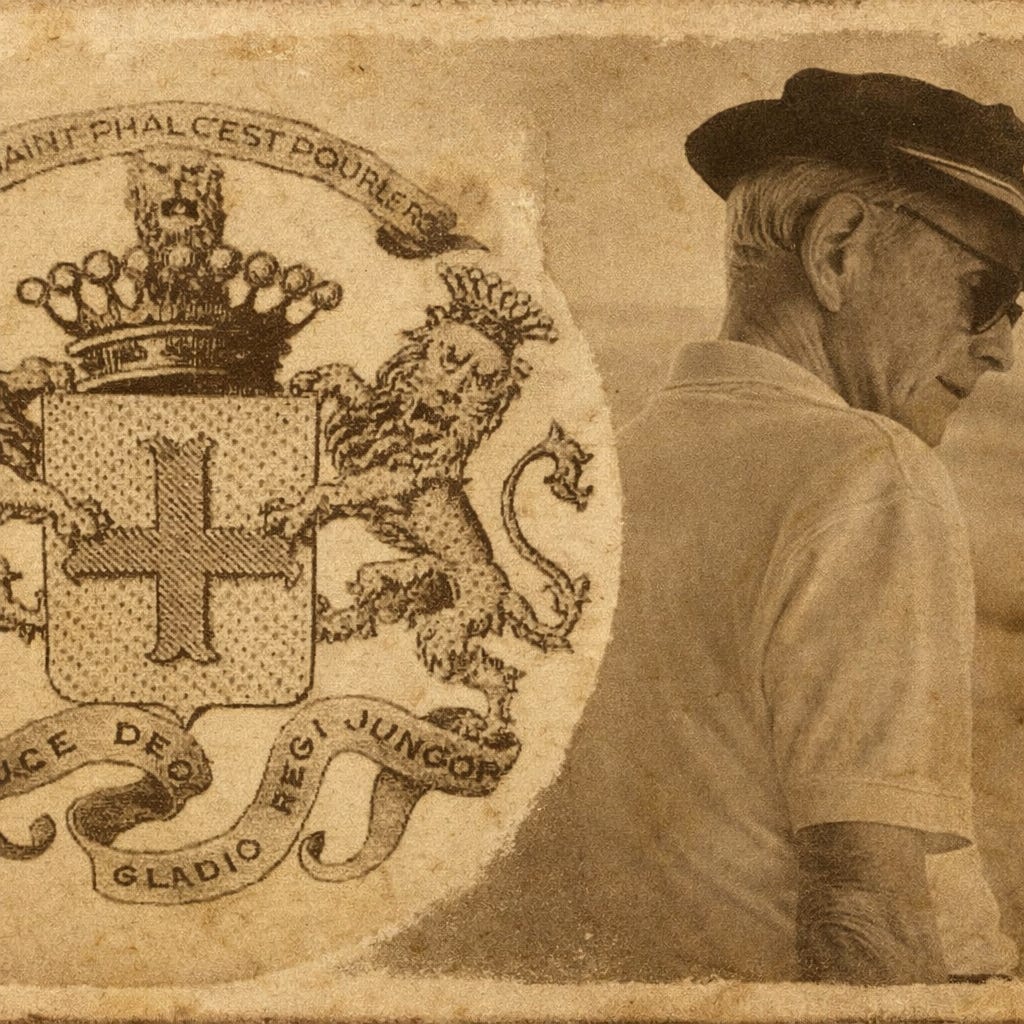
Dux was the sun the whole family revolved around — towering, godlike, larger than any room he stood in. It’s hard to square that with how he ended: by the time he died he’d shrunk to a kind of munchkin, frail and shriveled, the broken remainder of an enormous man. But in those years he was immense, and he loved hugely and lived grandly. The trouble was that he was attached to the fruit of everything he touched, and to nothing more than his six children. We weren’t people he’d set in motion and released. We were results he was owed — and more than that, we were stories he intended to write. He searched tirelessly, all his life, for the angle that would turn each of us into some grand success of his own authorship, driven by his ego, almost never shaped to what the kid in front of him actually wanted. He wanted me to be a monk or a priest — he burned incense, played Gregorian chant, brought Monsignor Blake to Sunday dinner. He wanted me to go to Vietnam as an officer and die a hero: you might as well go as a lieutenant rather than some buck private in the mud.
And one summer he decided I would be a pitcher. I’d shattered my right elbow at six — a bad fall, badly healed — and I think in his mind the pitching would fix it, rebuild the broken arm into something that could throw like Juan Marichal, the high leg kick, the whole motion. Evening after evening, home from the city, he’d make me throw. Pitch after pitch after pitch until the elbow screamed. He believed that if he just drilled it into my body long enough, the result would have to come — the boy repaired, the arm made right, the outcome delivered. I had a great start. Then I fell apart, and never pitched again. That was the man in miniature: the thing wanted so badly, drilled so hard, that what he was trying to fix simply broke again. He’d stumbled into a partnership with one of JFK’s groomsmen and let himself imagine an ambassadorship to France, closer to the throne his name came down from. A man of unbridled ambition, dreaming in every direction at once, every dream a result he intended to collect.
And then 1973 came, and all of it crumbled into dust at once.
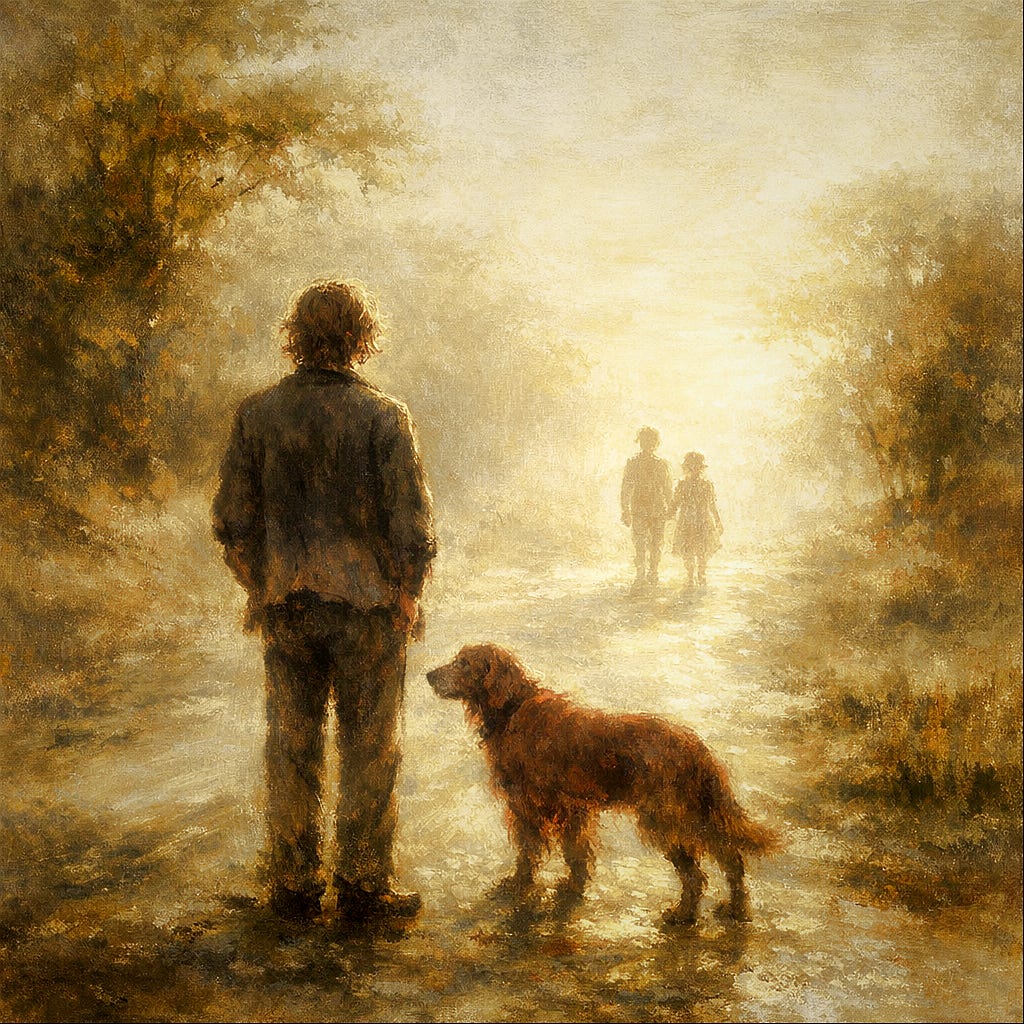
I came home from the road that September and pitched my tent in the pine groves across from the house, not sure I was even welcome anymore. The estate was under contract — twenty-five acres of Westchester about to belong to strangers. The house was empty. My father had moved to the city. My old room stood with the door wide open, exactly as I’d left it two months before; nobody had bothered to close it. On my way out, months earlier, I’d crested the last hill and let one memory tug at my resolve — my father in the Mianus River Gorge, yelling for the net, a brown trout breaking the surface with the sun on its impossible speckles. Then the other image rose up behind it and canceled it out. My father, scowling. Blaming me for being clumsy with the net, blaming me for his loss.
His loss. The marriage, the children, the estate, the dynasty — all of it experienced as a thing taken from him. And when the fruit came in rotten, he had nothing underneath it to stand on, because the loving had been bound to the winning the whole way down. So he walked away. Never looking back as he chased his dreams of owning and racing thoroughbred horses.
The results he’d grasped at didn’t just fail. They inverted, in ways that would have horrified him. Here was a man fixed on bloodline and on the throne of France his name came down from — a man who pictured grandchildren on thrones, heading corporations, chairing university departments. Somehow he married the orphaned daughter of an Irish immigrant, expecting her to give him a president of the United States. What he got instead came out a generation later of mixed race, Black, Japanese, working in the trades and as nurses. The careful line he’d guarded, scattered to the wind. The only one of six children ever to earn a college degree was the dyslexic rebel he’d least have bet on — the chainsaw man, a timber faller in the Oregon woods. Even there my father couldn’t stop trying to write the story: he pushed my brother toward geology, told him there was far better money in rock than in trees. My brother was horrified. Are you kidding me? The last thing on earth he’d ever want to be. Every fruit my father clung to turned into something he could not have wanted.
And me? I was no Arjuna who’d renounced his ego. I wanted to be a film director. I wanted to be a rock star. I wanted, if anything, the same grand outcomes my father wanted for me — I’d just chosen my own list. My Nana told me reprovingly, “You are just like your father.” And then the road took the list away.
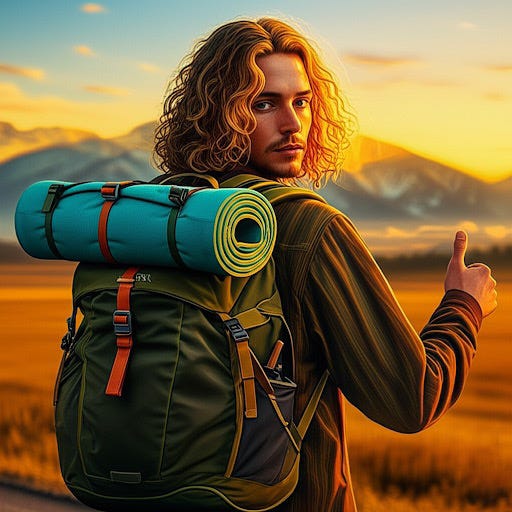
Because you can’t hitchhike with a plan. There I was, a pauper in the breakdown lane with eighty borrowed dollars — a hobo, a Woody Guthrie figure thumbing through a country I was seeing for the first time from underneath. I’d come from immense privilege and hadn’t known it until the road showed me. I moved through regions where the opportunities I’d taken for granted simply didn’t exist — had never existed — for the people who stopped to pick me up. The vet from Bridgeport who went to Vietnam because he didn’t know any better. The draft resister who did two years in Leavenworth and couldn’t get decent work after. I was learning the shape of my own luck by leaving it behind.
And mile by mile, the road did to me what Krishna asked of Arjuna and what my father could never do for himself. It pried my hands off the outcome. You do the single action that’s yours — stand there, thumb out, available — and you let go of all the rest. Whether anyone stops. Where they’re going. What comes next. You don’t choose the ride. You don’t steer. You receive what comes and you make something of it, and then you let that go too, because there’s another mile and another stranger and the day isn’t done. Do that for ten thousand miles and it stops being a technique and starts becoming a way of being in the world. The craving quiets. The wheel slows. Something in you that was clenched since boyhood begins, mile by mile, to loosen its grip — never all at once, never for good, but enough.
The ambition didn’t die out there. It rode shotgun with the surrender — it still does. But it stopped running the car. And somewhere in all that letting go, following my own path away from him, I became — without ever meaning to — the very thing my father most wanted. A kind of monk. Abstinent most of my life. Broke most of my life. Living on the edges, occasional feast and mostly fast. He grasped at sanctity with both hands and lost everything, and shrank to a munchkin doing it. I fled sanctity, empty-handed, and it found me on the side of a highway.
That’s what my reader saw before I did. Not a road book. A book about the one lesson my father spent his whole life unable to learn, and that the road beat into me before I was old enough to know I was being taught. The right to the action. Never to the fruit.
And here is the part I’m still learning. Writing this memoir was my action, mine to do, and I did it. But I cannot govern the fruit of it. The book has cost me my siblings — complete alienation. Telling the truth as I lived it carried a price I never got to set, paid in the one currency I’d have most wanted to keep. I had the right to write it. I never had a right to how it would land. Most days I feel strong — and I’ve learned to be a little afraid of feeling strong, because the pride of having let go is just one more thing to let go of. It still saddens me. The phone doesn’t ring the way it used to. But that’s the work. It always was.
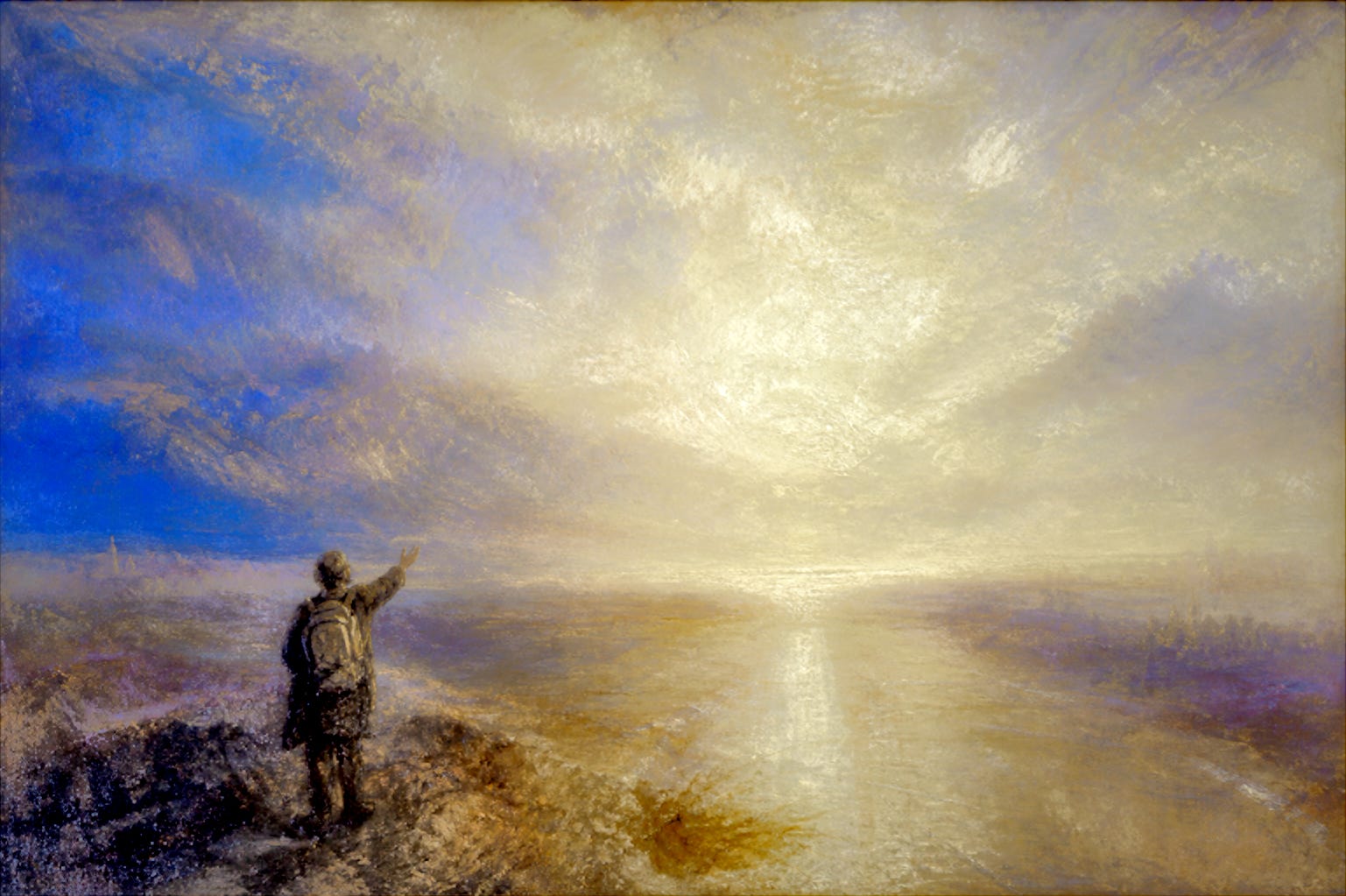
My reader was reminded of the Gita. I get it now.
I write here about the long road from that summer to this kitchen table — new pieces when they come. Surfing the Interstates is the book this one came from. If any of it speaks to you, stay a while.
That reader was Alan Hamsher — the first person to ever buy and read my book, and still, somehow, the one who understood it first. This one's for you, Alan.
I write here about the long road from that summer to this kitchen table — new pieces when they come. Thumb Out is the book this one came from. If any of it speaks to you, stay a while.
“Thumb Out” Book One of my memoir trilogy “The Spaces Between” is available now
e-book ~ kindle ~ paperback ~ hardcover ~ signed paperback