

A while back I wrote here about “Shy Girl” — Mia Ballard’s horror novel that Hachette acquired, published in the UK, and then killed in the US after a YouTuber posted a video titled “I’m pretty sure this book is AI slop.” One-and-a-half million views. A detection company put a number on it — 78% AI-generated — and a major publisher folded a book over a percentage and a viral clip. Ballard said a freelance editor introduced the changes before Hachette ever saw the manuscript. Didn’t matter. She deleted her accounts and disappeared.
I said at the time it was pearl-clutching, and I’ll say it again, because the pattern has only gotten worse. Around the same stretch, the Commonwealth Short Story Prize had three of its five regional winners flagged by the same kind of detection software. Three of five. Writers who’d made it through a real competition, suddenly under suspicion — not because anyone read the work and found it wanting, but because an algorithm assigned it a probability.
And here's the thing you should know as you read this: the detection company behind those flags is named Pangram — and it's the same one Substack just wired into this very platform. Right now, on the page you're reading, there's a button that will scan these words and hand you back a percentage: how much of this, it will estimate, was written by a machine. Not by reading any hidden mark — it can't see one — but by sniffing the rhythm and shape of the sentences and guessing. The same guess, from the same company, that helped bury a novelist and shadow three prize-winners. I've left the button on. I could have switched it off — Substack lets you — but hiding from the scan would concede the very thing I refuse to concede. So scan away. Then read the note below, in my own words, about how this was made. One of those two things will tell you something true. It won't be the percentage.
That’s the tell. Nobody’s reading anymore. They’re scanning.
And now the machine has arrived to make the scanning permanent.

This week Anthropic — the company behind Claude, the tool I’ve been open about using in my own work — announced it’s embedding an invisible watermark into every piece of text its AI generates. Not a logo. Not a disclaimer. A statistical signature woven into the words themselves, imperceptible to any reader, that travels with the text when you copy and paste it and can survive a certain amount of editing. It’s part of complying with a new European law, the AI Act, that requires AI output to be “detectable as artificially generated.” Anthropic went further than the law required and turned it on worldwide — so it applies to a memoirist in Vermont exactly as it applies to someone in Brussels.
Sit with what that actually means. Not a label you choose to put on. A mark you can’t see, that you can’t easily remove, riding inside your own sentences, waiting for someone with the right tool to hold your work up to the light and ask the question.
Have you now, or have you ever?
But before you decide the watermark is just literary hall-monitoring, look at when it arrived. Look at what it walked in to protect.
Because the whole business model of AI — the reason a handful of companies in Silicon Valley are worth more than most countries — rests on a single assumption: that the machine belongs to someone else. That you rent it. That every sentence you generate runs through their servers, on their metered account, under their terms, and they can see it. That’s the moat. The intelligence lives in a data center you’ll never enter, and you pay by the token, forever.
And that moat was starting to drain.
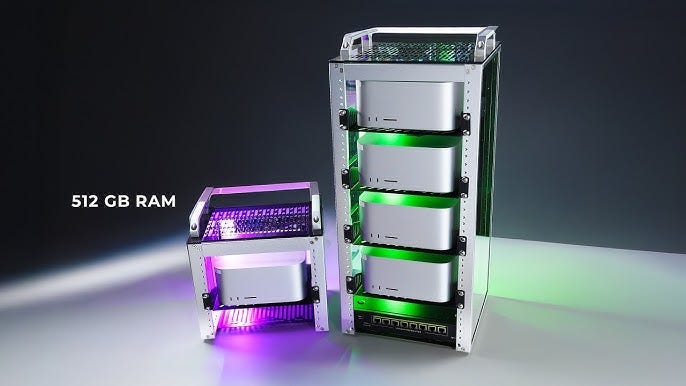
For one brief window, Apple sold a desktop computer — a Mac Studio you could set on a table next to your books — with enough memory to run the best open-weight models in existence entirely on its own. No cloud. No account. No token meter running in the background. No company embedding a signature into your sentences, because the model never left your house. Under ten thousand dollars, and the largest open models on earth — models the big labs would happily rent you by the token — would sit in its memory and answer to no one but you. The open-weight models are free to download. The hardware existed. The math suddenly worked. For the first time, the intelligence could belong to the person using it.
That is the thing the moat was built to prevent. And it had just been breached by a computer you could buy at a mall.
Now watch the timing. At precisely the moment the technology threatened to slip the leash — to become something a person owns rather than something a corporation rents — the governments and the incumbents discovered an urgent need to mark and detect every word the machine produces. To make AI use visible. Traceable. Flagged. Suspect. A new law appears requiring outputs to be “detectable.” The companies rush to comply and go further than asked. And the culture, primed by the Shy Girl mobs and the prize-committee flaggings, stands ready to treat any detected sentence as a confession.
I’m not saying anyone drew up a plan in a room. I’m saying incentives don’t need a conspiracy. When a monopoly is threatened, the pressure to make the escape route look shameful, dangerous, and detectable arrives on its own — from regulators worried about the wrong things, from incumbents worried about exactly the right ones, and from a public trained to sniff for heresy. The watermark and the witch-hunt are the same reflex. One marks the work. The other marks the worker. Both exist to make sure that using this tool costs you something — your standing, your presumption of authorship, your good name — right at the moment it was about to cost you nothing at all.
And there’s a longer game here that I can’t stop thinking about.
Right now, the terms say the words are yours. Every one of these companies, Anthropic included, currently hands you whatever rights it might have in what the machine produces and claims none for itself. Fine. But terms are just words on a server, and words on a server get rewritten whenever the incentives shift. What doesn’t get rewritten, once it’s in place, is the machinery. And a watermark is machinery. It is a permanent, invisible, self-reporting record that says: this text passed through our system. Our model made this.
Ask yourself what that record is for, five years out, ten. Today it’s sold as transparency. But it is also, precisely, the thing you would need to build first if you ever intended to claim that the output was yours to license. You cannot assert ownership over what you cannot identify. The watermark solves the identification problem — quietly, at the model level, worldwide, before anyone was asking. Build the ledger now, under the banner of a European transparency law nobody will read, and the claim it enables can come later, whenever the terms of service quietly change and the writer discovers the sentences he thought were his carry someone else’s invisible signature of ownership.
I’m not saying that’s the plan. I’m saying that’s the capability, and capabilities have a way of finding their use. You don’t lay this much track without eventually running a train down it.
Here’s what the pearl-clutchers refuse to reckon with: every other medium they consume without a second thought is soaked in the same assistive technology they’ve decided is disqualifying in prose. The film they watched last night had an algorithmically-scored soundtrack and generative-fill VFX. The ad that played before it was AI-assisted top to bottom. The article they read this morning, the legal brief their lawyer filed, the logo on their coffee cup. The suspicion is reserved, with real venom, for the writer — as though the sentence is the last sacred object and any hand but the lonely tormented one in the garret is a desecration.
I don’t accept the premise. I never have.
I wrote “Thumb Out” — three hundred and thirty pages about hitchhiking across America — from a journal I kept in 1973, on the road, day by day, seventy-six days of it. That journal is the book’s spine. Everything in it happened, and I wrote it down when it was happening, and decades later I sat with those pages and built the memoir out of them. The words are mine. The remembering was never in question, because I’d already done it, in a notebook, at twenty-one.
What I used Claude for is smaller and more honest than the panic wants it to be: I’d hand it a line that wasn’t sitting right and ask for another way to say it. Rephrasing. The same thing a writer has always done with a sharp friend, an editor, a spouse who reads the paragraph back to you over coffee and says try it this other way. I wrote the book. I used a tool to help a sentence land. Those are not the same act, and only someone hunting for heresy would pretend they are.
I am not ashamed of that. I won’t perform shame for people who’ve mistaken suspicion for standards.
And here’s the part that should keep the incumbents up at night: the door that opened doesn’t un-open. Apple quietly pulled that 512GB machine — a memory shortage did what no policy could, and the top configuration now tops out at a fraction of what it briefly offered. Convenient, if you’re the one renting out intelligence. But the fact was established, and facts like that don’t reverse. The capability exists. The models are free. The only variable left is hardware, and hardware gets cheaper and smaller every year that passes, not dearer. Whatever they build to mark and monitor the rented machines, there is a version of this work that runs entirely on a desk in Vermont, watermarked by nothing, answerable to no one, mine from the first keystroke to the last.
So let them build their watermark. Let them ship their detector, whenever they get around to it — right now, notably, no one outside Anthropic can even read the mark, which tells you how much this is about transparency and how much it’s about the appearance of it.
My name is on the work. My life is in it. The remembering is mine, the shaping is mine, the responsibility for every word of it is mine. They can mark what their machines make. They cannot mark what mine does. And they cannot make me ashamed of a road I hitchhiked at twenty-one, wrote down in a notebook, and carried the rest of my life.
Scan all you like. The twenty-one-year-old on that road never asked anyone’s permission, and neither will I.
“Thumb Out” Book One of my memoir trilogy “The Spaces Between” is available now
e-book ~ kindle ~ paperback ~ hardcover ~ signed paperback