

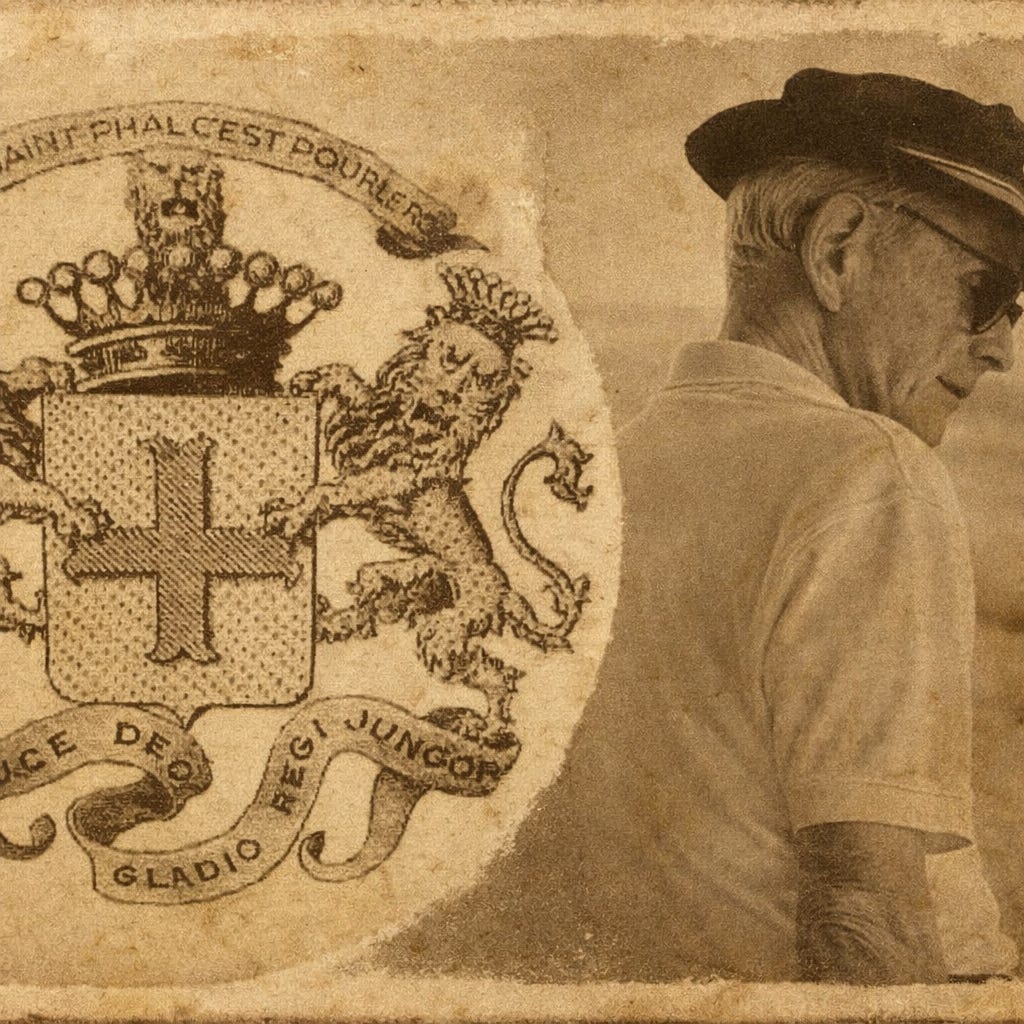
My father had a quiet fascination with thresholds.
He’d watch the odometer in whatever car he was driving the way he watched his beloved thoroughbred horse races — with genuine anticipation, building toward a climax. When the numbers rolled from all 9s to all 0s, he’d announce it like a small miracle had occurred in the dashboard. He did this every time. Ten thousand. Fifty thousand. A hundred thousand. As if the accumulation of miles deserved a witness.
He brought this same energy to birthdays. When I turned ten, he informed me — proudly, as if delivering important news — that I would never be in the single digits again. When I turned twenty, he pointed out I was entering my third decade. Not my second. My third. The mechanics of time passing interested him the way the mechanics of everything interested him — he was a man who read Kierkegaard and C.S. Lewis, who went to church not out of habit but out of genuine seeking, and who once told me I had to study philosophy before I could make films because you’ve got to understand the deeper layers before you can say anything worth hearing. He wanted to mark the turnings. He wanted to know what was underneath them.
I’ve been thinking about this lately because of something Dr. Seuss once wrote: “Sometimes you will never know the value of a moment until it becomes a memory.”
It’s a clean little sentence. Almost too clean. Because in my experience, there are really two kinds of last times — the ones you see coming, and the ones that ambush you years later when you finally understand what you were living through.
I knew, for instance, driving home from a wedding in 2012 — two and a half hours on a dark highway — that Veronica and I had just photographed our last event. We’d built something real over the years, gotten good at it, worked together in that silent shorthand married couples develop. But the economy had hollowed out the business, and the math didn’t lie anymore. We drove home knowing. That was a last time we could see.
But there are the other kind.
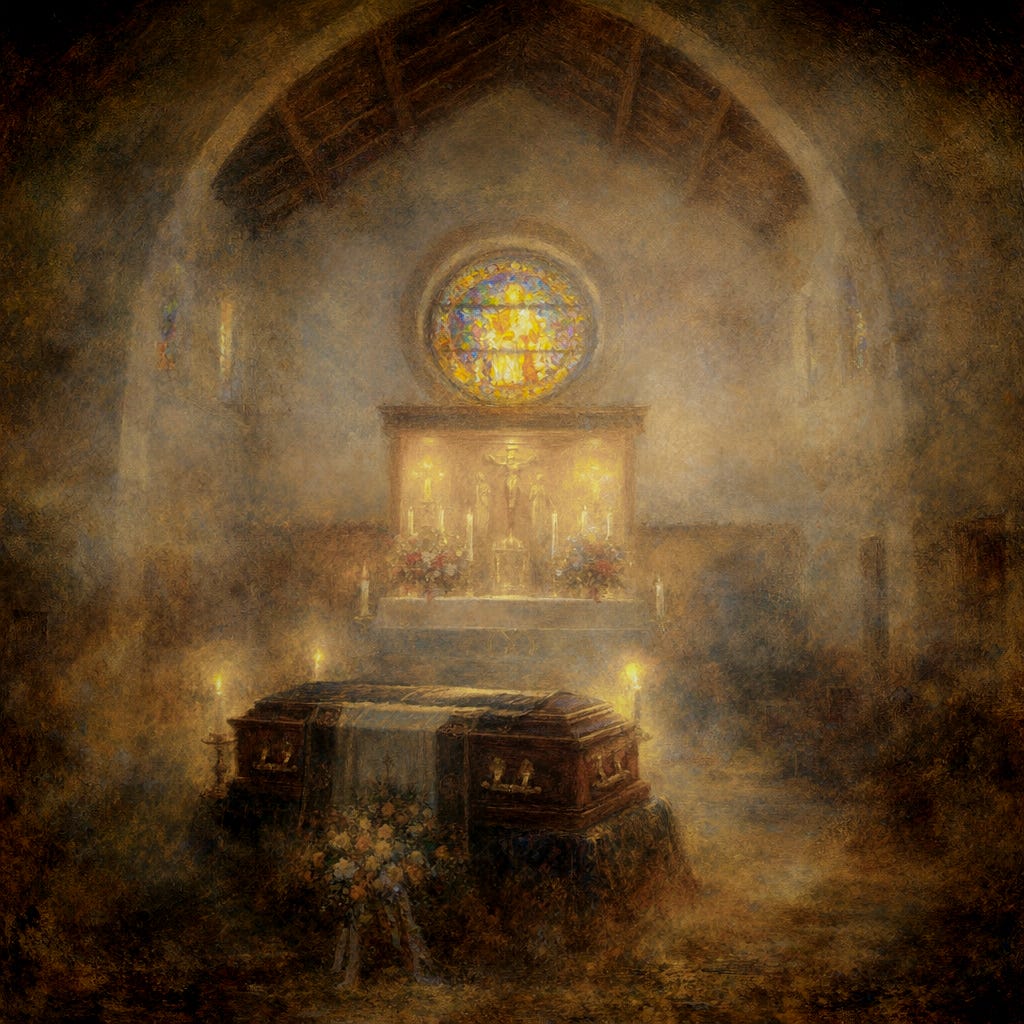
My father’s funeral in 2022. I stood in St. Patrick’s Church in Bedford, New York — the same church built the year he was born, 1928 — by his casket with three of my five siblings. The place had marked every turning in our family’s life: first communions, baptisms, my brother’s wedding, Nana’s funeral, my mother’s funeral. My father would have appreciated the symmetry of ending where so much had begun. I didn’t think about it being the last time. Why would I? Families gather. Families scatter. Families gather again. Except this time they didn’t. I haven’t seen any of them since. And the two who weren’t there? One brother I haven’t laid eyes on since my mother’s funeral in that same church, nearly three decades ago. One sister, thirteen years now. They’ve each found their own reasons for the distance. I don’t fully understand them, but I’ve learned that families hold different versions of the same story, and not all of them can live in the same room.
Or 2017, when my closest friend brought his whole family up to Vermont for a week. His wife, his two daughters. We kayaked on a lake during the eclipse, that strange midday twilight falling over the water. I remember the light more than anything — how wrong and beautiful it looked. I didn’t know I was supposed to be memorizing it. He’s separated now. His daughters don’t talk to him and he won’t talk to me. Addiction swallowed that family whole, and the lake and the eclipse and the kayaks became something I can only visit in my mind.
And my mother. She died of lung cancer in 1997, and with her I remember the last times vividly. I remember lying next to her in her bedroom, the two of us cuddled together watching The Brothers McMullen — that small Irish movie about three brothers trying to figure out love and family and faith. Her hair was gone by then. She was thin in a way that made her feel both fragile and fierce at the same time. We watched those brothers stumble through their lives on that little screen, and when it ended I broke down. Not because of the movie. Because of her. Because I knew. She held me and told me everything was going to be okay, and I let her say it even though we both understood it wasn’t true. She was dying and she was consoling me. That was my mother. That was a last time I could see clearly, even as I was living it — and it carved itself into me in a way that nothing has been able to wear smooth.
My father watched odometers because he understood something most people don’t think about until it’s too late — that the numbers only go one way. Every mile is a mile you can’t drive again. Every birthday is a door that closes behind you. He made a celebration of it, which was his way of saying I see you, time. I know what you’re doing. Memoir is my version of that. Except instead of watching the numbers turn, I’ve found a way to reach into the machinery and spin them backward. Not in life — life doesn’t allow that. But on the page, in the quiet work of remembering with precision and honesty, something extraordinary happens.
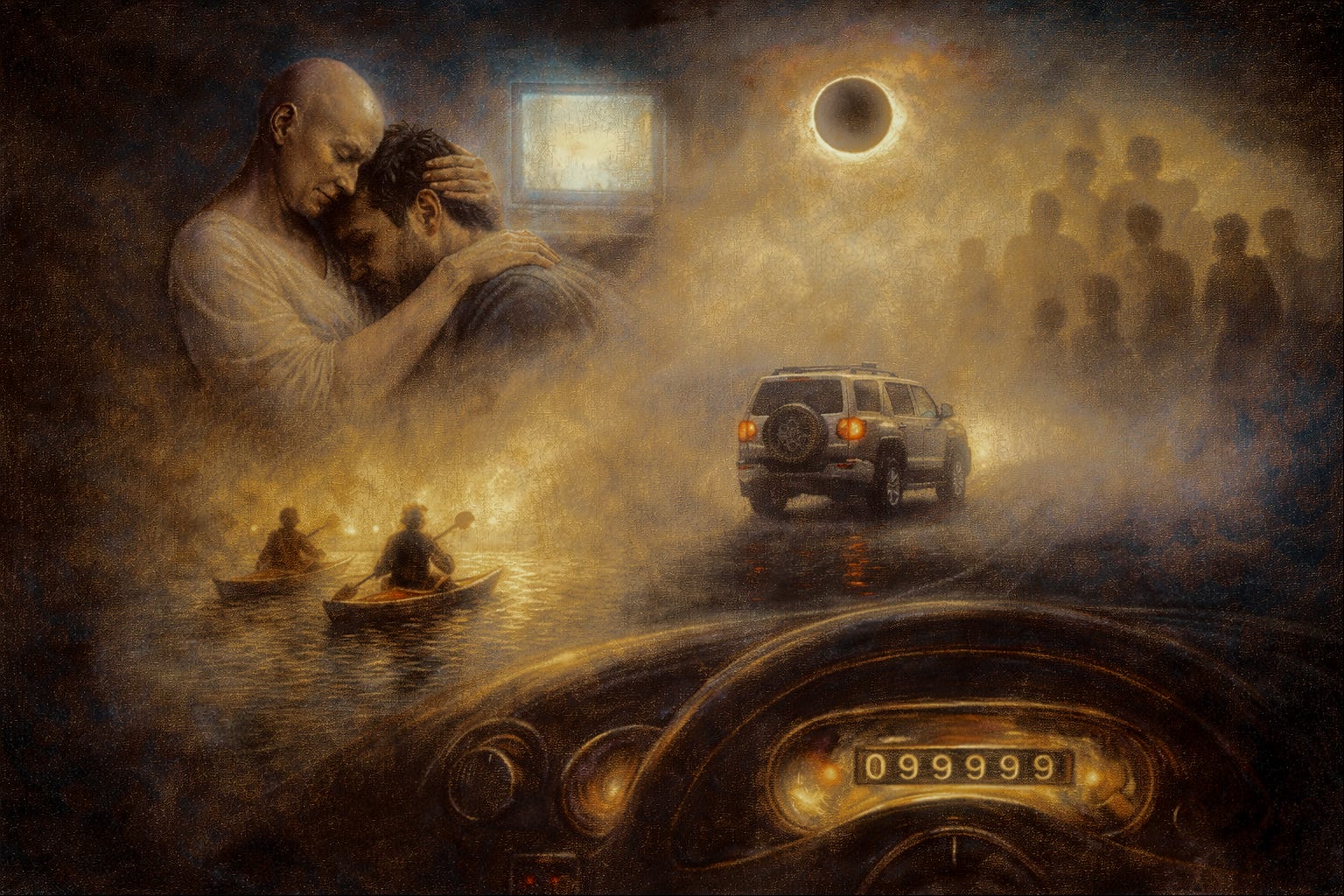
You sit down at your desk on a Thursday morning in Vermont, seventy-three years old, snow outside, coffee going cold — and then you’re not there anymore. You’re in your mother’s bedroom and the television is casting blue light across the sheets and her arm is around you and you can smell her skin. You’re on a lake in the weird half-dark of an eclipse, your best friend’s daughters laughing in a kayak, water dripping off a paddle. You’re in a car on a dark highway with your wife, the silence between you full of everything you both know but haven’t said yet. These aren’t memories. Not the way people usually mean that word. Memories are things you look at from a distance, like photographs under glass. This is different. This is walking through the glass. This is sitting down inside the moment and feeling it close around you like warm water — the sounds, the textures, the quality of light, the exact weight of what you didn’t yet know you were about to lose.
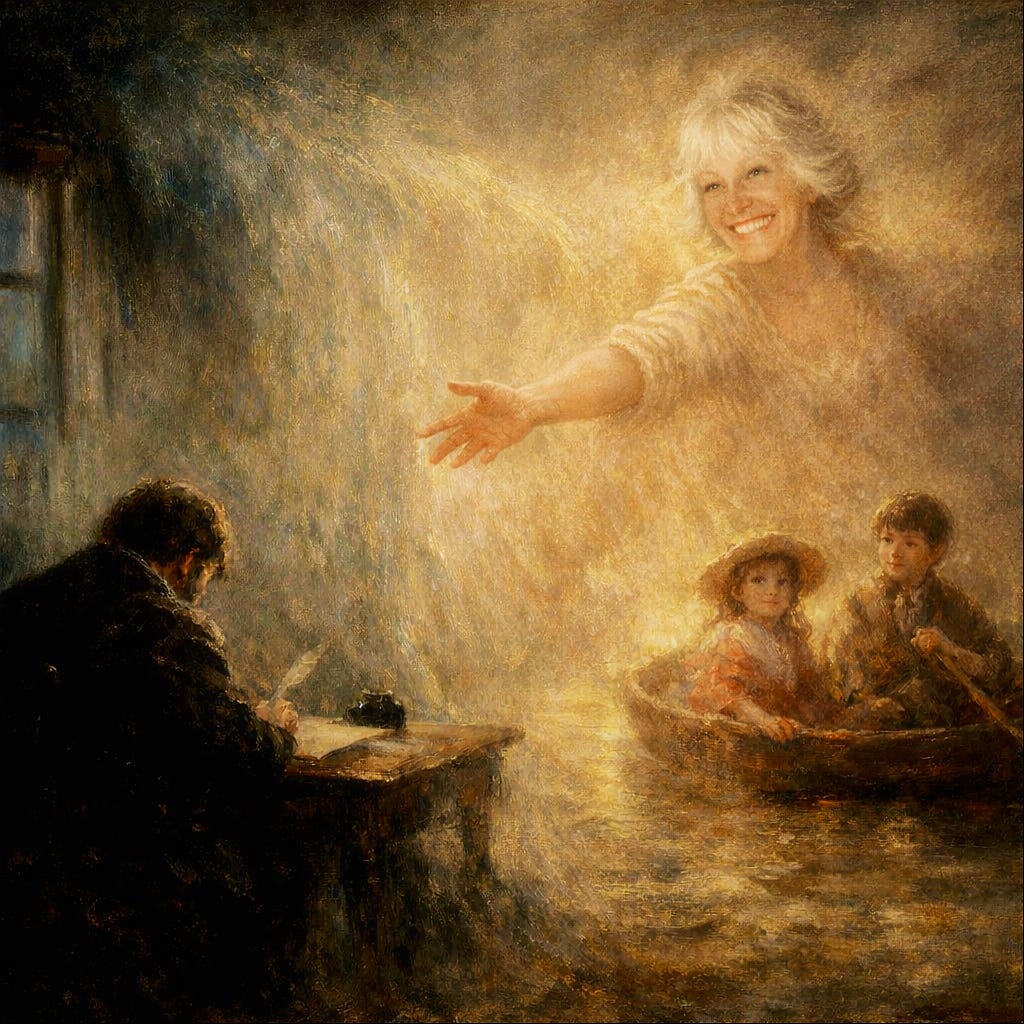
There’s a kind of sacred privilege in that. A grace. The world doesn’t owe us this. Time doesn’t owe us a door back in. But if you’re willing to do the work — the real work, not the pretty version but the honest, unflinching, sometimes brutal work of looking at your life without turning away — something opens. Some membrane between now and then gets thin enough to pass through. And for as long as you can hold it, for as long as the writing sustains that strange communion between who you are and who you were, the odometer stops. The numbers have no power. You are outside the march. You are in the presence of people and places that the calendar insists are gone, and they are not gone. They are right there. Breathing. Waiting for you to come back and finally see them clearly.
There is no finer thing a human being can do, if they want to die in peace, than to write an honest memoir. To revisit it all with an open heart and a spirit of forgiveness — for the people who hurt us, and for ourselves. The numbers only go in one direction. But the writing, if you trust it, takes you everywhere.