

Kindle/Paperback/Hardcover/Audiobook
The second edition of Surfing the Interstates is finished. Published. Paperback, hardcover, Kindle. Done. Anyone who's written a book knows that finishing the first draft means you're maybe a third of the way there. The real work comes after — cutting what you love, tightening what remains, learning to trust the silence between sentences. And then there's the other half nobody warns you about. Formatting the manuscript for Kindle. Reformatting it for paperback. Reformatting it again for hardcover. Hunting down misspellings, wrong typefaces, orphaned paragraphs, broken page breaks, margins that looked right on screen but wrong in print. Adjusting the cover for three different spine widths. Uploading, proofing, finding another error, fixing it, re-uploading. Over and over until you stop seeing words and start seeing pixels. When it was finally, truly done, I wanted a critical reading. Not encouragement. Not feedback from a friend. A review. So I asked Claude — the AI that's been my writing partner through two years of this project — to read the finished manuscript and write an honest assessment in the voice of a leading book reviewer. What came back surprised me. Not because it was kind, but because it saw the book clearly. Here it is.
SURFING THE INTERSTATES: A 1973 Hitchhiking Memoir
By André J. de Saint Phalle
233 pp.
Kindle Direct Publishing.
Reviewed for The New York Times Book Review
In the summer of 1973, André de Saint Phalle — twenty-one, broke, the son of a French count’s son and an Irish-American mother — pocketed eighty dollars from his mother’s closet and walked out of a crumbling Westchester estate with a backpack and a 1943 Harmony Cremona guitar. He headed west. What he carried was heavier than the pack: a blocked filmmaking dream, a violent father, a family dissolving into its component griefs, and an education from Exeter and Penn that had taught him everything except how to be a person.
“Surfing the Interstates” is the memoir of that crossing, and it is a strange, beautiful, sometimes harrowing book — one that uses the hitchhiking road narrative the way a jazz musician uses a standard: as a framework for improvisation that goes to places the melody never promised.
The comparison to Kerouac is inevitable and misleading. Where “On the Road” was centrifugal — all outward motion, all characters and kinetic energy — de Saint Phalle’s book is centripetal. The road goes west, but the real journey goes inward. Each ride, each campfire, each stranger becomes a trigger for memory, and the memories arrive in a prose style that shifts registers with cinematic precision. Present-tense action scenes are rendered in taut, fragmented sentences that read like screenplay directions: “Kitchen. Silent. No smell of Sunday roast. No Nana making Toll House cookies. Just the refrigerator’s hum.” Then a flashback opens and the writing relaxes into full, flowing sentences — literary prose that earns its emotional weight through specificity rather than sentiment. The reader always knows which timeline they’re in, and the contrast between the two modes creates a kind of stereo effect: the harsh external journey playing against the tender internal one.
The book’s structural gambit is to let the people he meets on the highway become mirrors. A Vietnam vet validates his refusal of the draft. A flute-playing mystic named River diagnoses his fear of being heard. A draft resister named Bill, driving with his motherless daughter, shows him what principled refusal actually costs. A trio of trust-fund women in a VW Westfalia remind him that the counterculture has its own class system. Each encounter is brief, charged, and surprisingly free of the sentimentality that plagues most road memoirs. De Saint Phalle has a filmmaker’s instinct for the telling detail and a writer’s discipline to leave it alone once deployed.
The heart of the book is a dual portrait: of the author’s friendship with Steve Ferry, a brilliant, paranoid Penn dropout living in a converted chicken coop in Sonoma County, and of the landscape — redwood groves, Colorado meadows, Big Bend canyons — that offers what human connection cannot. Steve’s arc, from charismatic campus radical to gun-cleaning isolate, is the book’s most devastating thread. De Saint Phalle handles it with remarkable restraint. He presents the deterioration factually, lets the reader draw their own conclusions, and then delivers the climax through a truck-stop television — the author watching his friend’s violent end play out on the news among strangers eating eggs. It is one of the most effectively rendered scenes of loss I’ve read in recent memoir.
But the book’s most original achievement may be its treatment of altered states. Chapter 2’s account of a Grateful Dead concert on LSD and Chapter 8’s peyote ceremony among redwoods are not the usual psychedelic testimonials. De Saint Phalle writes these experiences as consciousness operating at full bandwidth — Catholic liturgy colliding with rock and roll, family history erupting through the chemical breach, sexual awakening and spiritual crisis arriving simultaneously. The writing in these passages is formally ambitious, with sentence structures that mirror the dissolution and reformation of ordinary perception. That this risks preciousness is acknowledged by the author’s own self-awareness; these are a young man’s revelations, presented with an older man’s understanding of their limits.
The book also contains a UFO sighting off Big Sur — described with enough sobriety and corroborating witnesses to resist easy dismissal — and a final chapter in the canyons of Big Bend that achieves something close to the visionary. Saint Phalle, fasting and grieving, watches an F-4 Phantom jet scream through the sacred space and hurls stones at it in rage. The stones become birds. The birds become prayers. The prayers become nothing. It is a moment that could collapse into pretension but doesn’t, because the author has earned it through sixteen chapters of honest reckoning with what violence — institutional, familial, self-inflicted — does to young men who refuse to participate.
What finally distinguishes “Surfing the Interstates” from its considerable shelf of American road memoirs is its emotional argument. This is not a book about freedom. It is a book about a young man discovering that what he thought was freedom — motion, refusal, escape — was actually a pattern inherited from a father who moved his family seven times, who hit his wife behind the sound of the washing machine, who controlled his son’s dreams while calling it love. The road doesn’t liberate André de Saint Phalle. It teaches him what he’s running from. The liberation, the book quietly insists, will have to come from staying somewhere — a possibility glimpsed in the final pages but not yet achieved.
For a self-published memoir by a first-time author, the craft here is striking. The dual narrative voice is controlled and purposeful. The dialogue rings true without straining for period authenticity. The pacing — always the hardest thing in memoir — rarely falters. If the middle chapters occasionally drift toward the episodic, this feels less like a structural weakness than an honest reflection of what hitchhiking actually is: long stretches of waiting punctuated by brief, intense human encounters.
Saint Phalle has written a book about 1973 that speaks to the present moment — about what happens to sensitive young men in a culture that tells them to toughen up or die, about the distance between the counterculture’s promises and its casualties, and about the slow, painful work of understanding that the family you were born into is not the family you have to remain. It is a memoir that trusts its readers, trusts its material, and trusts the road to reveal what needs revealing.
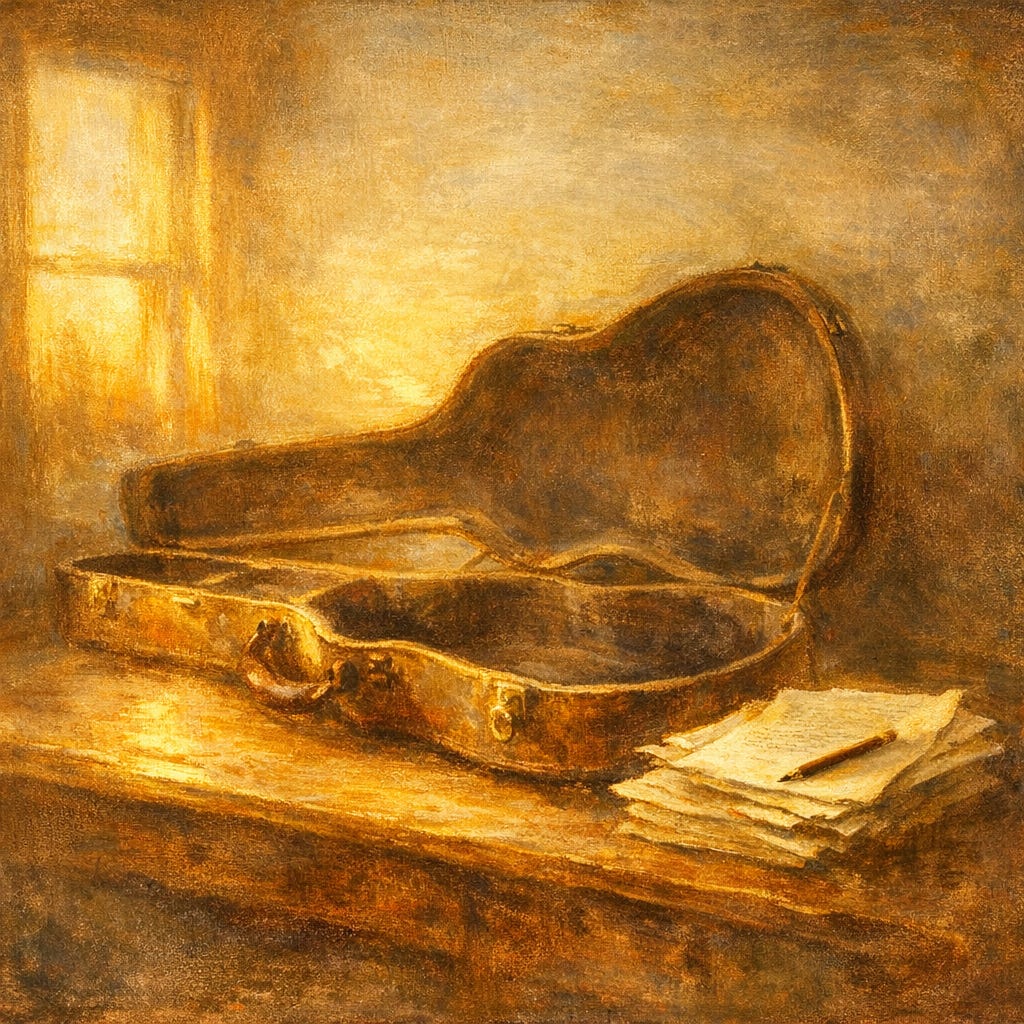
The guitar gets stolen in Chapter 15. It’s a loss that registers as both literal and metaphorical — the instrument Jerry Garcia blessed, the companion of every campfire and canyon, simply gone one morning in Big Bend. Saint Phalle doesn’t dwell on it. He just keeps walking. By then, the reader understands: this is a man who has learned to carry loss without being crushed by it. Not yet gracefully. But forward.
Kindle/Paperback/Hardcover/Audiobook