

It’s been rainy today and I’ve been watching David Lynch.
Not the films, this time. Just him, in a chair, that stiff gray hair, talking the way he talked. And he keeps circling one story.
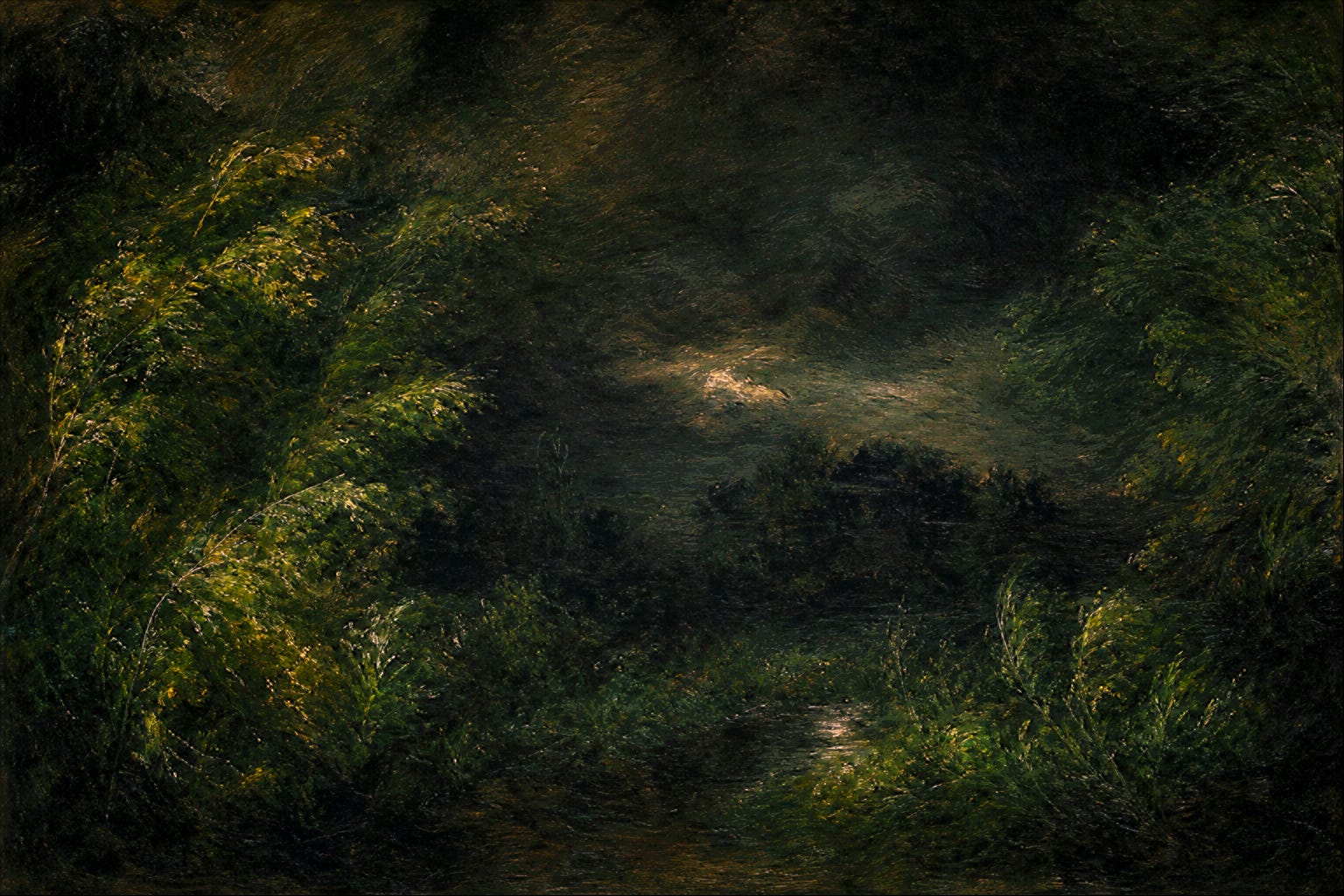
He’s a young man in Philadelphia. A painting student. He’s working on a canvas — a garden at night, mostly black, a little green where the leaves come out of the dark. And he’s sitting there looking at it, and he hears a wind. From inside the painting. And the green starts to move.
Oh, he thinks. A moving painting.
That’s where all of it came from. Eraserhead, the Elephant Man, Blue Velvet, the whole strange body of work. A man looked at a still image and wanted it to move.
He said it different ways his whole life, but it always came down to the same thing. Everything starts with an idea. Or an image. Or a fragment. You don’t invent it. You catch it. He talked about it like fishing — go quiet, wait, feel the tug, pull up whatever’s down there in the dark. And the thing you catch tells you what it wants to be. Your only job is to not scare it off by deciding too early what it means.
I’ve been sitting here all afternoon trying to understand why I can’t stop listening to him. And then I realize — he’s not teaching me anything. He’s reminding me of something I already know. Something a man named Paul Czaja gave me when I was twelve years old.
***
Whitby School. Greenwich, Connecticut. 1965. A Montessori classroom, which meant we weren’t sitting in rows being lectured at. Paul was our teacher, and he had this exercise. He’d bring in photographs — carefully chosen, black and white, images that didn’t explain themselves. And he’d spread them on the table and say: pick one that speaks to you. Look at it. Really look. Then write whatever comes.
No grades. No judgment. No right answer. Just an image and the silence to receive it.
I don’t remember which photograph I picked the first time. What I remember is the feeling — that something opened. A door between seeing and saying that I didn’t know was there. The image didn’t tell me what to write. It waited, the way a patient animal waits, until I was quiet enough to hear what it was carrying. And then the words came, not from me exactly, but through me, as if the photograph had been holding them and I was just the hand that wrote them down.
Paul gave me that. The habit of looking. Of letting images generate words. Of trusting the spaces between seeing and saying. That exercise opened something in me that nothing since — not Exeter, not Penn, not New York, not over half a century of living — managed to close entirely.
I just didn’t know, sitting there at twelve, that he was teaching me how to fish.
***
I learned a different kind of fishing first.
There’s a scene early in my book Thumb Out. I’m twenty-one, walking down the mile-long dirt road away from the house I grew up in, leaving for good, a pack on my back and a guitar in my hand. And the sight of the old aqueduct toward Byram Lake brings my father back to me — taking us fishing when we were boys.
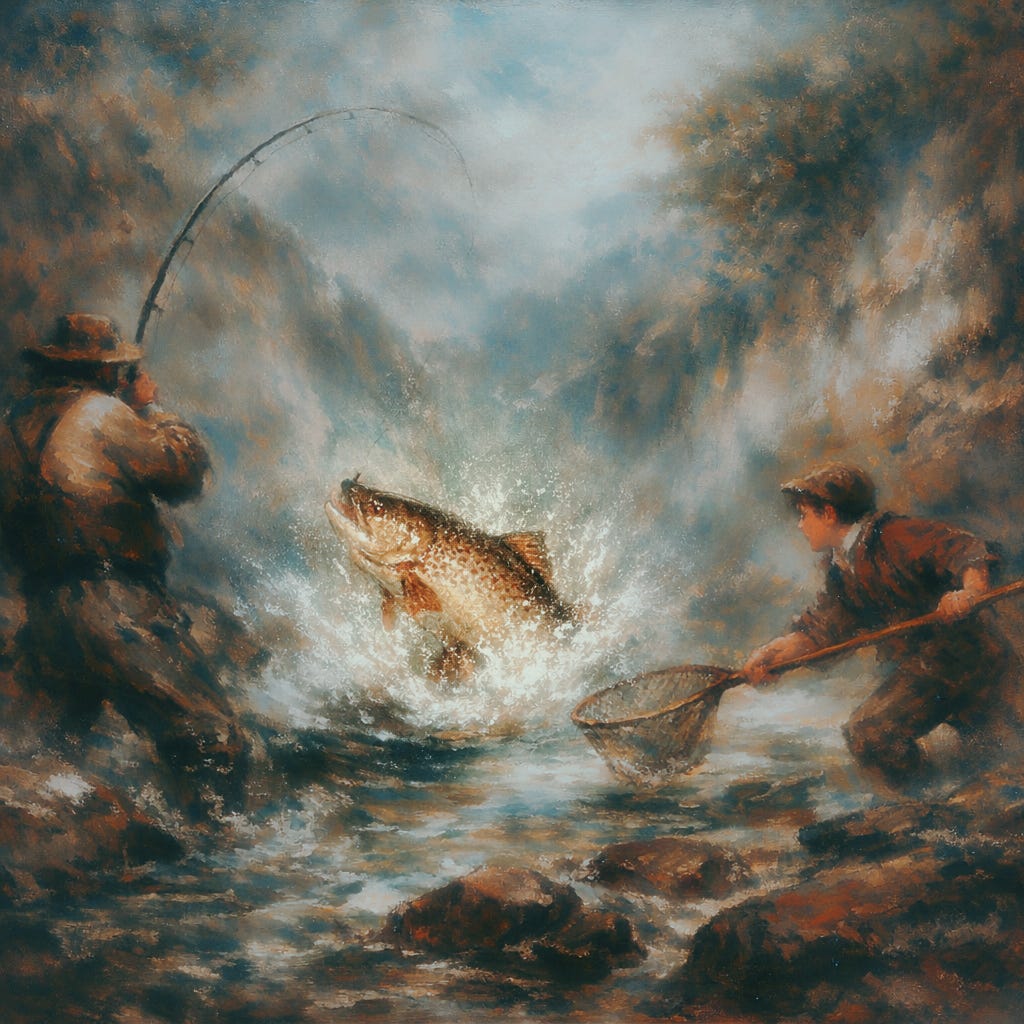
I see him hook a brown trout in the Mianus River Gorge. Big one. He’s yelling for the net. And the fish throws the hook and is gone in an instant — sun flashing on its impossible speckles, and then nothing. And my father turns and scowls and blames me for the loss.
That was the other fishing. Catching as winning. A fish in the water is a fish you’re owed, and a fish that gets away is somebody’s fault. My father had to win — at chess, at cards, at war games, at the inheritance, at fishing. He could not lose a trout without it being a wound, and he could not let the wound be his.
Two men. Two kinds of instruction. Paul said: look at the image, be quiet, let it come. My father said: grab it, net it, and if it gets away, someone’s going to answer for it.
I’ve spent most of my life in the spaces between those two instructions.
***
When I was seventeen — 1969 — I made a Super 8mm film I called “463-4357.” A boy in a glass phone booth having a nervous breakdown, trying to call God. The title was the phone number you'd get if you dialed the words “GOD-HELP.” I got my effect by spinning the camera around the booth — all that glass turning, reflections swirling like mirages, the boy multiplying and fracturing inside the box.
I didn’t design that. The image arrived — a boy in glass, spinning, dialing a number that couldn’t connect — and I trusted it and shot it. Paul’s exercise, without my knowing it. Pick the image that speaks to you. Let whatever comes, come. It won the Ralph Bradley prize that year. I was seventeen and I’d caught something and I didn’t know what.
A few years later I landed at the University of Pennsylvania — the same city, it turns out, where Lynch’s painting moved. I didn’t want to be there. Ended up there anyway, against all odds and most of my wishes, but it gave me the Grateful Dead and it gave me a film course taught by a man named Rudy Burckhardt. I didn’t know who he was at the time. Turned out he was the real article — came out of New York in the thirties, ran with the painters and poets, made quiet watchful little films about the city.
We never shot anything in that class. We just talked. And while I was in it, I started writing a script. I called it Sasha. It was about a girl who could talk to trees — really talk to them, hear what they were thinking. I never finished it. Dropped out. The script went in a drawer the way most things go in a drawer.
***
Five years after making “463-4357” I stuck out my thumb and hitchhiked from New York to California and back. Seven thousand miles. That trip became Thumb Out, which is finished and out in the world, so I won’t retell it here. But I need to put some things side by side, because putting things side by side is what a memoir writer does. It’s the prerogative — the creative braiding of real fragments into something truer than chronology.
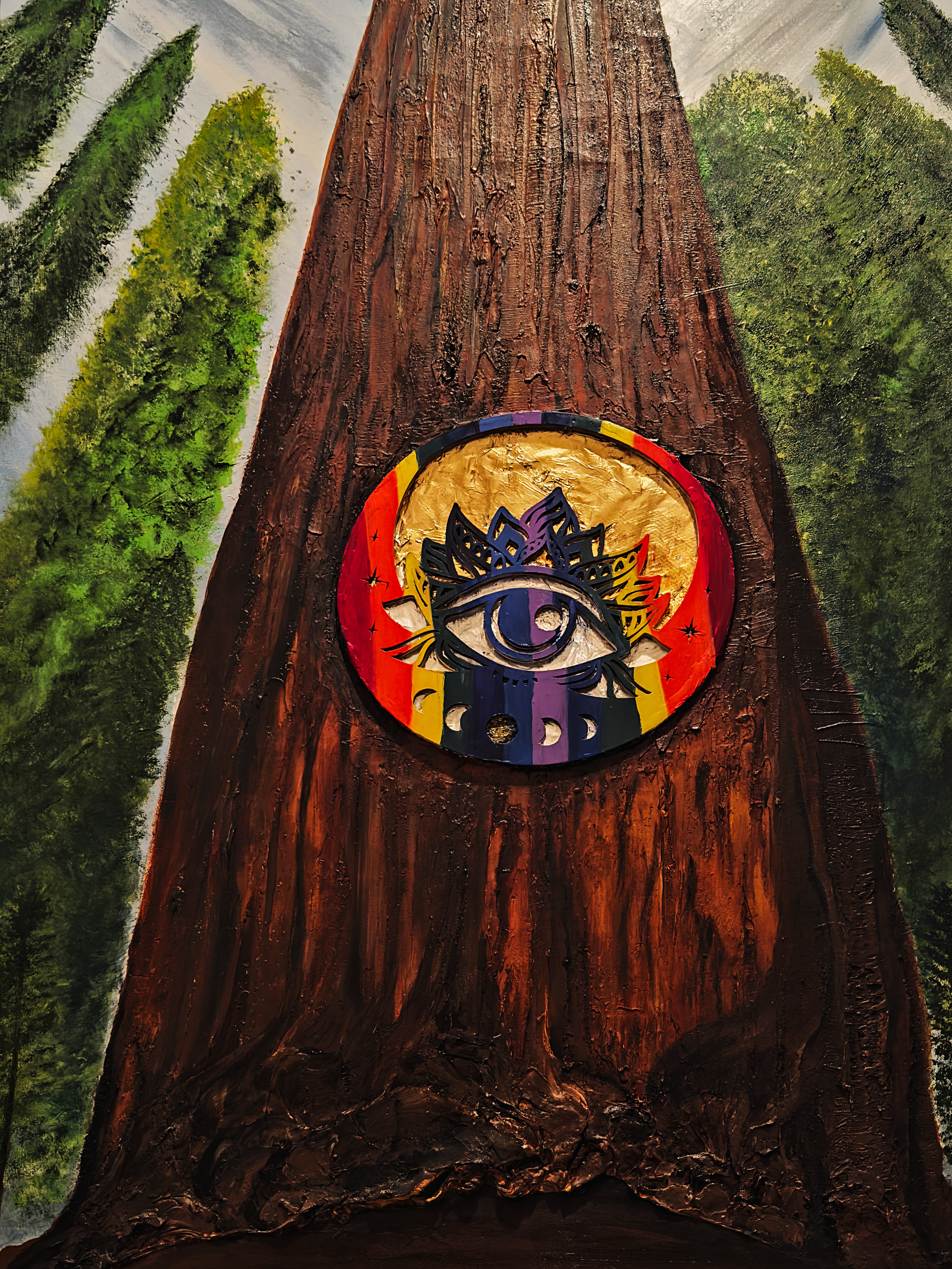
Here’s what happened— I spent days alone in a redwood grove along the Eel River during the summer of 1973. Swam in water so cold it erased everything but now. Slept on pine needles. Sat with my back against bark older than Christ and let the silence work on me until the forest started to breathe.
I took peyote among two-thousand-year-old trees.
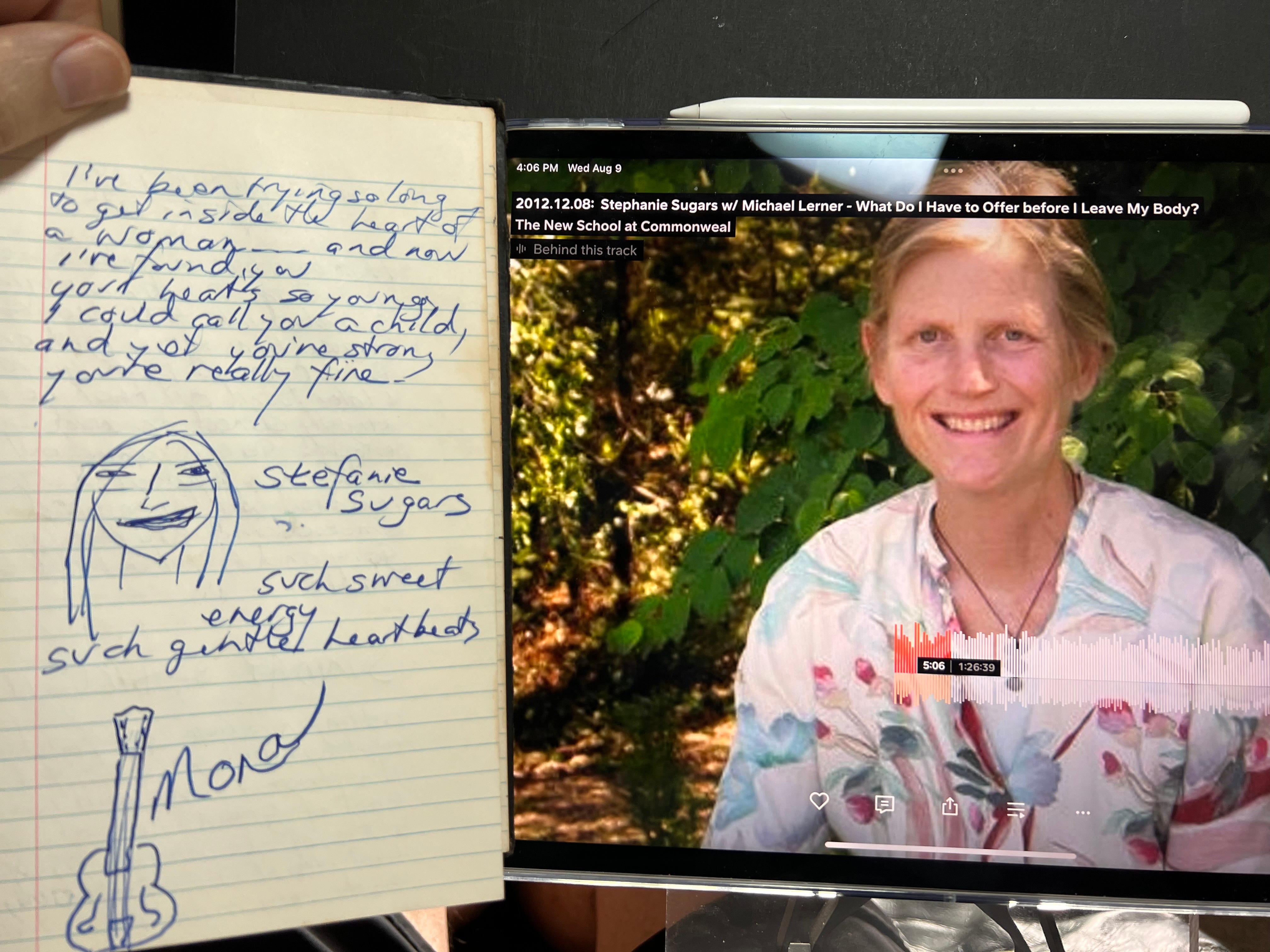
At a vineyard party in Healdsburg a week earlier, I met a girl named Stephanie Sugars. We talked, we laughed, we kissed. I was twenty-one and taken with her. She wrote her address in the notebook I carried, and before that, sitting there, I drew her. Her face, her long hair, her wide-open smile. Out of seven thousand miles and every face I met, she’s the only person I drew. And under the drawing I started writing her a song: such sweet energy, such gentle heartbeats.
I tried to find her afterward and couldn’t. Never saw her again.
And three years earlier at Penn, the unfinished script — Sasha, the girl who talked to trees.
Four fragments. Four separate catches from different waters. A script, a girl, a grove, and the medicine. None of them happened together. They lived in different pockets of the trip, different pockets of my life.
When I sat down to write the chapter called “Sasha Among the Giants” fifty years later, I braided them into one scene. The fictional girl and the real girl became one character. The grove and the medicine became the setting where she appeared. The unfinished script became the recognition — I know you, I wrote you before I met you. The memoir fused what life had kept apart, the way Paul Czaja’s exercise let a photograph generate a story that wasn’t literally in the image but was truer than the image alone.
And I gave the scene a line that has become the truest thing I think I’ve ever written:
She was never meant to be possessed. Just witnessed.
That’s the patient kind of fishing, set down in plain words. You don’t grab. You don’t net. You witness, and you let go, and the letting go is not the loss — it’s the form the keeping takes.
***
In 2023, starting to work on my 1973 hitchhiking memoir, I went looking for the real Stephanie. And here is where the still drawing began to move.
She was gone — died in 2016, in Sonoma County, sixty years old, at home, surrounded by the friends she called her Circle of Care. A quiet, potent lesbian activist. A writer. She’d lived with breast cancer since 1990 — twenty-six years — and the people who loved her said she defied all odds, and she did.
And she talked to trees.
Not as a figure of speech. Docent work at a nature preserve. Her last years on a small farm in Kenwood. Rudolf Steiner’s anthroposophy — a way of moving through the world that treats nature and spirit as kin. In her own writing she said it flat out: nature, ideas, art, beauty, the dead, the divine and spirit were her friends. She’d spent her whole life learning to belong to the land instead of owning it.
I invented Sasha in 1970. I drew Stephanie in 1973. I braided them into one character in 2025 and gave that character a philosophy of witnessing instead of possessing. And only afterward did I find out that the real woman had been living that exact philosophy the whole time, out on a farm in Kenwood, until the year cancer finally took her.
I wrote the truth about her before I knew it was true.
I wrote to her niece. Told her the story, sent the drawing. She never wrote back. And that’s the right ending, the honest one — no tidy circle, no reunion. The thumb stays out and that particular car doesn’t stop. Just the drawing, the obituary, and the unanswered letter, sitting next to each other on the table.
***
Nine years after Paul Czaja taught me the photograph exercise, he became headmaster at Whitby and hired me as a teaching assistant. I found myself standing in his old classroom with his old photographs spread on the table, saying the words he’d said to me: pick one that speaks to you.
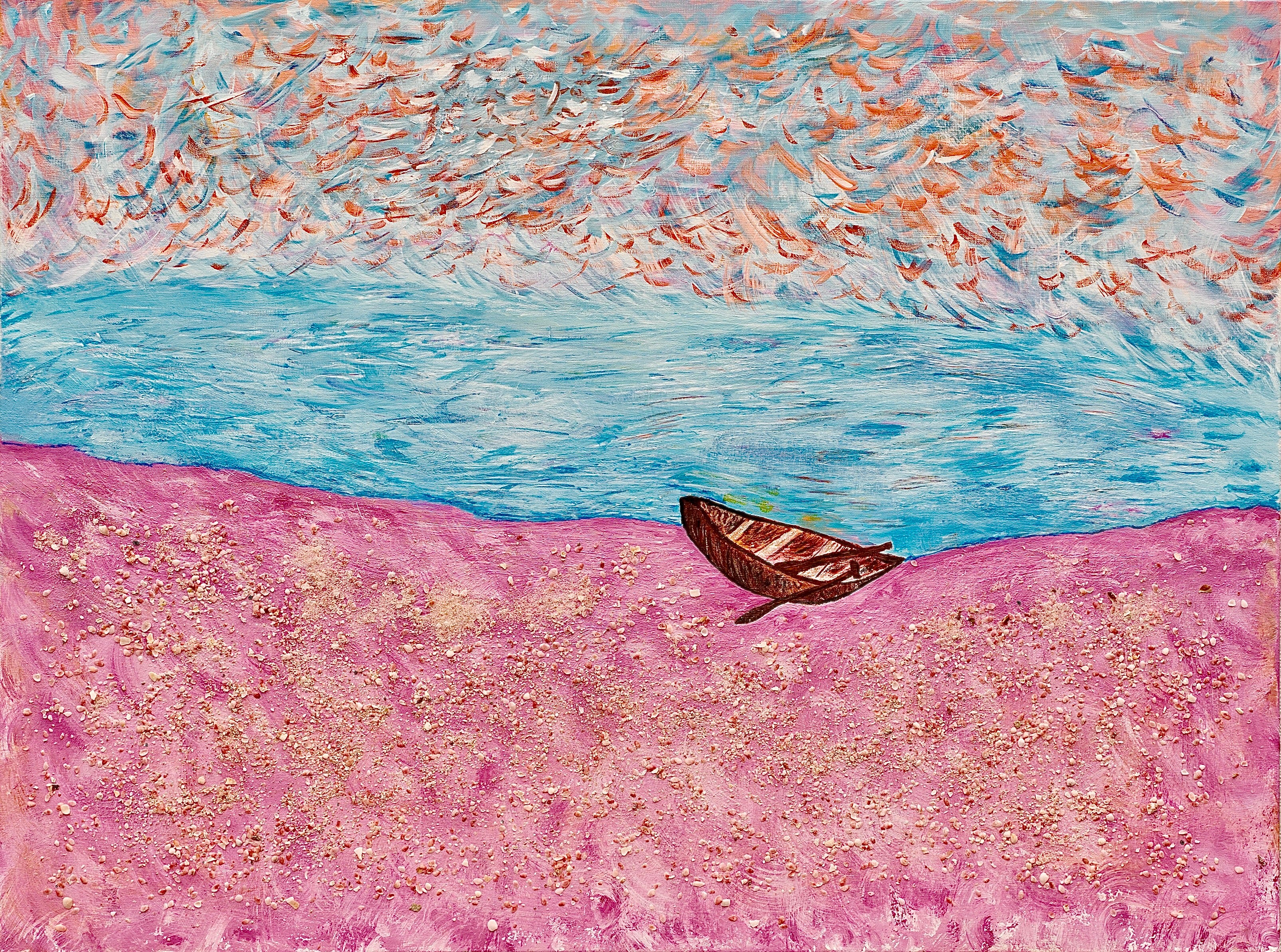
A boy held up a picture of an empty rowboat on a misty lake. “I don’t know what to write,” he said.
“What do you see?”
“A boat.”
“What else?”
He studied the image. “Maybe someone just left? Or maybe they’re about to come back?”
“Write about that,” I told him. “Write about the person who isn’t there.”
I didn’t understand then what I was teaching him. I do now.
Write about the person who isn’t there. That’s Stephanie Sugars. That’s a girl I drew in a notebook and lost for fifty years. That’s a woman who died on a farm in Kenwood three years before I finally went looking for her. That’s an empty rowboat on a misty lake — someone just left, or maybe they’re about to come back. Every chapter I’ve ever written has been about the person who isn’t there. And Paul Czaja handed me that instruction when I was twelve years old, standing in a classroom in Greenwich, Connecticut, looking at a photograph and waiting for the words to come.
***
Here’s what I keep turning over.
My father hooked a brown trout and yelled for the net and lost it and it was gone forever, because the only way he knew to keep a thing was to take it.
I drew a girl in a notebook and didn’t even have her phone number and let her go entirely — and fifty years later she came back to me whole. Came back as a whole life I got to witness, the way you witness a painting that’s started, finally, to move.
Two kinds of fishing. The kind you’re taught and the kind you have to learn. The netted fish lost forever; the released girl returned entire. My father couldn’t have caught Stephanie. He’d have grabbed, and she’d have thrown the hook. I caught her by not trying to.
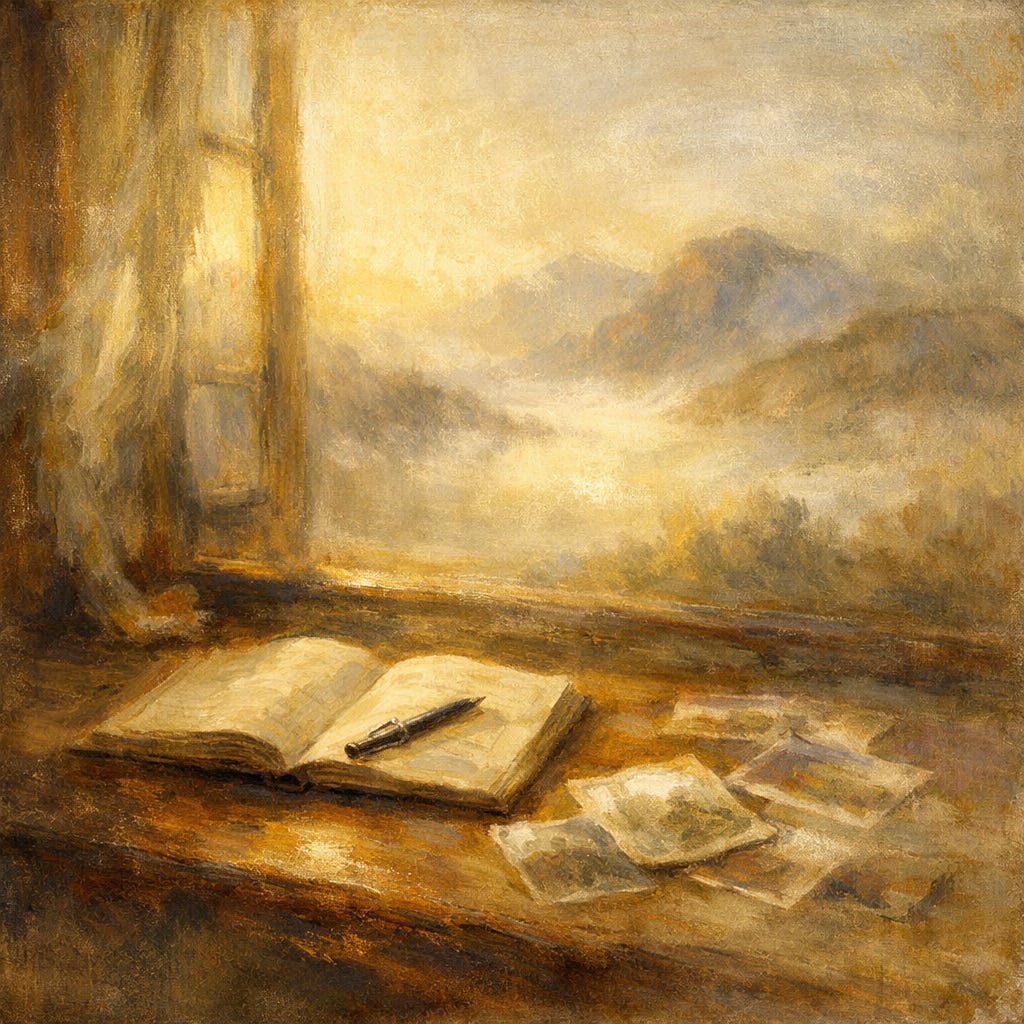
I’m writing Book Two now. Sahara Dust — the windsurfing years, the Caribbean, the woman I loved and the way it ended. And it does end. The book moves toward a death I can’t fish my way around, the biggest fish in the water, the one everything in me wants to net and hold and refuse to lose.
I know which kind of fishing my father gave me. I can feel it pulling, the old urge to grab the ending and win it.
But I’ve been watching David Lynch talk on a rainy afternoon. And I’ve got a drawing on my desk that took fifty years to move. And I’ve got Paul Czaja’s voice in my ear, quiet as it ever was, saying: look at it, really look, and write whatever comes.
She was never meant to be possessed. Just witnessed.
I think I finally know who taught me that. Both of them. It only took me a lifetime to hear it.
“Thumb Out” Book One of my memoir trilogy “The Spaces Between” is available now
e-book ~ kindle ~ paperback ~ hardcover ~ signed paperback