

subscribe ~ e-book ~ kindle/paperback/hardcover ~ table of contents

The biggest film I ever made, I made when I was seventeen.
And then I stopped doing it. Not because I lost interest but because somewhere along the way I absorbed the idea that the path to becoming a filmmaker — a real one, like Peter Fonda, whose Easy Rider had rewired my brain — ran through college. Get the degree, get the credential, get the career. My father’s programming, not mine, but I’d swallowed it whole. Everything that followed was me chasing a credential for something I’d already proven I could do.
* * *
The Maddens were wonderful. Claude was my father’s cousin, and she and her husband took me in like a son when I arrived in Palo Alto in early 1974. I got to know their children. They were generous, warm, genuinely helpful. But I stayed only a month or so before finding my own place down in East Palo Alto — a cheap apartment in the poor part of town. I enrolled at Foothill College and took a course in filmmaking, which is where I met Cathy Coker. Imagine Chrissie Hynde at eighteen with blonde hair — bold, brassy, charismatic, sexy in a harsh almost masculine way. Every boy in the class was mesmerized. She kept all of us at bay. I don’t remember a single thing we studied. I just remember her.
I realized fairly quickly that I needed to be in San Francisco, and so I started looking for work up there. I landed a job at Adolf Gasser, Inc. — a camera and film equipment dealer with two locations. They started me at the downtown store, which catered to professional filmmakers. We sold and rented 16mm and 35mm equipment — cameras, lenses, projectors, editing gear. I met my friend Randy there, and we eventually became roommates to save on rent. After a while they transferred me out to the original store on Geary Boulevard, which was more aimed at photographers. This is where Ansel Adams would come in periodically, the store’s most famous patron. I was positioned as assistant to Bob Price, who ran the movie room in the back, which was packed floor to ceiling with Super 8 and 16mm cameras and projectors and lenses.
One afternoon I was alone in the movie room when Jerry Garcia walked in. I’d met him briefly three years earlier in San Rafael when he played my 1943 Harmony Cremona and told me to let it guide me. He bought a Super 8 projector, and we got to talking about film. He was genuinely enthusiastic — he wanted to make films, loved the medium, and we stood there in that cramped back room going back and forth about cameras and what film could do. A few days later his publicist called and arranged for me to shoot on stage with my Super 8 during a show. Standing on stage filming the Grateful Dead — that was probably the high point of my entire time in the Bay Area.
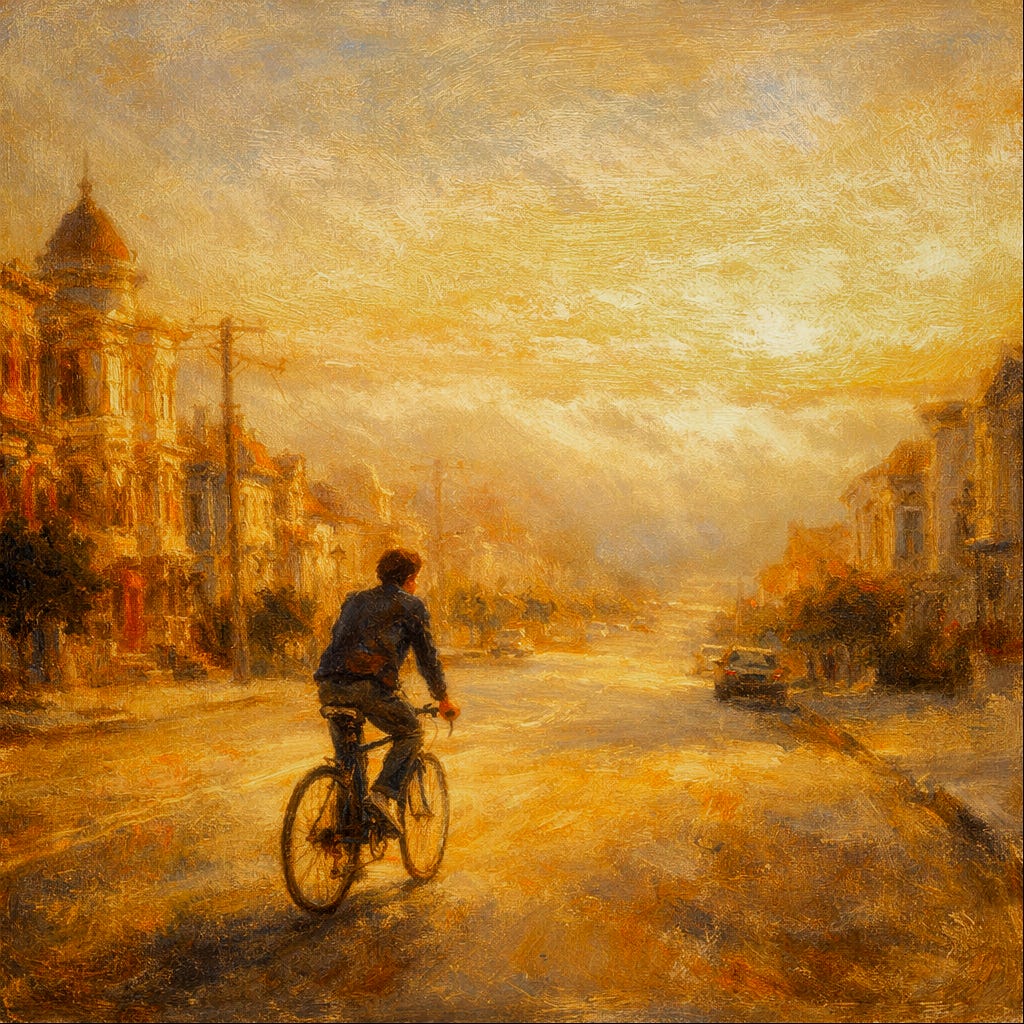
I found a tiny house just around the corner from the Geary store — not an apartment but an actual small house hidden inside a courtyard behind an apartment building. The bakery was less than a block from my door, and the store was just around the corner from that. Every morning I’d walk to the bakery — a glazed, an old-fashioned, and a large black coffee — then walk to work. The ten-speed was for getting to SF State, about twenty minutes each way.
San Francisco in the mid-seventies was a wonderful city. Clean, friendly, the fresh sea breeze off the Pacific, the fog rolling in through the avenues in the late afternoon. People were nice. The city still had a human scale to it — you could live on what a camera store paid, rent a little house, ride your bike to school, and feel like you belonged somewhere. It was the most positive stretch of those years, even with the grind.
I used my Basic Educational Opportunity Grant — all eight hundred dollars of it — to buy a Guild acoustic guitar. I still played for fun, but music had become a hobby by then, no longer a path. I kept that Guild for twenty-six years until it was stolen from my house in Vermont in 2001. I saw the Dead play live a few times during this stretch, including that time they opened for The Who at Oakland Coliseum. That was my social life, more or less.
* * *
The frustration at SF State was the same frustration I’d had at Penn and at Foothill. We never made any films. Everything was theoretical. There was a course on the sociology of film — what studying movies from different eras could tell us about the societies that produced them. Interesting, but not what I was there for. Two mandatory semesters of U.S. history, where the professor told me I should become a historian because I was so good at writing and conceptualizing. An animation course that turned out to be mostly about drawing. I was obsessed with cameras and editing and cutting film and splicing it together and working with sound, and I wasn’t doing any of it. I was talking about filmmaking instead of learning the craft.
Meanwhile, the real world kept delivering its own education.
A guy who worked with us at Gasser’s on Geary got a job with a TV station and ended up going to Jonestown. He was killed at the airstrip during the massacre. I’d stood next to him behind the counter.
There was a customer who came in regularly to buy old Bell & Howell crank cameras — the kind they used in World War II. He was a stringer for the local TV channels, kept a police scanner running, and would race to crime scenes to shoot footage he’d sell to the stations. He asked me if I wanted to ride along one day, and I said yes. There was a shooting. We ended up at the scene — a tidy little house in the Sunset District, and there in the front yard, face down, was a bald man of about fifty, his head blue, bleeding out. I stood there with a camera and understood something about the distance between studying film and standing in front of what film is actually made of.
There was Jim, one of the most charming fast-talking bullshit artists I’ve ever encountered, who turned out to be making amateur porno films in his apartment. I didn’t realize this until the day I was over there and he announced they were about to shoot. I left.
* * *
And there were the women who appeared and vanished.
I met a girl at a company softball picnic — attractive, warm, we were starting to go out. Then she was brutally raped by two Black men. I visited her in the hospital. I never saw her again.
There was another girl I was drawn to, but it turned out she was also dating Kenny Loggins. That was a hard compete.
The drought that had started after the hitchhiking trip continued. I was twenty-three, twenty-four, twenty-five, working sixty-hour weeks between Gasser’s and SF State, and the loneliness was a physical thing. I didn’t know it yet, but I had five more years of it ahead of me.
I got roped into running the annual Bay to Breakers race — six and a half miles, which was about six miles more than I’d ever run in my life. I wore blisters into my feet and the polyester mesh Gasser’s T-shirt rubbed my nipples raw. I crossed the finish line bleeding in two places and wondering why anyone did this voluntarily.
But it was Phil Radin who changed the trajectory. Phil had left Gasser’s for Los Angeles and landed a job at Panavision. He kept calling — come on down, the water’s fine. The film business was in LA, not San Francisco. I knew he was right. I’d known it for a while.
The pull south was strong. The grind in San Francisco had taught me how to work, how to survive on no sleep and bad coffee and bakery doughnuts, how to keep showing up. But it hadn’t gotten me any closer to making films. The theoretical world of SF State was a dead end. The real education had happened at Gasser’s — handling equipment, talking to professionals, learning what the tools could do. And now the tools were telling me to go to Los Angeles.
Randy was game. Phil had a couch. I gave notice at the store, packed what I had, and headed south.
