

subscribe ~ e-book ~ kindle/paperback/hardcover ~ table of contents

The editors walked around like movie stars.
Golden tans. Open silk shirts unbuttoned to the sternum. Massive gold chains catching the fluorescent light — and sometimes, hanging from those chains, a razor blade pendant. An actual razor blade, gold-plated, dangling against a tanned chest. It was the symbol of the craft — editors cut film with razor blades, spliced it with tape, built the illusion frame by frame. But the pendant wasn’t about the craft. It was about the swagger. These men had turned a technical skill into a lifestyle, and the lifestyle had almost nothing to do with film.
They drank at lunch. They did cocaine in their offices. They carried on like gods of a very small kingdom, and the apprentices — six of us in the ready room, the lowest creatures in the ecosystem — watched them and started to imitate them, the way young men do when they’re trying to figure out what success looks like and the only models available are deeply flawed.
Three-margarita lunches became routine. We’d walk to a Mexican place near the lot, order the first round before the menus arrived, and by the third round nobody was reading anything. The drunkest person — and there was always a competition for that distinction — would be delivered back to the studio and installed in a La-Z-Boy that someone had hidden in the back of the shipping department, behind the filing cabinets, where the supervisors never went. He’d sleep it off for two hours while the rest of us covered his deliveries. Then he’d wake up, splash water on his face, and clock out at five like nothing had happened.
One of the regulars at those lunches was a guy I’ll call Rick. He kept an aquarium of piranhas in his apartment. Full setup — big tank, aggressive lighting, the fish hovering in the water like little engines of destruction. His favorite thing was feeding them live feeder fish from the pet store. He’d drop one in and watch the piranhas tear it apart. He talked about it at lunch the way other people talked about their dogs.
Rick also loved cocaine. Loved it openly, enthusiastically, without apology. He’d offer it around like it was a bowl of chips. I’d already learned how dangerous that road was — I’d seen what it did to people in college — and I wanted no part of it. Rick thought I was square. I thought Rick was going to end up dead or in prison. We left it at that.
* * *
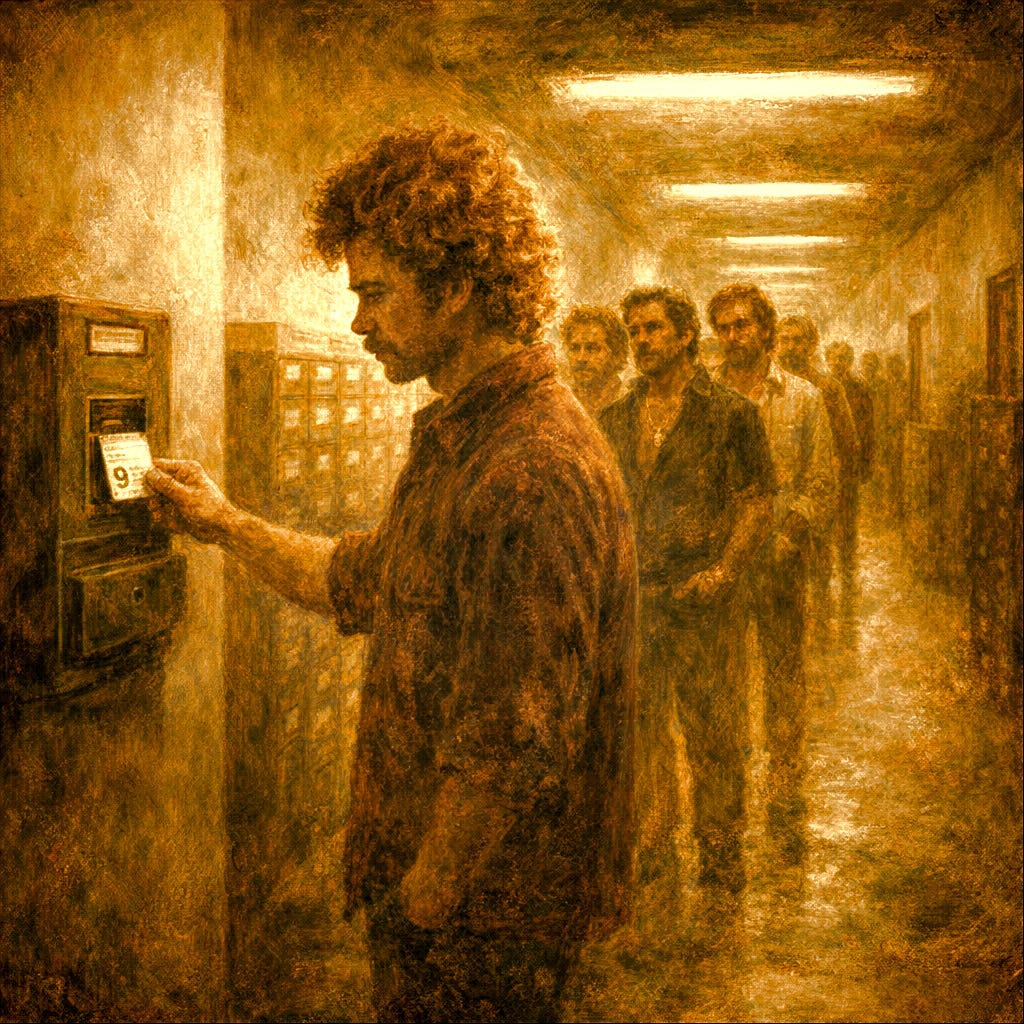
The punch clock was its own art form.
Everyone was supposed to clock in by a certain time. Late arrival meant lost pay and potential disciplinary action. The clock stamped the time on a card — hour, minutes — in ink. Workers discovered that white editorial tape, the same tape used to splice film, could be carefully applied over the minute digits on the time card. You’d cover the late minutes, wait until the next hour rolled around, and then cover the hour digit too — creating a pristine, doctored on-time entry. It was fraud. It was also universal. Everybody did it. The supervisors either didn’t know or didn’t care, and over time it became so routine that people would doctor their cards right out in the open, like tying their shoes.
I watched this happen every morning and thought: this is what the dream looks like from the inside. A building full of people whose primary creative act is falsifying a time card.
* * *
The money was the real religion.
Twelve dollars an hour base. That was my rate as an apprentice, and it was the most I’d ever made in my life. But the editors — the established ones, with their gold chains and their razor blade pendants — they’d figured out the system. And at Universal, the system was the money.
The union contract said workers couldn’t go more than four hours without a meal break. Miss the break, and the studio went into meal penalty — fifteen dollars per half hour, on top of the base rate. Overtime was double pay. So a looping session that ran past dinner could mean twenty-four dollars an hour plus thirty dollars an hour in meal penalty. Forty-two dollars an hour. In 1978 that was extraordinary money, and the editors talked about it the way other people talked about art or love or the meaning of life.
The whole culture was organized around maximizing penalty time. You wanted the late session. You wanted the call that said stay another four hours. You wanted the weekend shoot that kicked in double-time-and-a-half. The creative work — the actual cutting of film, the building of scenes, the assembly of a story — was something that happened almost incidentally, like a byproduct of the money system. Nobody sat around the commissary discussing the rhythm of a scene or the emotional arc of an episode. They discussed meal penalty math. They discussed overtime rates. They discussed which shows ran late and which dubbing stages were booked on weekends.
I’d come to Universal because I wanted to make films. I was learning that the people who worked there wanted to make money. These were not the same thing, and the gap between them was the gap between everything I’d imagined and everything that was real.
* * *
Occasionally the head of the sound department would pick an apprentice to stay late for an ADR looping session. ADR — Automatic Dialogue Replacement — was what happened when a line of dialogue had problems in the original production recording. Background noise, a flubbed word, a director’s change of mind. The actor would come into a recording booth, listen to the original line through headphones, and re-record it.
The head of the sound department looked like a cross between Dracula and an accountant. Tall, thin, pale, humorless. He’d walk through the ready room and point at one of us — you, tonight — and that was that. You stayed.
The apprentice’s job was to make an infinity loop out of 35mm magnetic film. You’d take the section with the problematic line, splice the ends together, and thread it through the playback machine so it would loop continuously. The actor in the booth would hear the line, then have an exact period of silence to re-record it. Over and over, until they got a take the director liked. Then an ADR editor would cut in the new line.
My job was to be there in case the loop broke. Mag film was fragile — the splice could pop, the film could snap, and if it did, the session stopped until someone re-spliced it. That someone was supposed to be me.
In all the looping sessions I attended — and there were several — the loop never broke. Not once. I sat in the dark room watching the film go around and around, listening to an actor say the same line thirty times, and never once had to do the one thing I was there to do. I was being paid overtime and meal penalty to watch a loop not break.
That was my career in film.
* * *
They promoted me to assistant editor. Which sounds like progress until you learn where they put me.
I had to deliver an envelope to the Black Tower one afternoon. The Black Tower was the executive office building — a dark glass monolith where MCA Universal’s top brass sat behind closed doors deciding what got made, what got killed, what got the budget and what got the axe. You didn’t go to the Black Tower unless you were sent, and you didn’t linger.
I got in the elevator. Sid Sheinberg was already inside. Sheinberg was the president of MCA — Lew Wasserman’s right hand, one of the most powerful men in Hollywood. He was talking with someone, and I don’t know what possessed me, but I added my two cents. I said something — I don’t remember what, probably an opinion about something I had no business having an opinion about.
The stare I got could have curdled milk.
I delivered the envelope and went back to the ready room and didn’t think much of it. But not long after that, I was promoted to assistant editor and simultaneously moved off the lot entirely. My new office was in a motel across the street — a regular motel where Universal had rented rooms as overflow workspace. One day you’re inside the gates. The next day you’re sitting in a converted motel room on Lankershim Boulevard watching traffic.
I can’t prove Sheinberg had anything to do with it. Maybe it was just the natural flow of assignments. But the timing was interesting, and in Hollywood, where everything is political and nothing is accidental, interesting timing usually means something.
* * *
At the motel I worked for a guy named Tony Sanchez, who reported to Harry Tatelman, a high-level vice president on TV conversion products. The job was reformatting theatrical films for network television broadcast — adjusting the picture for the smaller screen, re-editing for commercial breaks, and most importantly, sanitizing everything the networks wouldn’t air. This was before cable changed the rules. Network TV in the late seventies had strict standards about language, violence, and nudity, and a theatrical film that had played to packed houses with an R rating had to be scrubbed clean before it could air on ABC.
One of our projects was American Graffiti.
George Lucas’s film — the one that launched a thousand nostalgias, the one that made Richard Dreyfuss a star, the one that captured a very specific moment in American innocence — had to have every piece of profanity removed for network broadcast. The original actors came in to re-voice their sanitized lines. A woman writer, reportedly his girlfriend at the time, was hired to rewrite the offending dialogue. Rumor had it that she was paid over a hundred thousand dollars.
Her crowning achievement was a scene in a packed car where, in the original, someone says “Hey, who farted?” For network television, this became: “Hey, when do we eat?”
A hundred thousand dollars to change “who farted” to “when do we eat.” That was the film industry. This was not what I’d been chasing since I was seventeen. This was about as far away from Ingmar Bergman’s film “Persona” as one could get.
During the American Graffiti sessions I met Wolfman Jack. He came in to re-record some of his DJ bits and was exactly what you’d expect — big personality, big voice, a man built entirely for the microphone.
And I met Richard Dreyfuss.
Dreyfuss was different from every other famous person I’d encountered at Universal. He looked at me. He talked to me. He asked me questions — not perfunctory ones, but real questions, like he was interested in who I was and what I was doing there. He treated me like a person, which sounds like a low bar until you’ve spent two years in a place where nobody sees you. Dreyfuss saw me. That was so unusual, so startling, that it’s the single clearest memory I have from my entire time at that studio. Not the Foley stage, not Cary Grant, not Sinatra. Dreyfuss, sitting in a chair in a motel room on Lankershim Boulevard, talking to me like I mattered.
Forty-eight years later, that’s what I remember.
* * *
There were two other people I saw on the lot during those years — not encounters exactly, more like sightings. Moments where you lock eyes with someone from a distance and something passes between you, some flicker of mutual recognition, and then you keep walking.
Tom Petty was one. He was on the lot for something — a recording session, a meeting, I don’t know. Young, thin, that long hair, that face that looked like it had been carved out of Florida swamp wood. We locked eyes for a second. He was nobody yet — or rather, he was about to be everybody. He was on the cusp. You could feel it on him the way you can feel a storm coming. Within a year or two he’d be one of the biggest rock stars in America. I remember thinking to myself, “You’ll never come close to Bob Dylan.” But he certainly became Tom Petty, and I still treasure his music to this day.
John Belushi was the other. Also on the lot, having just wrapped up production on Animal House. That coiled energy, that sense of a man vibrating at a frequency slightly too high for the room he was in. We exchanged a look. He received my positive energy with a wry smile. He was right on the edge of enormous fame — Saturday Night Live had already made him a household name. He radiated something dangerous and alive. He still makes me laugh and cry at the same time.
I saw both of these men at the exact moment the fuse was lit. Both were young, burning with talent, about to explode into the culture. And both would be destroyed by drugs. Belushi dead at thirty-three — speedball overdose at the Chateau Marmont, 1982. Petty dead at sixty-six — accidental opioid overdose, 2017. Different drugs, different decades, same industry, same gravity.
The system chewed people up — not just the nobodies like me, but the ones who made it, the ones who had the talent and the fame and the golden ticket. The system didn’t care. It just kept running, and if you fed yourself into it, it would use you until there was nothing left.
Petty and Belushi didn’t know that yet. They were ascending. I was descending. We passed each other going in opposite directions, and the only thing we shared was a glance of recognition and approval, which was enough for both of us at the time.
* * *
I got laid off. I don’t remember the exact circumstances — whether it was a budget cut or a project ending or the natural expiration of someone who’d been promoted into a motel and was running out of rooms to be moved to. What I remember is the feeling. Not devastation. Something closer to relief. A long exhale. The thing I’d been pretending was still the dream had finally, mercifully, ended.
I’d spent close to two years inside the machine that made the thing I’d wanted to make since I was a kid. And I’d learned that the machine had almost nothing to do with making anything. It was a system — a system of money, hierarchy, fraud, ego, meal penalty math, and gold-plated razor blades. The people who thrived in it were the ones who understood that the system was the point. Phil Radin understood that. He stayed at Panavision, climbed the ladder, became a vice president. Raise a family, gotten divorced and died of a massive heart attack at 63. I couldn’t stomach it.
The credential I’d been running toward for a decade — always film, always the credential — had led me to a converted motel room where I watched someone get paid a hundred thousand dollars to replace a fart joke. The loop never broke. I never got to do the one thing I was there to do.
I packed my brand new pickup with the white fiberglass cap and pointed it east. I was done with California, done with the industry, done with chasing a dream that turned out to be a factory. Not so different from the Micro Acoustics speaker factory, really — just better lighting and bigger egos. Both jobs paid me to sit and watch for something that never broke. I was twenty-eight years old, and the only genuine artistic experience I’d had in two years at a major Hollywood studio was sneaking into a Sinatra concert alone, from the back, looking down. And I didn’t even like Frank Sinatra.
It was time to go home. Back to the people that loved me.
→ Next Chapter: An Entrepreneur Is Born
← Previous: Hitting The Big Time
