

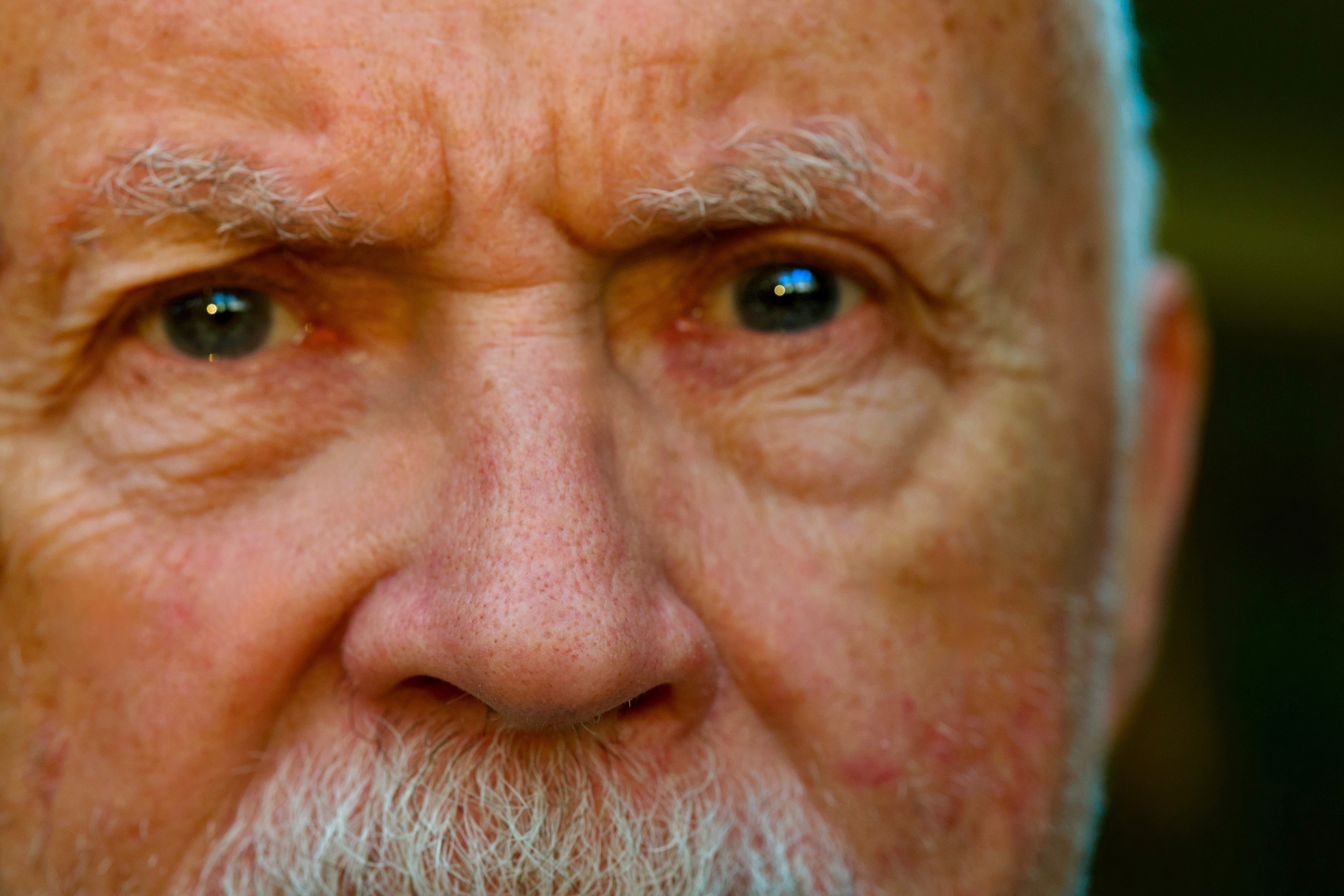
I’ve pointed lenses at other people’s faces for most of my life. I know what a face gives up when you get close enough — closer than conversation allows, closer than most marriages get. So I knew what I was doing when I set the focus on my own eyes and tripped the shutter. I was searching for the truth.
But my nose. I had the camera set to eye autofocus — a technology that exists for exactly one purpose — and it looked at my face and locked onto the tip of my nose instead, throwing the eyes soft. Perhaps I was too close? Lenses have minimum focusing distances. I kept the frame because something about it intrigued me.
There turned out to be something true in a witness whose eyes won’t quite resolve.
Then, in my iOS darkroom app I went through the frame and made a choice about every color in it. The heat in the skin I left alone — it had earned its place. But of all the rest, I saved only one: blue. And here is the confession inside the confession: the blue I saved out of my own eyes isn’t my eye color. My eyes are blue, but that blue — the one burning in the pupils, the one pressing in at the cold edge of the dark, the one the years have left in my hair and mustache — is the sky, reflected. I didn’t keep my own color. I kept the world’s, caught in my eyes, because that’s what eyes do whether you consent or not.
Over a few days the image haunted me, and I understood that I’d made a picture of exactly what I’ve been unable to say for months.
A face still burning. And one color left in the world: the one that got in.
Here is what I mean.
I am old enough to remember when “established fact” was a working category. Not a perfect one — I survived the brutal murder of JFK, being of draft age for Vietnam, the tragi-comedy of Watergate, the psyop of 9/11, the weapons of mass destruction that weren’t there, the psyop of Covid-19. I never mistook my government for an honest narrator. But there had always been a floor. Beneath the spin and the lies, there was a layer of shared ground in American society where even enemies stood together. A man was shot or he wasn’t. An election happened or it didn’t. You could argue all night about what it meant, but not about whether it was.
That floor is gone. And I don’t mean it’s gone for other people, for the gullible, for whichever tribe you’ve decided is the deluded one. I mean it’s gone for me. A man who spent decades trusting what came through his own viewfinder now reads the news the way you’d eat a meal you suspect is poisoned — slowly, watching for symptoms.
I’ll give you the straw that finally broke this camel’s back.
When Charlie Kirk was unalived on that stage in Utah — and notice that I chose my word carefully. “Shot by Tyler Robinson with a rifle from a rooftop”: you’ve read that phrase a thousand times, in every headline, every chyron, every story shaped by the same hand, repeated ad nauseam as if repetition could stand in for proof. “Unalived” is my word.
I use it to refuse the framing — because there is no murder weapon, no autopsy report, no “proof beyond a reasonable doubt” that he was even shot. Within 33 hours there was an official story, a suspect, an alleged confession, the machinery of “justice” grinding into motion. And none of it added up. I did not believe it. I still don’t. The closer one looks at the “mountain of evidence” the more it disappears.
Here is how BasedSamParker on X summarized the prosecution’s case —
You can’t show one picture that places Tyler definitively on campus. You can’t put the gun on campus. You can’t put the gun in Tyler’s hands on campus. You can’t put either of them on the roof.
Maybe he was there. But you have nothing that can actually prove it.
There are no ballistics that match the bullets to the gun.
There is no testimony from his “closest family”, that’s a bullshit lie.
You’re literally just making shit up and hoping that through the power of repression repetition, people will become programmed.
Maybe Tyler’s guilty but none of the evidence yet presented can prove any of it.
Charlie Kirk sat under a tent on campuses across this country, beneath a banner that said three words: “Prove me wrong.” It was an invitation, and thousands of kids took him up on it, and he listened respectfully, debated fairly, and dismantled every woke fantasy regurgitated from leftist fantasia. Now that he’s dead and buried at 32, I find the words becoming mine. I believe his own people killed him and they’re trying to pin it on Tyler Robinson. Prove me wrong.
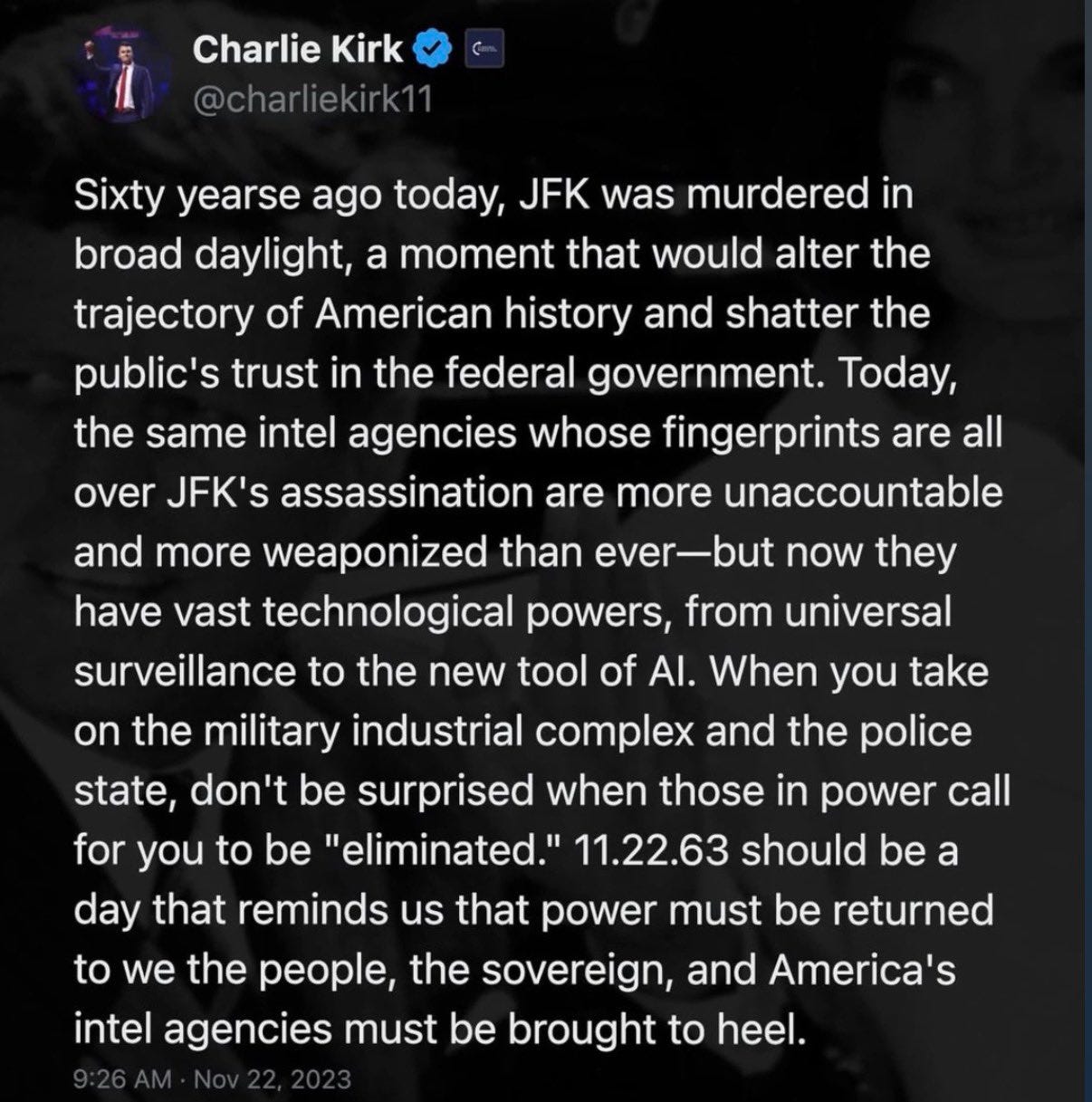
You can’t. And I can’t prove it to you (at least not yet) — that’s the part I won’t pretend away. There’s a courtroom in Provo right now full of what I’m assured is “overwhelming” evidence, and every trained instinct I have says it’s been dressed for the stage. The reasonable position — the one promoted by the media and by paid influencers at government expense, the one I’d have likely swallowed if it hadn’t been for the heartbreaking devotion and tireless work of his only true friend, Candace Owens — is that the evidence is the evidence. Some of you reading this hold that position, and I can’t prove you wrong any more than you can prove me wrong, because the instruments we once used for proving things to each other have been smashed. The court says one thing. My gut, trained on a lifetime of watching this country operate, says another. And there is no referee left standing that both of us would accept.
I’ll go one further, and I’ll put a date on it so you can hold me to it: I don’t believe Tyler Robinson will live to stand trial. Why? Because they do not have a winnable case. No murder weapon. Robinson’s heirloom .30-06 had not even been fired. No actual witness that places the accused at the scene. No autopsy report confirming that he was even shot, let alone by Robinson’s rifle, which had cobwebs in it. The police brought in canine units to search for a weapon and found nothing. It was only when the FBI arrived and pointed them to a spot that a gun materialized — and even then, they’ve shown two different photographs of it, each one a different weapon, one of them with the sight mounted backwards. Neither matches the rifle that actually belongs to Tyler Robinson, which when inspected had cobwebs in the barrel, had not been fired, and carried the DNA of four or five people — with Robinson’s own DNA the most degraded of all.
That’s the confusion I set out to write about. Not an argument. A condition.
Because here’s what nobody tells you about losing the floor: the world doesn’t actually stop turning. My woodpile still dries at the rate it always has. The frost still comes to this hillside in Johnson when it comes. My camera still resolves a face at f/2 exactly the way physics says it must — well, when it isn’t choosing my nose. The facts didn’t vanish from the world. They vanished selectively — from exactly the places where a citizen most needs them. From the capitol. From the courtroom. From the screen.
So I live in two countries now. In one of them — the one made of firewood and frost and glass — everything is still established. In the other, nothing is. We don’t even know how many Americans have died in the unprovoked and criminal war on Iran.
And I need to tell you what the second country looks like from here, because this is the part I’ve been circling for months, the part that led me to stare into my own lens.
It looks like an inversion of everything I was raised to believe about sin and consequence.
I’m not going to catalogue it. You know the catalogue. You carry your own version of it in your chest like a stone. The men whose names sat in the flight logs and the little black books, who walk free and give commencement speeches. The billionaires who mistake their winnings for wisdom and buy the referees. The tech lords who feed our grandchildren into machines and call it connection. Unimaginable sin — the kind my grandmother’s generation didn’t have polite words for — met with unimaginable impunity. Not one of them touched. Not one.
And beneath them, the opposite arithmetic. Innocent people killed by our own government — abroad, where we’ve always done it, and now at home, in our own streets, wearing our own flag. People who did nothing, who owned nothing, who were simply in the way.
And beneath them, the quietest violence of all, the one that never makes the news because it happens one grocery receipt at a time. I live on a fixed income. Fixed is the government’s word. What it means is that my income stands still while everything else runs. Every month the same dollars buy a little less — less heat, less food, less margin, less future. Nobody shot at me. Nobody had to. They’re taking my life the slow way, at the register, and calling it the economy.
Sin at the top, punished never. Innocence below, punished always. And me on this hillside, watching all of it, with exactly as much power to stop any of it as I have to stop the frost.
That’s the horror I couldn’t name until I made the picture. Not any single crime. The arrangement. And my perfect, absolute helplessness before it. I can see everything. I can touch nothing. I try to write, I’ve given up on voting, I speak into this digital emptiness — and the machine doesn’t even register the input. There is no lever on this hillside connected to anything. At forty I’d have told you that was defeatism. At my age I can tell you it’s just eyesight.
The other horror is more private. It’s that I can no longer locate the version of me who would have found any of this outlandish. He’s gone. He drained away so gradually I never got to say goodbye to him. That earlier boy — the one who trusted that institutions had my interests at heart, who believed the sinners eventually paid — I miss him. He slept better. And I can’t get back to him, because getting back would require unseeing, and seeing is the one thing I’ve spent my whole life training to do.
Which brings me back to the self portrait.
I understand now why I saved the blue. It was a design choice — one hundred percent — and that’s precisely why it’s a confession. Out of everything in that frame, I chose to keep the heat, which is the anger, and one color, which isn’t even mine. The blue in the eyes is the sky’s, borrowed. The blue at the edge of the dark is the world, pressing in. Even the blue in my hair and mustache is just what a lifetime of standing under that sky has left behind. A witness doesn’t own a color. He carries one — whatever’s in front of him, caught in the eyes, whether he consents or not. Everything else I let go. What remains is a man reduced to the two things nobody has figured out how to take from him: what he feels, and what he carries.
That’s what a witness is. Not someone who knows the truth. Not someone who can fix anything — God knows. Someone who can’t stop looking. It’s the one power they can’t index for inflation and can’t legislate away and can’t price out of my reach: I see you. All of you. I have no lever, no vote that counts, no court that listens. But I have seventy-four years of trained eyes and the stubbornness to keep them open, and I am writing down what they take in.
The camera doesn’t lie. That’s what we used to say, when film was the documentary — when a photograph was light from the actual world striking silver, a physical trace of something that happened. Today an image is a digital creation with no provable relationship to reality at all.
Which is why I’ve told you exactly what I changed in mine. The focus that missed. The colors I drained. The blue I kept, and where it really came from. Every alteration, confessed. That’s the difference between my picture and the pictures they’re showing you, and it’s the whole difference.
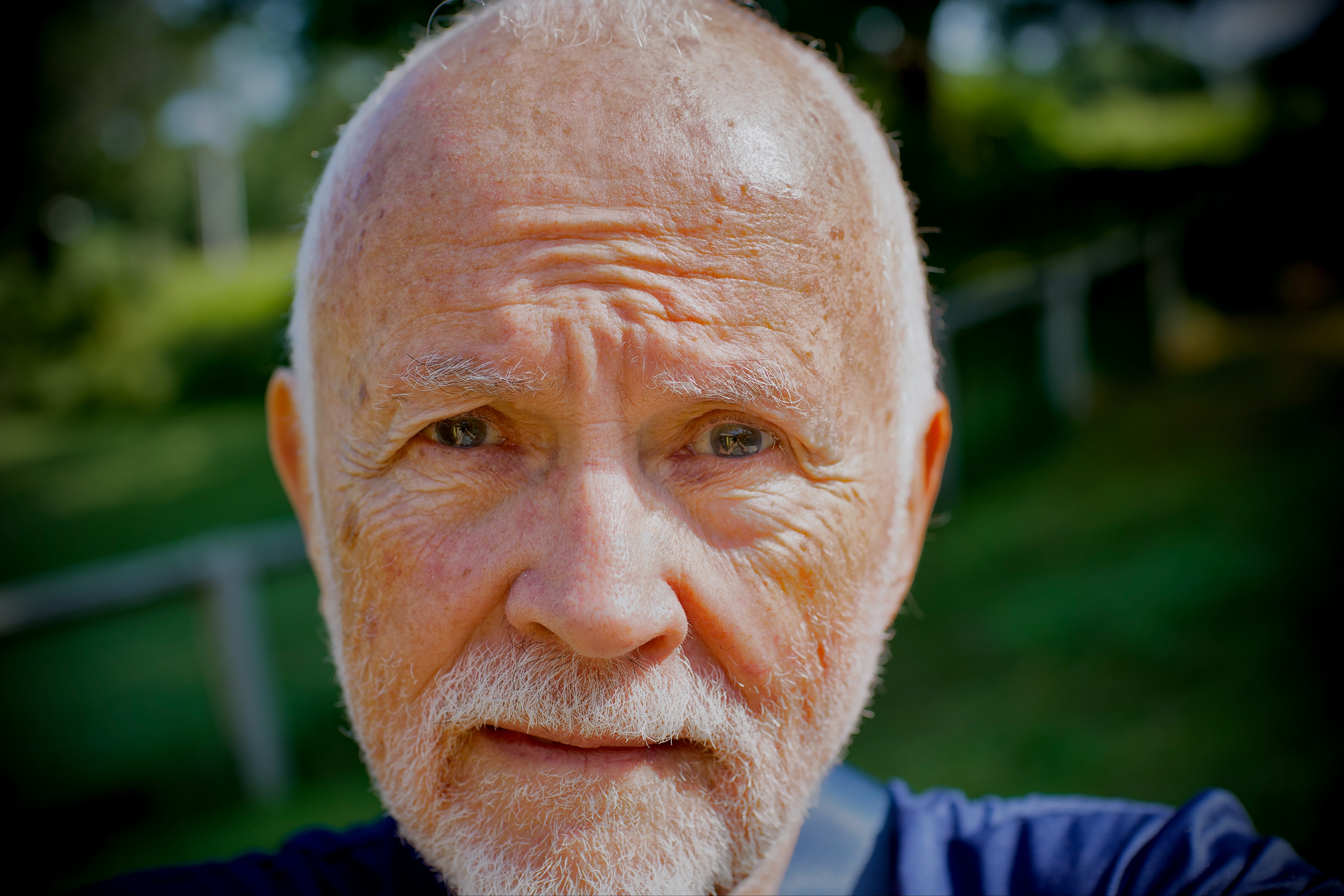
Look at the picture. Tell me what’s true.
“Thumb Out” Book One of my memoir trilogy “The Spaces Between” is available now
e-book ~ kindle ~ paperback ~ hardcover ~ signed paperback