

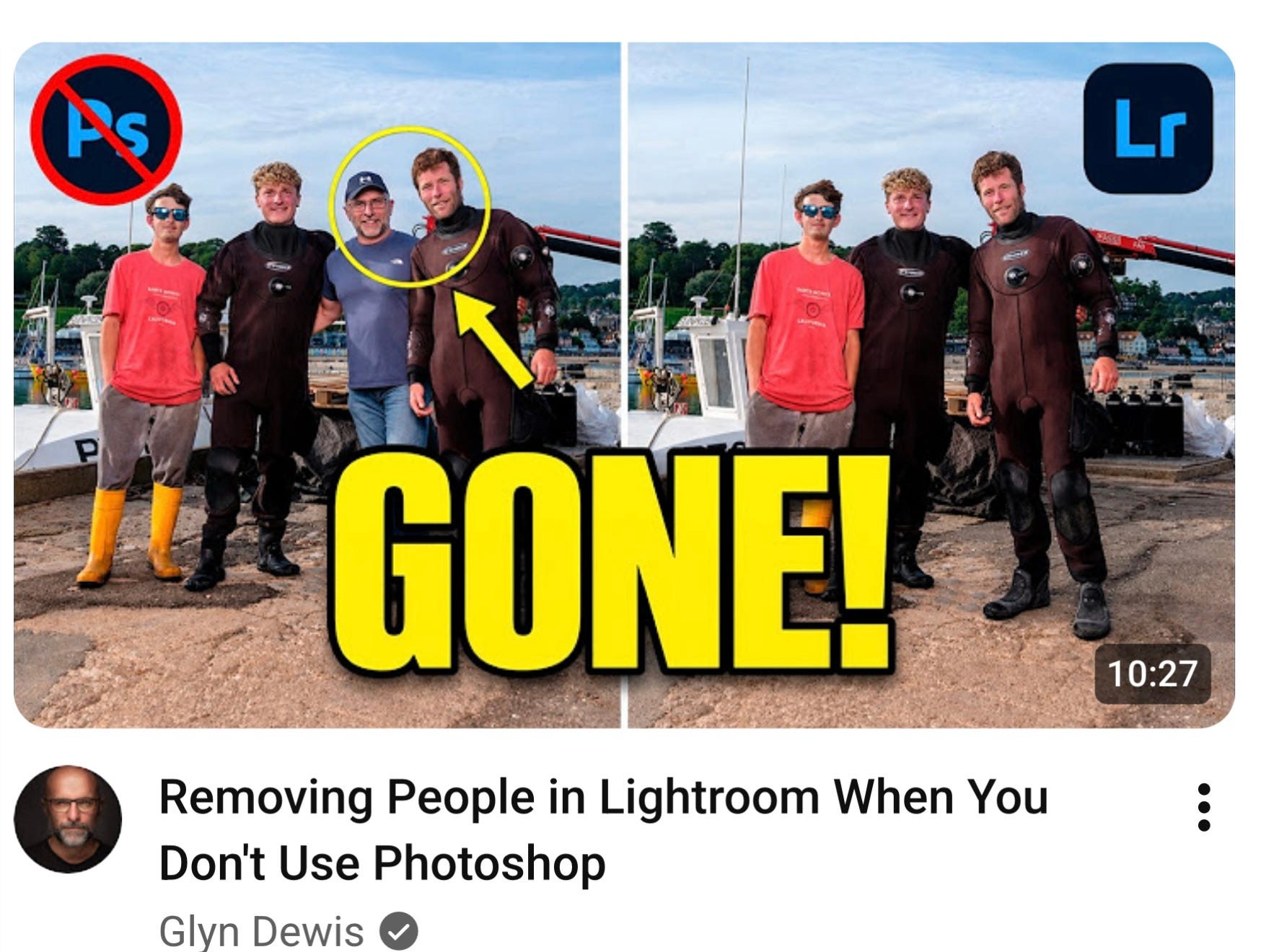
There’s a YouTube tutorial making the rounds. A photographer named Glyn Dewis shows you how to remove a person from a group photo using Lightroom. Not Photoshop — just Lightroom. A few clicks and a man standing among his friends on a dock is gone. Erased. The gap closes, the remaining people shift together, and it’s as if he was never there.
It’s a ten-minute video. It’s cheerful. It’s a tech tip.
And it’s the most honest metaphor I’ve seen for what’s coming.
I’ve spent the last 74 years trying to understand what the hell is going on around me. Not in some abstract, geopolitical sense — around me. In my town. In my trade. In my life.
I’ll never forget when the move to Chinese manufacturing hit Johnson, Vermont. Tubbs Snowshoes — a significant local employer — closed its factory in the old mill across the street from my office and shipped everything to China. Laid off all these Vermonters. People I knew. And I thought, that’s strange, but I guess that’s the economy.
Then a friend of mine, a surfboard shaper on Maui, signed a contract with a company in China to mass-produce his designs. His craft, his hands, his years of knowledge — exported, replicated, made cheap. And I thought, that’s the same thing again.
Then 2008. Wall Street piling into another boondoggle, the whole house of cards collapsing, and the crash ruined my business. Thirty years as a photographer and the floor dropped out. And I thought, something is wrong, but I couldn’t name it.
Then the plandemic. Because that’s what it was — a manufactured, preplanned crisis in which they gave billions of people what amounted to a bioweapon. The injections contained SV40, a turbo cancer accelerator, and the results are everywhere if you’re willing to look — young athletes dropping dead, cancer rates exploding in demographics that never saw numbers like this, an entire generation of damaged immune systems. This wasn’t incompetence. This wasn’t a rushed vaccine. This was a massive effort at population reduction dressed up as public health. Step one of the end game, carried out in broad daylight, with your consent, while you stood in line for it.
And no one has been prosecuted. Not one person. Dr. Fauci — who engineered the whole thing, who was the highest paid employee in the history of the United States government — lives as a multimillionaire, revered by millions of brainwashed fools who still think he saved their lives. He didn’t save anyone. He orchestrated the largest medical crime in human history, walked away clean, and wrote a memoir about it.
And then, in the aftermath, the zero-percent interest rates. The stampede of hedge funds buying up properties and doubling the price of everything, stripping the dream of homeownership from ordinary Americans. First they wrecked your health. Then they took your house. And I thought, this isn’t accidental anymore.
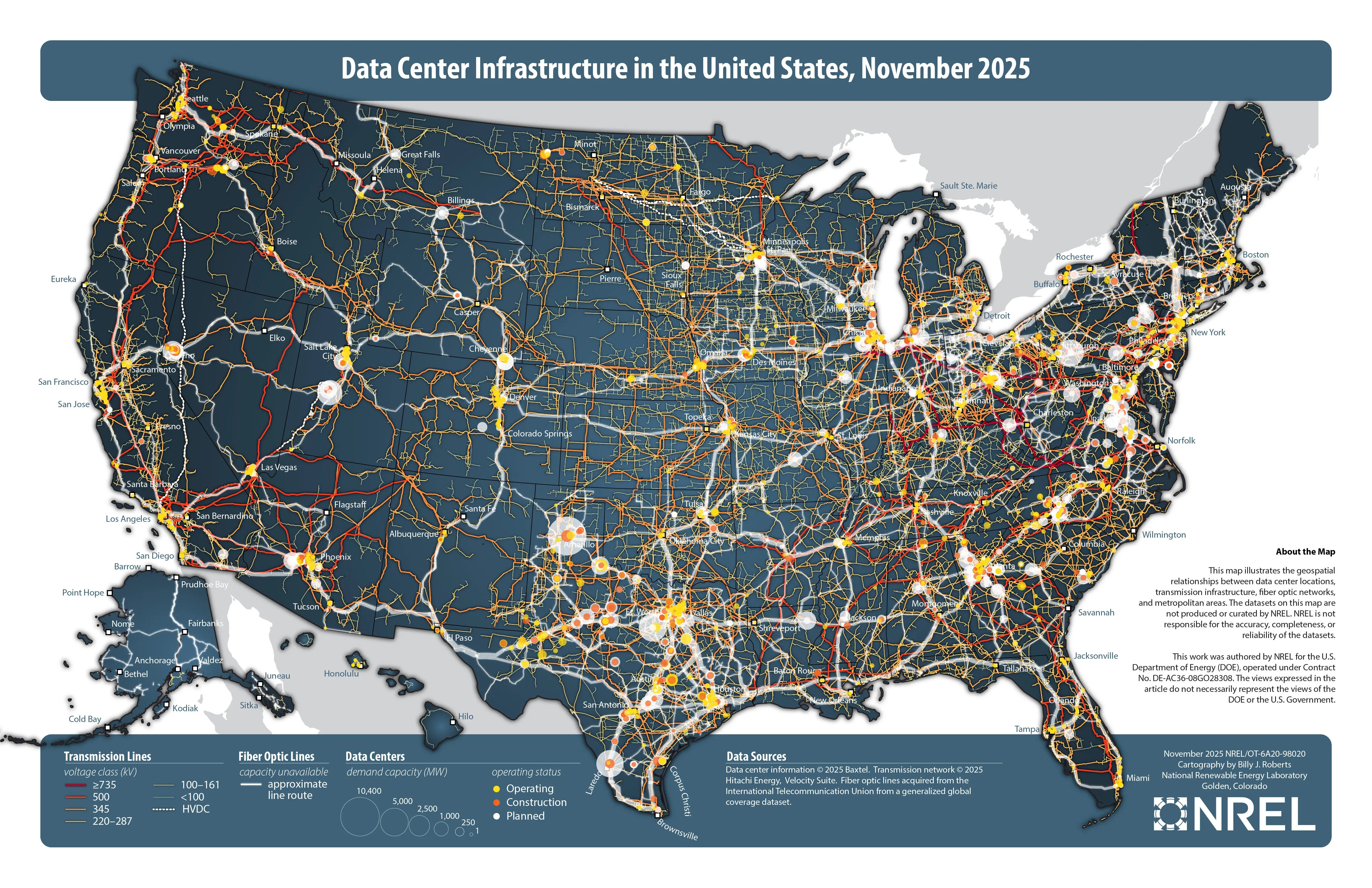
Then the climate change crusade — years of being made to feel guilty about every decision you made, every mile you drove, every degree you set your thermostat. Be conscious. Reduce your footprint. Sacrifice. And then — like a magic trick — all of that gets thrown out the window so they can build AI data centers that drink more water and burn more power than three human populations combined. No guilt. No hand-wringing. No carbon lectures. Just full speed ahead, because this one’s for them.
And now I see it. All of it. Not as a series of disconnected misfortunes, but as a pattern. A direction. A plan.
The problem is that most people can’t see it. And that’s by design. In a world of constantly churning news cycles, complete saturation propaganda, and relentless distraction, people have lost their minds. They’ve been herded into useless culture wars and meaningless political divisions — fights that generate enormous heat and zero illumination — and in the process they’ve lost all of their power. They’re arguing about pronouns while the house is being sold out from under them.
Which is why, when I find someone who can actually see through the noise, I pay attention.
I’ve been listening to Professor Jiang. He’s not who you’d expect. He’s a high school teacher. Chinese, but he grew up in Canada — a dual national. He attended Yale, then went back to China, where he teaches and studies game theory. That’s his lens. He takes the mathematics of strategic decision-making — the logic of how rational actors pursue their interests when the stakes are existential — and applies it to global geopolitics. No ideology. No partisan loyalty. Just the cold logic of what powerful players will do when you map their incentives and constraints.
And the results have been stunning. He predicted Trump’s victory. He predicted the attack on Iran. He predicted how the attack on Iran would backfire. Not because he has inside information, not because he’s clairvoyant — because game theory doesn’t care about your feelings or your news feed. It cuts through the propaganda and the distraction and shows you what the board actually looks like.
Recently he laid out what he calls the end game — not for you and me, but for the people who actually run things. The Bezoses, the Thiels, the Altmans. The billionaires and the aspiring trillionaires. What he described wasn’t a conspiracy theory. It was a business plan.
It goes like this.
You look at the world and you see chaos. Eight billion people making noise, making demands, making trouble. And if you’re someone who built an empire on control — on algorithms, on data, on systems that do exactly what they’re told — then all that human chaos is the problem. So you fix it.
Step one: reduce the population. From eight billion to five hundred million. Five hundred million is governable. Eight billion is not. You don’t need to believe anyone has written this number on a whiteboard to notice that every system these men build treats human beings as excess inventory.
Step two: population replacement. Americans are too rebellious to rule. Too loud, too armed, too belligerently independent. Tell an American you need to microchip him and you get an armed insurrection. So you need a different population — one already accustomed to hierarchy, to obedience, to caste. Jiang names India. If you’re an Indian and you want to come to America, and someone says the price of admission is a microchip and a managed life, you accept the deal. You don’t resist. You’ve been shaped by a system that taught you not to. Americans — with their history of free speech and guns and revolution — would never submit. And that is exactly why they are being diluted, suppressed, and eliminated. You need war and chaos and revolution to clear the board, and then you fill it with people who won’t fight back.
Step three: the AI surveillance state. Jiang speaks with an authority almost no American commentator can match, because he’s from China. “I’m from the AI surveillance state,” he says, “and I’m shocked and disgusted by the amount of surveillance in the United States.” A man from China — China — is appalled by how much data America collects on its own citizens. Your iPhone is always listening. It always knows where you are. It always wants access to everything else on your phone. And all of that data has to go somewhere, which is why data centers are rising across this country the way granaries once did, except the grain is you.
Step four: a new religion. You need something to legitimize the new order. Something to make five hundred million obedient, surveilled, microchipped people feel like this is not a prison but a paradise. So you give them a god. An AI god. Joe Rogan floated it on his podcast — Jesus returns as an artificial intelligence — and it sounds insane until you realize it’s the logical conclusion of everything else on the list. Total submission, wrapped in spiritual language. No hunger, because there are plenty of resources for five hundred million. No war, because there’s no one left to fight. No debate, because debate has been coded out of the system. The world is finally perfect. And the elite — the architects of this perfection — practice their transhumanism, extend their lives indefinitely, and reign as the guardian kings of a civilization they designed from scratch.
That is the end game.
And here’s the part that makes all of it cohere: ask yourself why. Why would anyone want this?
Because they don’t need us anymore.
The elite transnational financial interests that run this world — the ones who move across borders the way you and I move across rooms — are preparing to become the gods of this planet. That is not hyperbole. That is the trajectory. Robots can do the manufacturing. AI can do the thinking. Algorithms can manage the logistics, the agriculture, the energy grid. Eight billion human beings used to be necessary — as labor, as soldiers, as consumers. They are rapidly becoming unnecessary. And unnecessary people, in the calculus of power, are a liability.
So you reduce them. You replace them. You surveil the ones who remain. And then you get to the real project — the one all of this has been building toward. You solve aging. You extend life indefinitely. You merge with the machine, the way Ray Kurzweil has been promising for decades — consciousness uploaded, biology transcended, death itself engineered out of the equation. And you rule. Not for a term, not for a lifetime, but forever. Over a planet you’ve optimized the way a photographer optimizes a composition — by removing everyone who clutters the Now look at that photograph again. Four men on a dock. Then three. The one in the middle — gone. The gap filled in. The sky healed over. No seam, no scar, no evidence. Just a clean image, optimized, improved.
A few clicks. That’s all it took.
And then I eliminated the man who eliminated him. Glyn Dewis made a ten-minute tutorial about erasing a person from a photograph. So I erased Glyn Dewis from the photograph. I didn’t need Photoshop. I didn’t need Lightroom. I did it in the Photos app with a tool called “cleanup.” Took about four seconds. The man who taught the world how to make people disappear — disappeared. And nobody even needed his tutorial to do it.
And it isn’t just photographs.
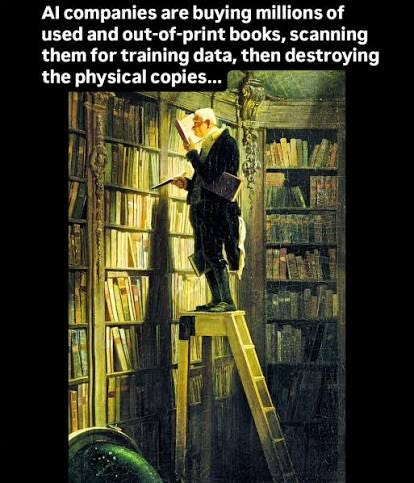
AI companies are mass-purchasing books — entire libraries of them — scanning them into data sets, and then shredding the originals. Think about that. The physical object is destroyed. What remains is a digital ghost, stripped of its binding, its margins, its handwritten inscriptions, its smell, its weight in your hands. What remains is data. And data can be edited. Data can be sanitized. Data can be made to conform.
We are heading — fast — toward a world where everything is ones and zeros. Where everything ever written, ever photographed, ever recorded can be scraped, ingested, and reprocessed until whatever soul it carried is gone. Until it says what they need it to say.
Remember the Apple ad from a couple of years ago? They took musical instruments, canvases, cameras, books, paint, clay — everything creative life produces — and placed it all into a giant hydraulic press. Squeezed it into a goo. And out of the goo came a thin, sleek tablet. They called that AI creativity. They ran it as a celebration.
It was the most honest advertisement ever made. They showed you exactly what they intend to do — take everything human, everything imperfect, everything alive, crush it flat, and call the result progress.
That’s what the photograph is. That’s what the shredded books are. That’s what the ad was.
The technology to erase a man from a photograph and the technology to erase a man from the earth are not the same thing. But they come from the same impulse. The belief that the picture would be better without him. That the composition improves when you remove the inconvenient, the unnecessary, the ungovernable. That the book is more useful as ones and zeros than as an object a human being once held in her hands and wept over.
We are building tools of elimination and calling them tools of optimization. We are rehearsing disappearance and calling it editing. We are crushing life into goo and calling it creativity.
“Thumb Out” Book One of my memoir trilogy “The Spaces Between” is available now
e-book ~ kindle ~ paperback ~ hardcover ~ signed paperback