

Subscribe · E-PUB · Kindle/Paperback/Hardcover/Audiobook
Yesterday was my 74th birthday. The vernal equinox. For the first time ever, none of my five siblings reached out. Much like a Christmas card, a birthday wish has always been an expected sign of connection, however faint.
I’m not sure when I stopped expecting them to. It wasn’t sudden. It happened the way families come apart — slowly, then all at once, then a long silence that hardens into its own kind of architecture. You stop noticing the absence the way you stop noticing a wall. It’s just there.
My mother’s dying wish was that we would all get along. She said it knowing we wouldn’t. She’d spent twenty years holding us together through sheer will and chain-smoked Kents, and when she was gone, the centripetal force went with her. We scattered like shrapnel from an explosion that had actually happened decades earlier.
I wrote a memoir. Surfing the Interstates — a book about hitchhiking across America in 1973, the summer my parents’ marriage finally detonated. The book only briefly touches the family. But it touches them at the point of fracture. And in that brief touching, I mentioned something none of my siblings had ever heard: I saw our father backhand our mother in the laundry room.
I think that was the fatal blow — not to any of them, but to whatever threadbare connection still held us in orbit around each other. I named a thing they’d rather not know. Some of them probably think I made it up. I didn’t.
What I’ve learned since, researching our father’s family, is that the violence didn’t start with him. His mother Jacqueline — the woman we called “Goms” because we couldn’t pronounce “grandmère,” the devout, prim ice queen who took me to Schrafft’s for lunch and gave me sweaters from Bloomingdale’s I never wore — was, according to my aunt Niki’s autobiography, violent with her children. She beat the younger ones. She abandoned Niki to a governess in France for two years while she and her husband tried to rebuild their finances in New York after the Crash. My father was the eldest of five. After him came Niki, who would be hospitalized, given electroshock, and eventually flee into art. Then Claire, the composed middle child. Then Liz and Richard, who would both die by suicide.
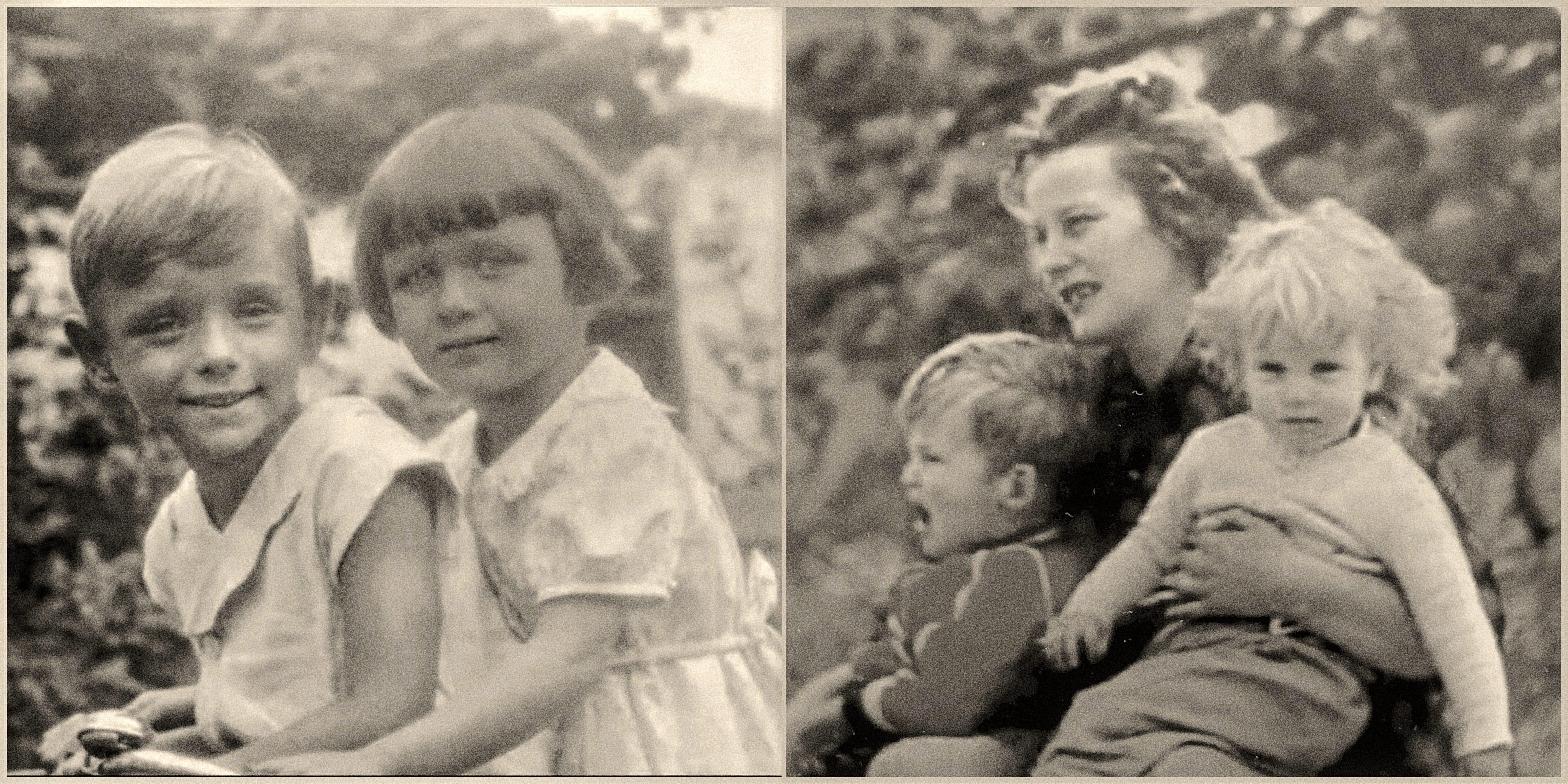
Look at them. My father and his sister. Two small children in white on what looks like a summer afternoon in France, before any of it happened. Before the violence, the breakdowns, the electroshock, the suicides, before he married a poor Irish orphan girl and raised six children.
The chain is clear if you’re willing to look at it. Most of my siblings aren’t. They’ve chosen the comfortable version — the one where our father was difficult but not violent, where the divorce was just a divorce, where the family simply drifted apart the way families do. I wrote the uncomfortable version. The one that actually happened. And the cost of writing it was the last of those ties.
Which brings me to Jean Biès.
Jean Biès was a French philosopher, writer, and poet born in Bordeaux in 1933. He spent much of his youth in Algiers, where early exposure to North African culture and Sufism oriented him toward Eastern spiritual traditions. He studied Classics at the University of Algiers and later at the Sorbonne, eventually becoming a professor of Greek literature at the University of Pau. His work placed him squarely in the Traditionalist and perennialist current, drawing on René Guénon and Frithjof Schuon while seeking a synthesis of Eastern and Western wisdom. He wrote across genres — essays, poetry, travel writing, spiritual testimony — exploring Hindu thought, Christian mysticism, Sufism, and the symbolism of nature and alchemy. He is best known in English for Returning to the Essential: The Selected Writings of Jean Biès.
Biès received the High Prize of the Society of French Poets and was made a Chevalier of the French Legion of Honor in 1997. Catholic philosopher Jean Borella regarded him as one of the most authentic poets of his time. He retired in 1993 to devote himself fully to writing at his home near the Pyrénées. After the death of his wife, the Jungian analyst Rolande Biès, in 2012, he died by suicide in January 2014, leaving behind a large body of essays, poems, and spiritual reflections.
He wrote this:
“The hermit keeps a window open onto the sky, without which the world would perish from suffocation, ugliness and boredom.
He is the only one, along with the poet, who still speaks the language of the beyond, who makes existence sacred, who gives life this verticality without which humanity is buffeted about beneath itself.
He is a rampart against the assaults of mediocrity, nastiness, hatred that is intolerant of its opposite…
For men turned toward secondary things, his presence recalls the existence of the essential things: the order of the world, knowledge, the priority of salvation and the adoration of the Supreme, by imitating the sunflower whose heliotropism has much to teach us, who never turns away from the trisolar brightness.
A living reminder of the transcendence, the hermit teaches this world that he is of other values, those of truths other than the world’s.
Seeming to live the opposite of a normal life, he is, in fact, emancipated from physical and psychological mechanicalness. Immobile in a consecrated place, he exorcises space and turns it into infinity.
A world without vision is condemned to losing its outlook.
Hermits and anchorites are the salt of the earth who keep the earth from completely rotting.
They are the ones who, in spite of their small number and anonymity—or thanks to it—can still to a certain degree, weaken or neutralize the poisons fabricated by society in its politico-social activities (even those that have a humanitarian mask) and by all of humanity in its psycho-mental activities.
Today, these men are the last and the only ones able to stop the generalized dissolution process, to avoid the definitive crumbling of everything.
The spiritual master who has naturally renounced his name, his possessions, his ties and his ego has thus gained in inner richness; the Spirit has taken him over, has extended him to its size, has made him a being of the here and now, of everywhere and always.”
— Jean Biès
Biès writes about a man who chose solitude and gained the world from it. My situation is less elegant than that. I didn’t renounce my ties — they were severed, slowly, by decades of silence and one act of truth-telling. The hermit in Biès’s vision “has naturally renounced his name, his possessions, his ties.” I just wrote down what I saw in the laundry room.
But there’s something in this passage that resonates beyond the philosophy. Biès writes about people “turned toward secondary things” — and I think that’s what the comfortable family story is. A secondary thing. A version of events that lets everyone sleep at night. The primary thing is harder. It’s the backhand. It’s the chain of violence running from Jacqueline through my father and into the rooms where we grew up. It’s Niki’s electroshock. It’s Richard’s champagne and Tylenol. It’s Liz going upstairs at Claire’s house in Providence and never coming back down.
My mother wanted us to get along. She wanted it so badly she said it as she was dying. But getting along required not looking, and I looked. And then I wrote it down.
By any external measure, the book failed. A boarding school acquaintance who went on to become chairman of the board at Farrar, Straus and Giroux read the manuscript and told me it had no commercial appeal — too personal. He suggested I print copies privately for family distribution. The family, of course, being the very people who won’t read it. I mailed twelve author copies to siblings, old friends, people I thought might care. Not one person responded. My Substack has maybe ten subscribers. The phone didn’t ring on my birthday.
So there’s a version of this story where I wasted two years of my life writing a book nobody wanted, published it myself into a void, and alienated what remained of my family in the process. That version isn’t wrong, exactly. It’s just incomplete. It measures the wrong things.
My father — the boy in that photograph, being held by his little sister Niki as they rode a bicycle together on a summer afternoon before any of it happened — that man spent my entire youth insisting I figure out what things mean. He wouldn’t let me major in film. He said I had nothing to say yet. He assigned me books. He corrected my writing. He pushed me toward philosophy, toward the examined life, toward some reckoning with the essential questions that I wanted no part of at twenty-one. I wanted to make movies. He wanted me to understand why.
I hated him for it. For decades, I carried that obstruction as the defining wound — the father who blocked his son’s artistic life. But here I am at seventy-four, and the book I just finished isn’t a film. It’s a written excavation of my own life that required exactly the tools he spent my childhood trying to give me. The depth. The discipline of looking. The insistence that surface isn’t enough. No philosophy major at Penn could have taught me what writing this memoir taught me. It took the full fifty years — the hitchhiking, the windsurfing, the relationships, the losses, the seizures, the dead ends — to arrive at the understanding he was pointing toward. He just didn’t know it would take a lifetime. Neither did I.
This is the complicated inheritance. Not the noble name. Not money — he left us nothing. Two of my sisters married into enormous wealth and sit now in multimillion-dollar homes, their husbands incapacitated by illness, unable to do much of anything. I sit in a simple home in northern Vermont with two dogs and a guitar and ten Substack subscribers and a clarity I have never had before in my life. I changed the way I eat — went carnivore, stripped everything back — and my body responded. Clearer head. More energy. Less noise. The physical transformation mirrored what the writing had already started: a shedding of skins, of fears, of the need for anyone’s approval or recognition.
I emerged from the process of writing Book One shell-shocked. The world outside isn’t reassuring — it tilts toward war, toward fracture, toward dissolution. My family has completed its own dissolution, the one that started in that laundry room in 1973. My mother’s dying wish — that we would all get along — sits unanswered, the way those twelve mailed copies sit unopened. But standing in the debris of all that, I feel more centered and confident than I have at any point in seventy-four years. Not triumphant. Lucid. The skins are off. The voice is mine. And the mission my father planted — find out what it all means — turns out to be the richest inheritance I could have possibly received: richer than any money, property or gold signet ring.
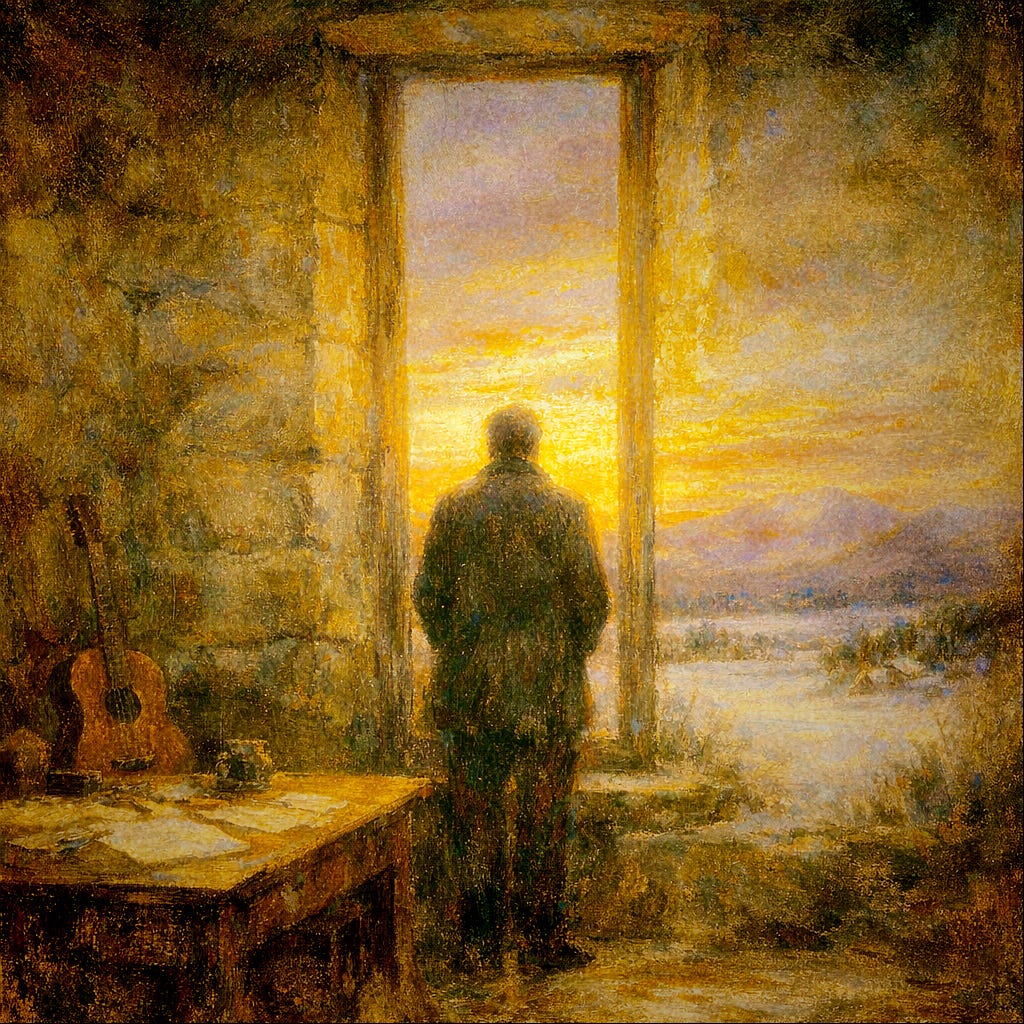
So I’m going to write the next two books. Sahara Dust — the Antigua years, Thea’s death, the paradise I built while everything I loved was dying. And Green Mountain Flash — what happens when a lifelong wanderer finally stops. The hermit at his window doesn’t open it because the view is pleasant. He opens it because the alternative is suffocation. The writing is the window. I’m not done opening it.
Subscribe · E-PUB · Kindle/Paperback/Hardcover/Audiobook