

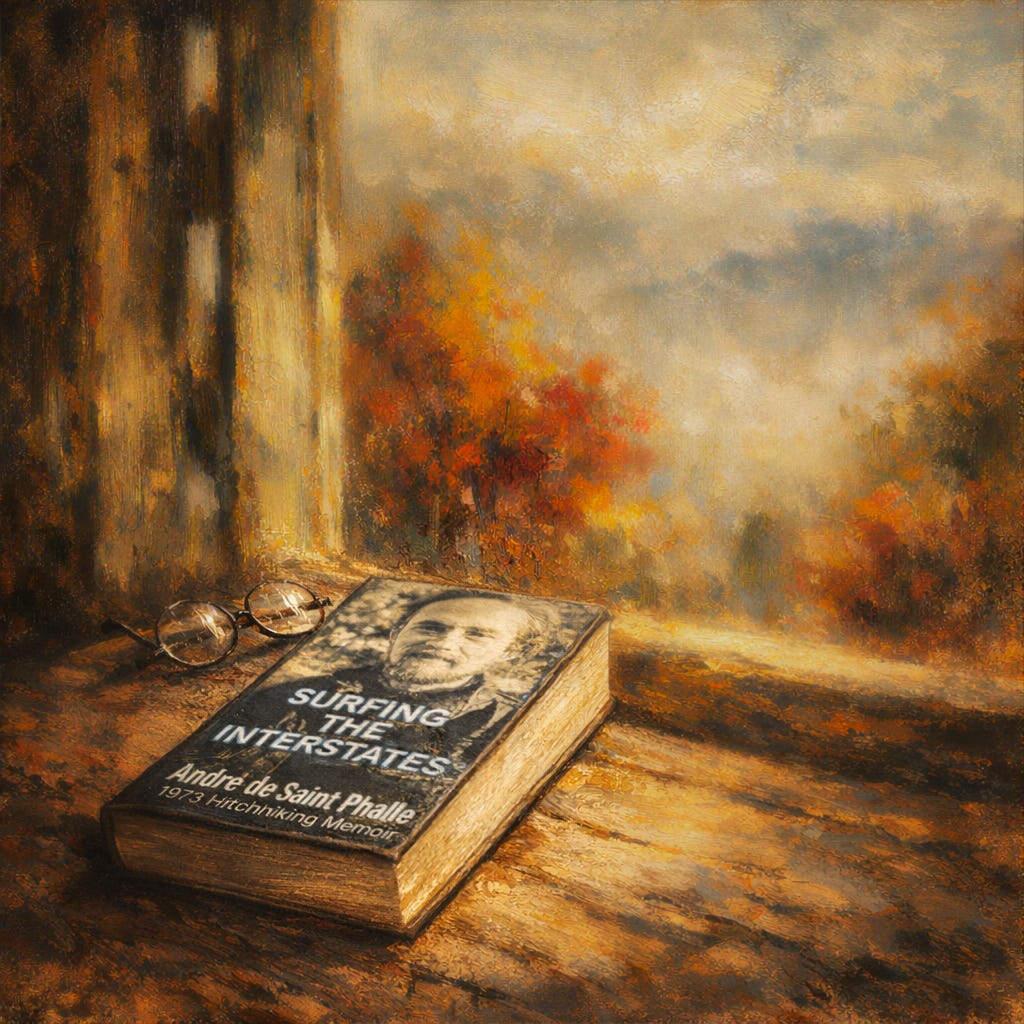
My father wanted me to study philosophy. I wanted film school. He won. He always won. He made me read the entire Bible cover to cover. He sent me on retreats. He made me read Kierkegaard. He dragged me to West Point for an interview I never wanted. Six years later, after I’d worked my way into USC Film School on my own — the dream he’d vetoed when I was eighteen — he refused to help as promised. He said he was financially stretched, but he was also buying racehorses with his new wife. Philosophy, he said. The examined life. Know thyself.
I spent the next fifty years ignoring that advice. Hitchhiking. Windsurfing. Running from everything he represented. And then, as the 50th anniversary of my 1973 hitchhiking odyssey approached, I pulled out the falling-apart journal I’d somehow kept all those years — the one I’d carried every mile of that summer, the one where I’d written down my thoughts and feelings during the six months before leaving, the two months of the trip itself, and the month after I got back. The pages were soft and brown at the edges. The handwriting was mine but younger — urgent, unguarded, full of a certainty I no longer recognized. I’d kept it for half a century without quite knowing why, the way you keep a letter you’re not yet ready to answer.
I started writing. And I discovered that the old man had been right all along. Not about West Point. Not about Kierkegaard. But about the examined life — the idea that understanding your own story is the real work. I just needed fifty years, a falling-apart journal, and an artificial intelligence to prove it.
I posted the contents on an older Substack — now defunct — reading each entry aloud, transcribing it, embellishing the pages with photographs and maps I found online. It was an act of archaeology. But something in me was calling me to do more with the material. The journal was a skeleton. It needed flesh.

That fall I discovered Anthropic’s Claude, and I began interfacing the AI with my iOS writing app, Scrivener. I also started recording voice memos. Originally I wanted to write a screenplay — the old film school dream that life had rerouted but never quite killed. Funny how the thing your father blocks at eighteen keeps knocking at seventy-two. Over the months that followed I invested unbelievable amounts of time learning how to efficiently record my thoughts on a walk into my phone, how to transcribe them later with different software. I tried Aiko, NovelCrafter, Sudowrite. Each taught me something. None of them stuck. But the impulse kept pushing, and over the next two years I ended up writing the memoir that became Surfing the Interstates.
Along the way I discovered something about myself that I’d never named. During the course of my life, the typewriter and the blank page had been a huge obstacle. Not writer’s block — something deeper. The pressure of that blank page and the mechanical clacking of the keys carried a kind of judgment. Every word had to justify itself before it hit the paper. I was the kid who wanted to be a famous writer but was too shy to sing in front of people, too paralyzed by his own ambitions to actually make anything. I liked the idea of thought bubbles — loose, provisional, free to dissolve and reform.
And then ultimately I fell in love with voice memos.
Because all stories start with the human voice. The word for spirit comes from the Greek word for air — for breath. Pneuma. Before there was writing there was telling. Before there was telling there was breathing. And there’s just something about talking that unlocks me in a way that sitting at a desk never could. I walk through the Vermont woods with my phone in my pocket and the stories pour out — raw, unstructured, alive. I’m doing it right now.
This is where AI comes in. Not as a ghostwriter — as an editor with infinite patience and a memory that doesn’t quit. It takes out all of the ums and you-knows and conversational clutter, turning spoken thought into prose. But more than that — over time it begins seeing patterns and motifs that I was too close to see myself. Connections between moments separated by decades that only become visible when someone, or something, holds the whole story at once. Writing the memoir, I discovered that my lifelong compulsion to move — hitchhiking, windsurfing, overlanding — wasn’t freedom. It was addiction. I couldn’t have seen that without the writing. And the writing couldn’t have happened without the voice. And the voice couldn’t have become a book without AI. Each tool unlocked the next.
Not all AI is the same. After trying a handful of different apps I ended up with Anthropic’s Claude. I was particularly attracted to the project feature, which allows a much larger context — so the AI has a specific and comprehensive awareness of what you’re doing, who you are, where you’re going. It remembers what you said three months ago. It knows your characters. It knows that your aunt was Niki de Saint Phalle and your father read Kierkegaard and your teacher Mr. Czaja taught you to write from images when you were eight years old. Over time I trained Claude on how I liked to write. I developed a dual approach: cinematic staccato short phrases for action in the present tense, and flowing, introspective, sometimes poetic language for the mature voice looking back and understanding. Two speeds. Two lenses. The young man hurtling through the world, and the older man finally grasping what it meant.
One of the big things with writing is how you do it, and there are two basic schools. There are those called pantsers — they write by the seat of their pants, trusting the current to carry them. I am not one of those. I worked for a few years as a carpenter. I even studied architecture briefly. I’m a firm believer in having an outline — in knowing where the load-bearing walls go before you start hanging drywall. My goal is to not waste my time. At 74, time is not an abstraction.
And my deep love and knowledge of cinema embedded me in present-tense narration — show, don’t tell. I knew that to write about my trip I had to make it engaging, and that only the key moments were needed to flesh out the true heart of the story. A memoir isn’t a diary. It’s a curated act of memory — deciding what matters enough to survive.
All of these things were just the beginning, however, of the long process that took me to today.
...
Let me talk about publishing, because that’s where the real education began.
Substack publishes sequentially — newest post on top. Which means the only way to serialize a book in reading order is to publish in reverse chronological order, building a table of contents that reads correctly from first chapter to last. It’s counterintuitive. You have to think backwards to move forward. Nobody tells you this. You figure it out at midnight, staring at your screen, wondering why Chapter 12 is sitting on top of Chapter 1.
Then there’s Amazon. Kindle Direct Publishing handles e-books, paperback, and hardcover, and each format has its own specifications. Cover art requires precise bleeds and margins that differ between formats. The interior text has its own formatting demands — font choices, line spacing, paragraph indentation, page size. Cream paper or white paper. Matte cover or glossy. Every decision cascades into three others. And typos. You think you’ve caught them all. You haven’t. You publish, you order the proof, you open it with the pride of a new parent — and there they are, staring back at you from page forty-seven. So you fix them and resubmit and wait and order another proof and find two more. It’s humbling. It’s also, in its own maddening way, deeply satisfying — because you are building something real with your hands, even if the hands are typing.
The audiobook was another education entirely. Recording the audio. Editing the audio. Learning that your reading voice and your speaking voice are not the same instrument — that one tells and the other performs, and the difference is everything. Making sure every file meets ACX standards for RMS levels and volume — specifications I didn’t even know existed six months earlier. I went through multiple approaches before landing on a workflow that actually produced professional results.
I don’t think I could have done any of this without Claude. When it came to writing, I’ve already described how that worked. But when it came to formatting, I spent multiple days with Claude solving the PDF challenges of cover art across different formats. Claude helped me get my final audiobook files to meet ACX specifications. It helped me develop my website, work out keywords and meta tags, set up subdomains. At every turn where I hit a wall — and there were many walls — I had a collaborator who never got tired, never lost patience, and never forgot what we’d already figured out.
If someone had handed me this syllabus three years ago — Scrivener, voice transcription, AI collaboration, narrative structure, KDP formatting, cover design, audio engineering, web development, search optimization — I would have said they were out of their mind.
...
So why did I do this? What’s the point?
The biggest surprise was that the motivations of an entire lifetime — to achieve, to perform, to be praised, to make money — had to fall by the wayside. All of them. Every one. I come from a family where nothing less than becoming a cardinal or a senator was considered acceptable for the eldest son. I wanted to be a famous writer. Then a famous director. Then a famous musician. Always famous. Always the validation I never got from the man who named me after his father and then spent my childhood trying to mold me into something I wasn’t.
Writing a book is like putting a note in a bottle and throwing it into the ocean alongside three million other bottles tossed out there every day. If you do this expecting to be on the Today Show, you will break your own heart. If you do this expecting to roll in cash, you will break it twice.
But here’s what nobody tells you. The joy I feel right now — sitting in Vermont with a finished book on Amazon, an audiobook on Audible, a Substack archive that functions as a mausoleum of my creative life — surpasses anything I ever imagined fame or money could deliver. And I’m not saying that the way people say it when they’re pretending not to care. I mean it the way you mean something you’ve earned by doing the work.
The real payoff has been revisiting a transformative summer of my life and understanding my life better for having done the introspection, the recollection, the contemplation. Writing forced me to sit with moments I’d been running from for fifty years. It showed me that my perpetual motion wasn’t freedom — it was the thing that kept me from ever having to stay. And staying, it turns out, is where the actual living happens. I didn’t learn that from Kant’s Critique of Pure Reason. I learned it from recording voice memos and writing my life in my own words. My father was right. You can’t really say anything worthwhile until you’ve really understood what you’re trying to say.
And the flip side of all that inner work is the activation and energization of the mind. Which is so important as we age. In 2019, I started having grand mal seizures in my sleep. Nine of them over the course of a year and a half — my body convulsing in the dark while Veronica watched and documented each one, helpless. I woke up each time not knowing what had happened, the bed soaked, my tongue bitten, my muscles screaming. The doctors wanted to put me on seizure meds which are really just heavy psychiatric drugs that also happen to throw a blanket over your soul. I looked at that road and saw where it might end for me — a defeated, medicated, sad vegetable sitting in a chair, waiting to die. I refused to comply. My neurologist abandoned me. I went on the keto diet, embraced CBD, and lost ninety pounds. I chose to fight with everything I had left. And then I started writing.
Thank God, I have been seizure-free since 2021.
Every single one of the technical challenges — Scrivener, KDP formatting, audio mastering, Substack architecture, AI collaboration — lit up a part of my brain that might otherwise have gone dark. Every wall I hit and solved was a synapse firing that hadn’t fired in years.
Nobody designs a curriculum like this. There’s no syllabus for teaching yourself Scrivener at 72, audio mastering at 73, and self-publishing at 74. My father wanted me to study philosophy — to live the examined life. He was right about the destination. We both just had the route wrong, and the timing off by about fifty years.
This was the degree I actually needed.
We've had something in common for 55 years without knowing it. Going down a You-Tube-induced rabbit hole in search of various performances of "Althea", I landed at <dead.net/archives>, looking for info about the first Dead concert I attended, which happened to also be the first one you attended: Irvine Auditorium, Oct. 15, 1970. You seem to recall a lot more about it than I can! My main memories were: 1) the byzantine decorations around the proscenium arch turned into enormous glowing snakes; and 2) backstage after the show, staring dumbly at some of the band members, we accepted the big, soft cookies they offered us. I was living at 4000 Pine in something called "The Experimental College", which was one of Penn's sincere but lame attempts to respond to the student strike of the previous academic year. I look foward to reading your memoirs. Everyone should write a memoir, because everyone has at least one good story to tell, even to strangers.
Goosebumps, I say. I’ve ordered the paperback version and will upgrade my subscription soon. “Surfing the Interstates” has bumped “Infinite Jest” as my next goal once I complete The Brothers Karamazov. Your embrace of Anthropic’s Claude in your 70s is profoundly inspiring.