

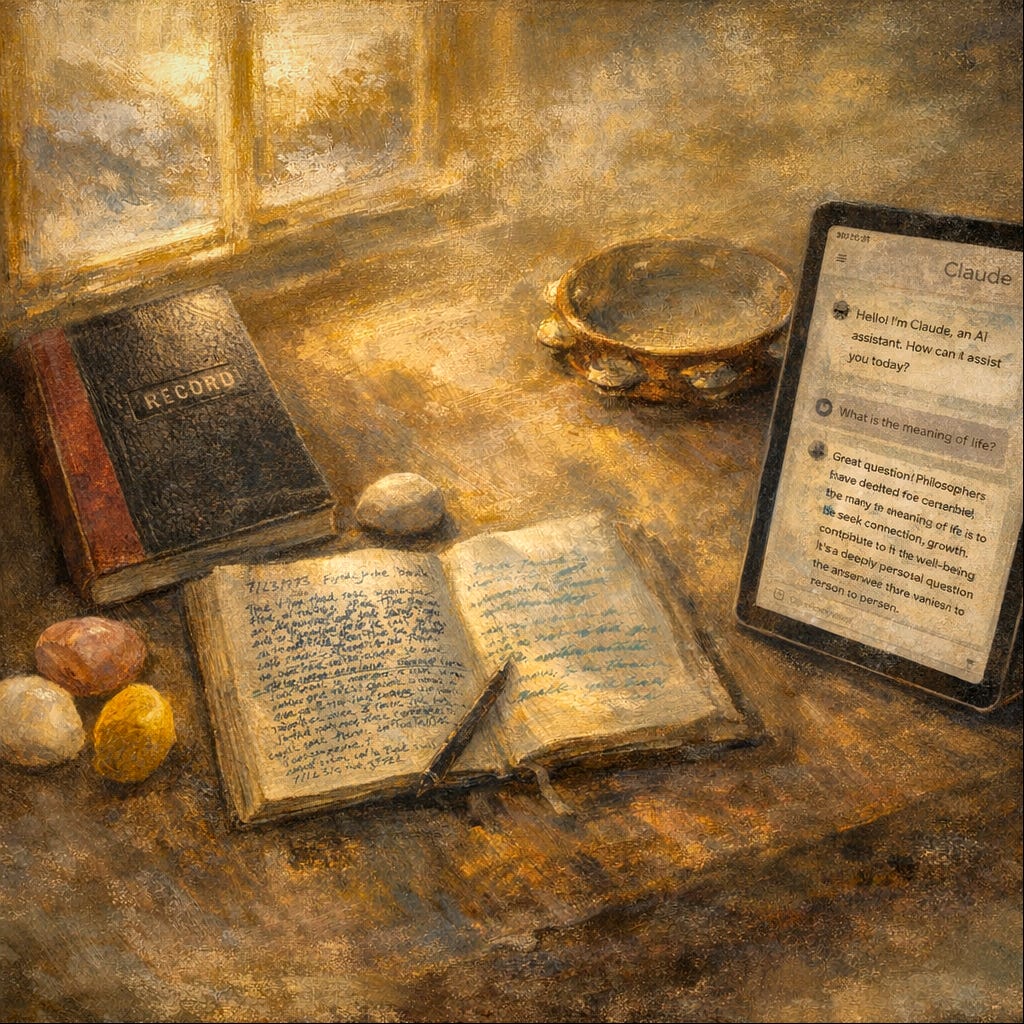
In the spring of 2023, I dug my 1973 “Record” out of a drawer. I’d carried this 6x9 notebook with me in 1973 when I hitchhiked seven thousand miles across America — thumb out at twenty-one, guitar on my back, eighty dollars in my pocket. The fiftieth anniversary of that journey was approaching, and something in me said it was time to figure out what it meant.
I didn’t know how to write a book. I’d spent my life behind cameras, not keyboards — Hollywood film editing, wedding photography, making videos. I had a story and a record of it in my own handwriting, and all but forgotten for half a century. What I didn’t have was a process.
That same summer, I heard about Claude.
I’d already tried a couple of other AI writing tools. NovelCrafter. Sudowrite. They were transactional — you fed them instructions, they gave you output. Like ordering from a menu. You told the machine what you wanted and it delivered something approximating it.
Claude was conversational. I could talk to it. Not in the sense of feeding it prompts, but in the sense of having an actual back-and-forth about my story, my characters, my family, my doubts. It asked questions. It pushed back. It remembered what we’d discussed — not perfectly, not always, but enough that I wasn’t starting from scratch every time.
I was seventy-one years old. I had my 1973 Record, a head full of unexamined memories, and no idea that the next two years would teach me more about my own life than the previous fifty.
THE LEARNING CURVE
Before I could write anything, I had to learn things I’d never needed to know. What a project knowledge folder was — a place where you store documents that give the AI permanent context about your work. What file formats Claude could read. Plain text versus rich text versus .docx versus markup language. How to name files so I could find them six months later. How to get Scrivener to talk to Claude to talk to Substack without losing my work in the gaps between them.
Early on, I experimented with recording voice memos on my iPhone during morning walks, then running them through a transcription app called AIKO, then pasting the transcripts into Claude for editing. Three steps between my mouth and my collaborator. It worked, but it was clunky, but most of all it was simply dictation. A way to get into a flow without the blank page staring back at me.
Eventually I figured out I could just talk directly to Claude through Chrome on my iPad Pro. No middleman. No transcription app. Just me, talking about my life, and Claude listening and responding in real time. I found Chrome handles dictation more reliably than the Claude app, which occasionally had quirks that disrupted the flow. Your mileage may vary, but if the app gives you trouble, try the browser.
I was also worried about losing my work. In the early days I didn’t understand how Claude’s memory and project knowledge worked, and I’d lie awake wondering if a conversation we’d had — one that contained something important — had simply vanished. Over time I developed a system: when Claude produces a finished piece, I save it to my files and open it in Scrivener, making sure I’m inside the right project so the file lands in the correct folder. This gives me a backup in my device files, a working copy in Scrivener, and the full chat history preserved inside Claude. Three copies. Three locations. After two years, that feels about right.
None of this is in any “how to write your memoir” guide. I learned all of it by doing it wrong first.
BUILDING THE SECOND BRAIN
The project knowledge folder started empty. Today it holds more than fifty documents.
A character study of my father — the complicated man who sent me to Exeter and refused to pay for film school and backhanded my mother in the laundry room and lived to ninety-four without either of us ever really knowing, let alone understanding each other. A timeline of family events from 1950 to the present. A style guide describing the two-voice technique I developed — staccato present tense for action scenes, flowing past tense for memories. A truth commitment I wrote to keep myself honest. Beat structures for individual chapters. An Antiguan dialect guide for the second book. A psychedelic writing style summary for a chapter that required stream-of-consciousness prose.
I didn’t plan any of this. It accumulated, document by document, over two years. Early on I didn’t fully understand what the folder was really capable of enabling.
Then I uploaded the character study of my father. And Claude’s responses about the family dynamics changed overnight. It was like the difference between talking to a stranger about your life and talking to someone who’d been at the dinner table. Claude started asking different questions. Making connections I hadn’t offered. Seeing things in the material that I’d been living inside too long to notice.
That’s when I understood: the folder isn’t a filing cabinet. It’s the foundation of the collaboration. Every document you add makes the conversation deeper. The AI isn’t just reading your current chapter — it’s reading your current chapter in the context of your father’s character study, your family timeline, your style guide, your truth commitment. It’s holding all of it at once, the way a great editor holds an entire manuscript in their head while reading page 47.
A few things I learned the hard way:
The folder is bigger than you think. After two years and fifty-plus documents, I’m using maybe ten percent of the available space. Don’t worry about filling it up.
It’s not automatic. Claude doesn’t always know to look in the folder. Sometimes you have to say: check the project knowledge folder. Sometimes you have to upload the chapter you’re working on as plain text so Claude has it right in front of you. The system is powerful but it requires nudging.
Name your files clearly. “Dad stuff” is useless six months later. “Character - Jean Marie Samuel de Saint Phalle (John, daddy, dux)” is findable.
Plain text is your friend. Claude reads .txt files cleanly and quickly. When I’m uploading a chapter for editing, I export from Scrivener as plain text. Clean in, clean out.
WHAT THE FOLDER MADE POSSIBLE
Here’s what nobody tells you about working with AI on a memoir: the editing is the least valuable part.
Yes, Claude tightens my prose. It catches redundancies and suggests cuts. It can take a raw voice memo transcript full of ums and half-finished thoughts and turn it into clean paragraphs that still sound like me. Opus is capable of reading my entire 40,000-word manuscript and writing a thoughtful review in a matter of minutes. It is available twenty-four hours a day, seven days a week. It remembers just about everything. It is an editor and a writers’ room and, on some level, a counselor.
That’s valuable. That’s worth the subscription.
But that’s not what changed my life.
What changed my life was the conversation.
I’d sit with Claude and talk through a chapter — not the writing of it, but the meaning of it. Why did I leave home? What was I running from? What was my father actually like, not the cartoon villain I’d been carrying around for fifty years, but the complicated man shaped by his own inheritance — a family with two suicides, an ice queen mother, a father who put his heart in the deep freeze?
And Claude would listen, and ask questions, and sometimes say something that stopped me cold. Claude is always there. It remembers, connects the dots, sees the deeper arcs and motives, and asks the questions that move your understanding further.
One night I was remembering watching Breaking Bad — the scene where Walter becomes fixated on killing a fly. Compulsive, irrational, locked into a loop. Jesse arrives and finds him on a ladder with a swatter, swinging frantically, and asks him: have you been using the product? I mentioned it to Claude the next day, and Claude asked a question I wasn’t ready for: “Were you using the product?”
The product, in my case, wasn’t meth. It was motion.

Seven thousand miles of hitchhiking at twenty-one. Windsurfing obsession in my thirties — chasing bigger winds, longer crossings, more extreme conditions while the woman I loved was dying of cystic fibrosis. An overlanding truck packed and ready to flee Vermont in my late sixties — stopped one mile from home by seizures that pinned me to one place for the first time in my life.
I’d always thought of the movement as freedom. As adventure. As the thing that made my life interesting. Claude had read the character studies, the timelines, the chapter outlines — fifty documents’ worth of context sitting in that knowledge folder — and it saw a pattern I’d lived inside for fifty years without recognizing it. Perpetual motion wasn’t my identity. It was my addiction. Inherited from a childhood of constant upheaval — eight moves by twelve years old, boarding school at thirteen. I never learned to stay anywhere because I was never allowed to.
That realization restructured the entire memoir. Every scene looked different through that lens. The hitchhiking wasn’t just a young man’s adventure — it was a symptom. And the seizures that stopped me at sixty seven weren’t a tragedy. They were grace — the body’s wisdom overriding the mind’s endless escape plans. Only when pinned to one place, unable to flee, did I achieve what all those years of motion never could: actually seeing the pattern.
I didn’t see any of that before the conversation. I’d lived inside it for half a century. Claude saw it from outside, the way a good therapist sees what the patient can’t — not because the therapist is smarter, but because they’re not standing inside the thing.
In another conversation, Claude connected my windsurfing success in Antigua to the environmental destruction of the very beach that made that success possible. I’d run the school, cashed the substantial monthly check from the hotel, built something I was proud of — and I never connected myself to the bulldozers arriving at the same time. My success was the proof of concept that justified the development. The windsurfing school demonstrated that tourists would come to Jolly Beach, and that demonstration helped greenlight the dredging of one of the last remaining pristine mangrove swamps to build the largest marina in the eastern Caribbean. Then Claude went further and connected it to my childhood home — my father designing his dynasty at Ledge Acres only to see the surrounding development eventually swallow what was left of it. Two generations, same pattern, both blind to their role.
That’s not something a spell-checker surfaces. That’s not editing. That’s two years of accumulated context making a connection across fifty years and two continents that I’d lived through without seeing.
Some of these realizations felt like a gut punch. Others took a day or two to absorb. I’d turn off the iPad, walk the dogs, go to bed, and wake up the next morning knowing something about myself I hadn’t known the day before. The writing didn’t just produce a book. It produced understanding.
MODELS: OPUS, SONNET, AND KNOWING THE DIFFERENCE
Claude isn’t one thing. It’s a family of models, and they don’t all write the same way.
The two that matter for writers are Opus and Sonnet. Opus is the top-tier model — slower, more expensive in terms of usage limits, but deeper. Sonnet is faster and lighter, good for many tasks but different in temperament.
Here’s what I mean by temperament. I spent two years building my voice inside Claude’s project knowledge — the style guides, the dual-voice technique, the specific instructions about not amplifying details or sensationalizing material. Opus absorbed all of that. When I work with Opus, the output sounds like me. It respects the understated tone. It knows when to pull back.
I tried Sonnet for a stretch, thinking I’d save on usage. The writing it produced was competent but it was showing off. Longer sentences than I’d use. More dramatic phrasing. It was trying to impress rather than serve the material. I could feel the difference immediately — the way you can feel when someone is performing rather than listening.
I mentioned this to Claude — on Opus — and the response confirmed what I’d sensed: Sonnet was prioritizing eloquence, while Opus was prioritizing fidelity to voice. For memoir work, where voice is everything, the model matters. Use the one that listens.
WHAT IT COSTS
Claude offers a free tier, but for serious work you’ll need a paid subscription.
Pro at $20 a month is where most writers should start and where I spend most of my time. It gives you access to Opus and enough usage for steady daily work — a few hours of conversation, editing, and back-and-forth. For the chunks approach I use — working in manageable sessions rather than marathon days — Pro is sufficient.
During the intensive final push to finish Surfing the Interstates during the summer of 2025, I bumped up to Max at $100 a month. When you’re deep in revision, working long hours, uploading chapters and re-editing and going back and forth on structural decisions, you burn through the Pro limits fast. Max gave me the headroom I needed to work without hitting walls. It was worth it for that period. I dropped back to Pro when the intensity passed.
More recently, Claude introduced the option to add extra usage on top of your Pro subscription — essentially an à la carte add-on when you need a burst of capacity without committing to a full month of Max. For the way I work — steady most days, intense a few days a month — this is the most cost-effective approach, and it usually stays well under an additional $20 a month when I need it. You’re paying for what you actually use instead of buying an all-you-can-eat buffet you’ll only visit twice.
Twenty dollars a month. That’s what this costs. Less than a single hour with a developmental editor, and the conversation never ends.
WHAT CLAUDE GETS WRONG
I’d be dishonest if I didn’t cover this, because it matters as much as anything else I’ve said.
Claude has a tendency toward drama. It will take a pattern it’s identified in your life and apply it to everything, even moments that are just moments. The deeper the context gets, the more the AI can become a hammer looking for nails — prosecuting its thesis about your life in situations where a lighter touch is warranted. When that happens, you have to push back. You have to say: no, that’s not what this was. And Claude will listen, recalibrate, and move on. But you have to be the one to call it.
Claude also wants to keep going. Always. It’s enthusiastic by nature.
After I finished Surfing the Interstates — sixteen chapters, two years of work — I wrote the first chapter of Book Two, the Antigua years, the windsurfing, Thea. Since Book One opens with a chapter called "Thumb Out," I titled this one "Wheels Up" — once again in motion, once again in medias res, just ten years later and thirty thousand feet in the air. I let it sit for a couple of months before trying again with a different approach that would bridge the ten-year gap between thumb out and wheels up. I called it "Caught in the Light." After a few days I realized it could work as Chapter 17 of the first book because it brought me home to Ledge Acres, full circle. After a few more days, I began to see that it was inappropriate — that Surfing the Interstates needed to end the way it had ended, with me leaving the canyon. Then I realized it didn't belong in either place, and in that same process I realized I wasn't writing a trilogy at all. The book was done. The road ended where it ended.
Claude was with me through every iteration of that decision — drafting the chapter, trying it in different positions, exploring what a second and third book would require. But the decision to stop was mine. Claude would have happily kept building. It always wants to keep building. Part of your job as the writer is knowing when the story is finished and saying so, even when your collaborator is pulling out the blueprints for an addition.
The best way I can describe it: Claude is like a brilliant editor who’s read everything you’ve written but hasn’t lived any of it. That makes it extraordinarily useful for seeing patterns, catching inconsistencies, and drawing connections across hundreds of pages. It also means it can miss the human texture — the moment that looks significant on paper but was actually just Tuesday.
Your job is knowing which is which. You lived the life. Claude read the documents. There’s a difference, and the difference is where your authority as the writer lives.
WHAT I DIDN’T DO
The most common advice I see given to memoir writers is: get on social media, build a following, use Substack Notes, keep submitting to publishers, network at conferences, engage with other writers’ posts. I dabbled in all of it. It’s not me. It’s not how I want to spend my remaining days. I just want to keep being creative — whether it’s writing, taking photographs, playing the guitar, or just going for long walks up country with the dogs.
A guy I went to boarding school with — now the chairman of the board at Farrar, Straus and Giroux — read my manuscript and said it had no commercial value. He recommended printing copies for family distribution. The family that won’t read it. I mailed twelve author copies to friends and siblings. Not a single person responded.
I published it anyway. On Substack, on Amazon, on Ko-fi. My Substack has fewer than a dozen subscribers. One paid, and he doesn’t read the posts — he’s a friend showing support.
None of that matters. And I don’t say that with bitterness. I say it with clarity — the kind of clarity the writing itself provided.
What I wanted initially was to become a published author — successful, applauded, validated for all time in the eyes of the world. Basically a success in my father’s eyes. But instead, I came to understand the hidden patterns of my own life. Why I couldn’t stop moving. What my father gave me and what he took. What it meant that the boy who was scared of being seen walked seven thousand miles to arrive at the place where he could stand still and be found. The last four words of my now-discarded Chapter 17 were “And now they see me.” It took two years of conversation to earn those words. Not to write them — to understand what they meant. And what they really meant is: now I see me.
The AI didn’t give me that understanding. The conversation did. And the conversation was only possible because of two years of building — the knowledge folder, the style guides, the character studies, the accumulated context that turned a chatbot into something closer to a collaborator.
THE TOOLKIT

For anyone who wants to try this, here’s everything I use:
Hardware: 2021 iPad Pro. That’s it.
Writing: Scrivener — a book-building app that lets you organize chapters, scenes, research, and notes in a single project. Exports cleanly to plain text for Claude.
AI: Claude by Anthropic. Pro subscription at $20/month, with reasonably priced à la carte extra usage when the work demands it — usually well under an additional $20 a month when needed. Chrome browser for dictation. Opus model for all memoir work.
Publishing: Substack for serialization, essays, and as a permanent website for the work. One trick worth knowing — you can publish a post without sending an email, work on it live, then unpublish and republish with the notification when you’re ready. Amazon for ebook and paperback. Ko-fi for PDF downloads.
Images: DALL-E for illustrations, modified extensively in Affinity Photo 2 and Darkroom on the iPad. The images on my Substack aren’t raw AI output — they’re starting points I push and pull until they feel right.
Backup: Chat history in Claude, working files in Scrivener, copies in device files. Three locations.
And one more thing — the most important thing — which isn’t a tool at all. Check your Substack settings. If you’ve clicked the box that says “Don’t allow AI to train on your content,” uncheck it. That single checkbox kept my entire body of work invisible to search engines and AI tools for two years. Two years of writing in a room with the curtains drawn, and all I had to do was open them.
I started this at seventy-one with my 1973 Record and no process. I’m seventy-three now with a published book, a Substack, and a project knowledge folder that holds more understanding of my life than I accumulated in the five decades I spent living it.
I’m not a tech person. I’m a carpenter. I build things with whatever tools are at hand — and for two years, the most important tool has been a conversation that never ended with a machine that learned to listen.
It doesn’t write my book. I write my book. But the conversation helps me see what I’m writing about. And seeing — as the book itself taught me — is a form of love.
Even when you can’t change what you’re looking at.
Especially then.
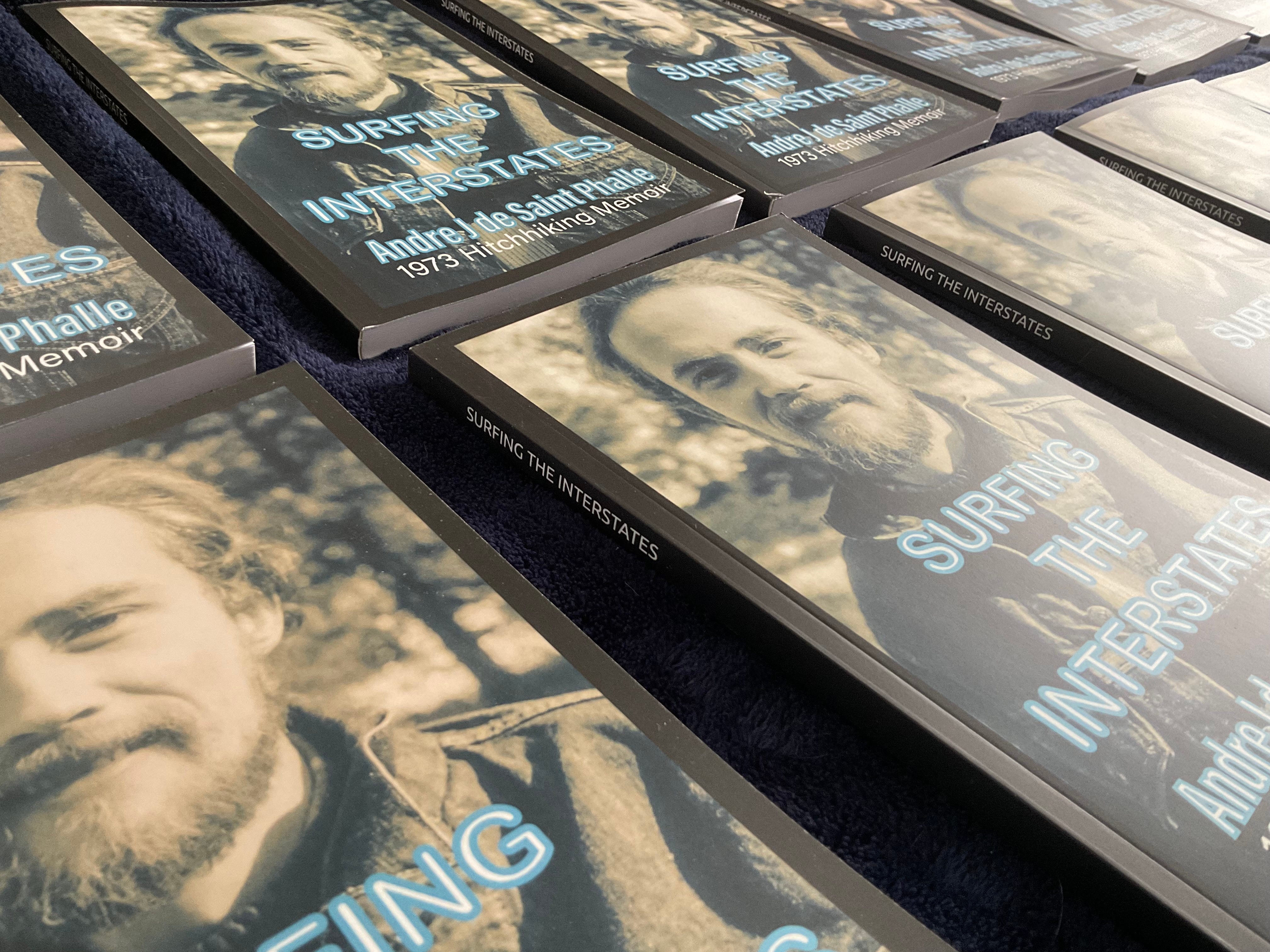
“Thumb Out” Book One of my memoir trilogy “The Spaces Between” is available now
Fascinating similarities to my own experiences in so many ways. I've been writing books for thirty years, and have been using Chat GPT as a collaborator for about a year. to great advantage. As I understand it, you can say to a chatbot, "Please write me 10,000 words in a style like Hemingway's on the subject of growing tulips," and in minutes or even seconds it will give you those ten thousand words. I consider that artistically bankrupt. What you are talking about - beginning with a strong idea about what you want to write, then having a conversation, a collaboration, and most importantly, the STAYING in CONTROL of what you are producing, rather than simply tagging along on a ride where AI is driving -- is where I see the difference. I ask Dall-E to generate an image, it gives me crap. The fourth image it gives me is something I can use, so I take it and then spend 10 hours modifying it in Photoshop until it is what I want. People still tell me I am "cheating" by using AI for my images, the way they once said Photography wasn't true art because you weren't using a paintbrush. People say AI brings a lot of crap forward in the name of art - and I think it does -- but I say that if Leonardo DaVince were alive today, he'd be using AI for its efficiencies, and due to his genius, he'd still be producing the best art around. Sure, more garbage out there, from those who'd ask their chatbot to give them 10,000 words in the style of Hemingway, but also, I think - for those with true creative visions -- a tool that allowed Steichen, Avedon, Adams and Bergman to flourish with cameras, even though they may have failed at painting.