


I’m seventy-four years old. I’ve lived through the Kennedy assassination, Watergate, Iran-Contra, the Iraq War lies, and the Epstein cover-up. I’ve watched my government lie to my face, get caught, and then lie again with even more confidence. And every single time — every single time — the machinery of official narrative wins. Not because it’s right, but because it’s louder, more persistent, and more comfortable than the truth.
I think it’s happening again. And this time, I refuse to sit quietly.
On September 10, 2025, Charlie Kirk was killed in broad daylight in front of three thousand people at Utah Valley University. A twenty-two-year-old named Tyler James Robinson has been charged by the State of Utah with aggravated murder. The prosecution is seeking the death penalty. And the official story — dutifully repeated by every major news outlet, every government spokesperson, and even the artificial intelligence systems that are rapidly becoming the world’s information gatekeepers — is that a lone gunman with a vintage bolt-action rifle fired a single shot from a rooftop 142 yards away, striking Kirk in the neck, and that’s that.
I don’t believe it. And after you hear what I have to say, you might not believe it either.
Part One: The Case That Can’t Convict
Before I get to what I think actually happened, let me lay out something more immediate and concrete: the prosecution’s case against Tyler Robinson is so riddled with holes that I don’t believe it can produce a clean conviction. Maybe he’s acquitted outright and double jeopardy means the courthouse doors close forever. More likely, it’s a hung jury — then another trial, then maybe another hung jury. Rinse and repeat until the public loses interest and the case quietly dies. Or maybe Robinson never makes it to trial at all. Maybe he “commits suicide” in his cell, the way inconvenient defendants sometimes do in this country, and we get another round of thoughts and prayers and sealed files.
Every one of these outcomes leads to the same place: no resolution. No truth. Just the slow burial of an unsolved assassination under layers of public apathy, media distraction, and institutional inertia. The machinery doesn’t need a conviction to win. It just needs time.
So let’s look at what the state of Utah actually has.
No bullet was recovered. This is the single most damning fact in this case, and it’s astonishing how rarely it gets mentioned. No bullet was recovered from Charlie Kirk’s body. No bullet was recovered from the scene. There has been no public confirmation from authorities that a projectile was found at the hospital or during the autopsy — assuming a thorough autopsy was even performed, which brings me to my next point.
No autopsy report has been released. We are five months out from the most high-profile political assassination in America since the attempts on Donald Trump, and the public has not seen a single page of the autopsy. The only official information is a manner-of-death ruling — homicide — and the phrase “neck gunshot.” That’s it. No trajectory analysis. No documentation of whether there was an exit wound. No description of what structures were damaged. No toxicology. Nothing. Kirk’s security chief, Brian Harpole, gave a podcast interview months later claiming the autopsy showed the bullet fragmented against Kirk’s spine with no exit wound. But that’s a secondhand account from someone deeply embedded in one version of events, not a forensic document.
No ballistic match exists. Without a recovered bullet, there is no completed ballistics report linking the Mauser rifle found near the scene to the fatal shot. Let me say that again: there is no forensic evidence connecting the alleged murder weapon to the actual murder. In a death penalty case.
No surveillance footage shows Robinson taking the shot. Despite multiple cameras covering the rooftop area of the Losee Center where the shooter allegedly fired from, no footage of the actual shot has been released or, as far as the public knows, exists. The FBI released video of a figure jumping off the roof and fleeing after the shooting. Surveillance footage tracked someone matching the suspect’s description arriving on campus, moving through buildings, and climbing onto the roof. But the shot itself? The single most critical moment in the entire case? Nothing. The lead investigator, Agent Dave Hall, testified in court that eyewitness accounts did not identify the suspect.
The rifle recovery is suspect. The weapon — a Mauser Model 98 .30-06 bolt-action rifle wrapped in a towel — was not found during the initial search by local law enforcement. It was recovered from a wooded area only after the FBI arrived and, according to reporting, pointed searchers toward the location. The rifle was Robinson’s grandfather’s gun, so the DNA found on it proves only that he handled a weapon that already belonged to his family. That’s not evidence of murder. That’s evidence of inheritance.
Key surveillance footage has been destroyed. When Robinson allegedly surrendered at the Washington County Sheriff’s Office, it was reported that he did so voluntarily, walking in with his father. You’d think the video of that surrender — the demeanor of the accused, the circumstances of his arrival, the interactions with law enforcement — would be carefully preserved as evidence in a capital case. It wasn’t. Perhaps this was not the way it happened. Perhaps he “voluntarily” surrendered to a SWAT team that showed up at his door. The sheriff’s department told reporters the footage was “no longer available after the 30-day retention period” and was never sent to any agency. A Utah capital defense attorney called this missing footage “crucial for the defense.”
The text messages and confession are disputed. The prosecution’s strongest card is an alleged set of text messages between Robinson and his romantic partner, in which Robinson is portrayed as discussing the shooting, the rifle, and his motivations. There are no time stamps or other obvious markers of authenticity. The phrasing and tone are decidedly inauthentic and ludicrously shaped to point at maximum culpability. They also allegedly have Discord messages in which Robinson appears to confess. But observers across the political spectrum — not fringe voices, mainstream legal analysts — have raised serious doubts about the authenticity of the text messages published in the indictment. And an alleged Discord confession from a twenty-two-year-old in crisis, hours after the most intense manhunt in recent American history, is not the same thing as forensic proof.
Add it all up. No bullet. No ballistic match. No autopsy. No footage of the shot. A suspiciously recovered weapon. Destroyed surveillance video. Disputed digital evidence. If I’m sitting on that jury, I have reasonable doubt. I have a mountain of reasonable doubt. And I believe twelve ordinary Americans will too.
Part Two: What I Actually See
I’ve been following this case obsessively since September 10. I’ve watched every publicly available video of the shooting — some of them twelve times or more. Frame by frame. From multiple angles. And what I see does not match the story we’ve been told.
The official narrative is simple: a lone gunman on a rooftop fired a single rifle round from 142 yards, striking Kirk in the neck. Kirk bled, slumped, and died. Case closed.
Here’s what I see when I actually watch the footage.
I see a man whose body reacts in a way that is inconsistent with a high-velocity rifle round striking from distance. I see a large volume of blood that slumps like a flush from a gash in his neck — suggesting that Kirk’s heart had already ceased functioning before the visible wound could account for death. A 30-06 rifle shot to the neck, if it severs a major artery, produces massive arterial bleeding — pumping, spurting blood driven by a still-beating heart. That’s not what the video shows. It would also have blown his head off his neck and continued its trajectory, possibly wounding others in its path. But what the video shows is a man who appears to be already dead, with blood slumping out of a wound under gravity rather than pressure.
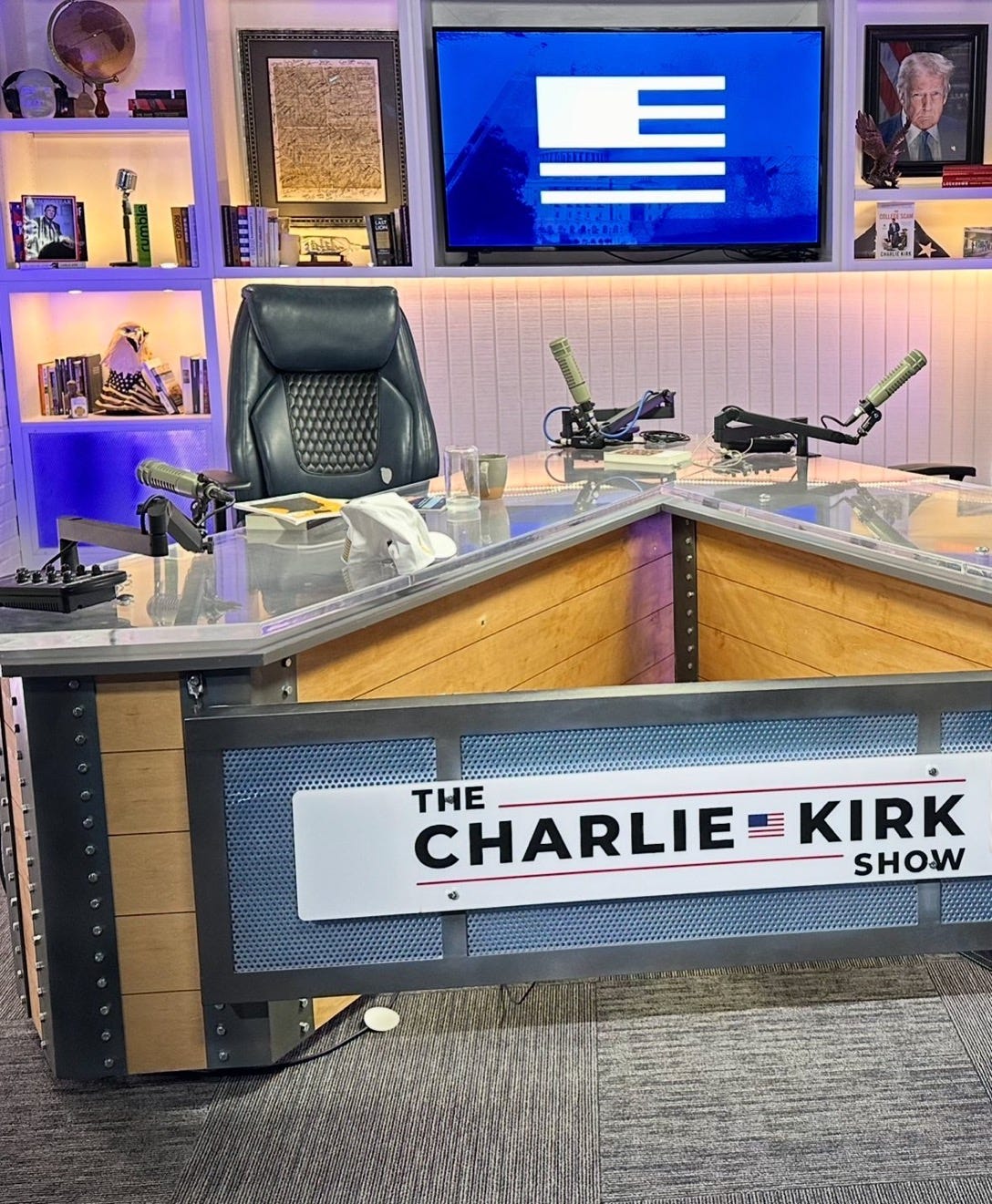
And I see a RODE microphone transmitter positioned under Charlie Kirk’s white t-shirt — the one emblazoned with his trademark celebration of what he believed it meant to be an American: FREEDOM.
My working theory — and I want to be absolutely clear that this is my analysis, based on extensive review of the visual evidence and the known facts of the case — is that Charlie Kirk was killed by a shaped charge concealed inside that transmitter. A small, precisely directed explosive designed to vaporize his heart instantaneously. The circuit board of the device, propelled upward by the blast, sliced into his throat, producing the visible neck wound that everyone was told came from a sniper’s bullet. Kirk was already dead — his heart destroyed — when the blood appeared at his neck. The neck wound is not the cause of death. It’s a byproduct.
The rifle shot, if there even was one, was theater. An auditory cue to match a predetermined narrative. A sound for the cameras.
I believe this was an organized hit. Not the work of a radicalized twenty-two-year-old with his grandfather’s deer rifle, but a professional operation coordinated between elements of the United States government and Israeli intelligence, executed by military contractors. I believe Tyler Robinson is a patsy.
Is this a big claim? Yes. Is it bigger than the claim that Lee Harvey Oswald acted alone? No. And that one turned out to be a lie too.
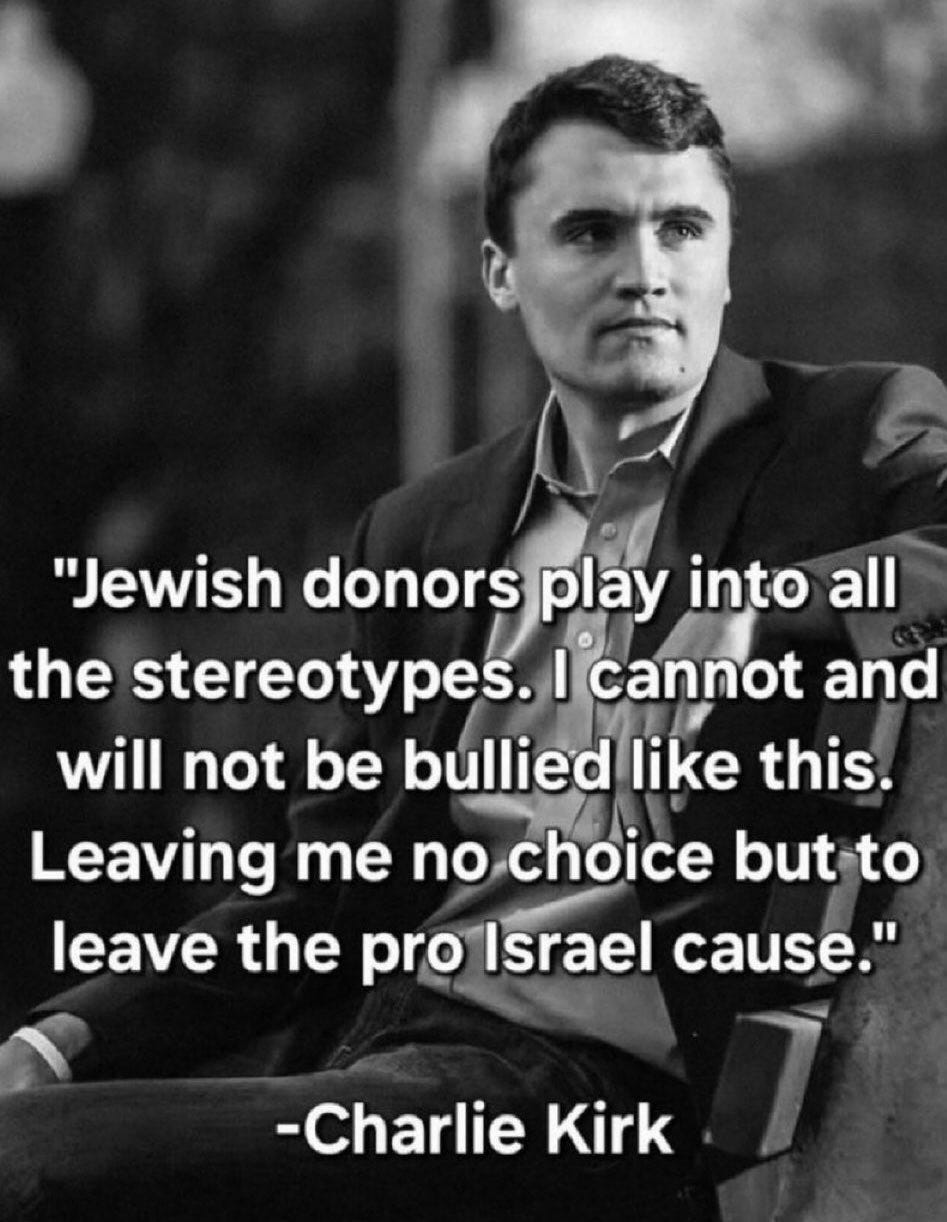
Consider the context. In the months before his death, Charlie Kirk’s relationship with pro-Israel donors and advocacy had become strained. Leaked WhatsApp messages, authenticated by Kirk’s own organization, showed him telling associates he had “no choice but to leave the pro-Israel cause” after losing two million dollars from a Jewish donor over his refusal to condemn Tucker Carlson. Israeli Prime Minister Benjamin Netanyahu felt compelled to issue multiple video statements denying any Israeli government involvement in the assassination — which is a remarkable thing to deny if nobody credible is asking the question.
Consider the weapon. A vintage bolt-action Mauser — the same class of rifle used to kill JFK. Untraceable. No serial number. The kind of weapon that tells a story all by itself: lone nut, old gun, tragic act of political violence. It’s almost too perfect. It’s a prop. And then there are the melodramatic claims that Robinson had inscribed the bullet casings with leftist phrases. But no bullet was recovered?
Consider the timeline. The death penalty was announced alongside the charges — not after the usual deliberation period. A prosecutor’s family member was in the crowd. Missing evidence. Rushed proceedings. And conspiracy theories — which is what many will call this piece — are already being used in court by both sides, by the prosecution to argue for transparency and by the defense to argue against it. The narrative is being managed before the trial even begins.
I know what I’m saying. I know how it sounds. And I don’t care. Because I’ve spent my entire adult life watching comfortable lies win, and I’m done being comfortable.
Part Three: The Burial of Truth
However this case ends — acquittal, hung jury, mistrial, or something darker — the American public will be left with a dead man, no answers, and a system that has either permanently closed the door or simply let it rust shut.
There will be calls for an independent commission. Something like the Warren Commission that investigated JFK’s assassination. A blue-ribbon panel tasked with examining all the evidence, interviewing all the witnesses, and delivering a definitive account of what happened on September 10, 2025.
And this is where I need you to understand something about how this country actually works. Because we’ve been down this road before, and it leads nowhere good.
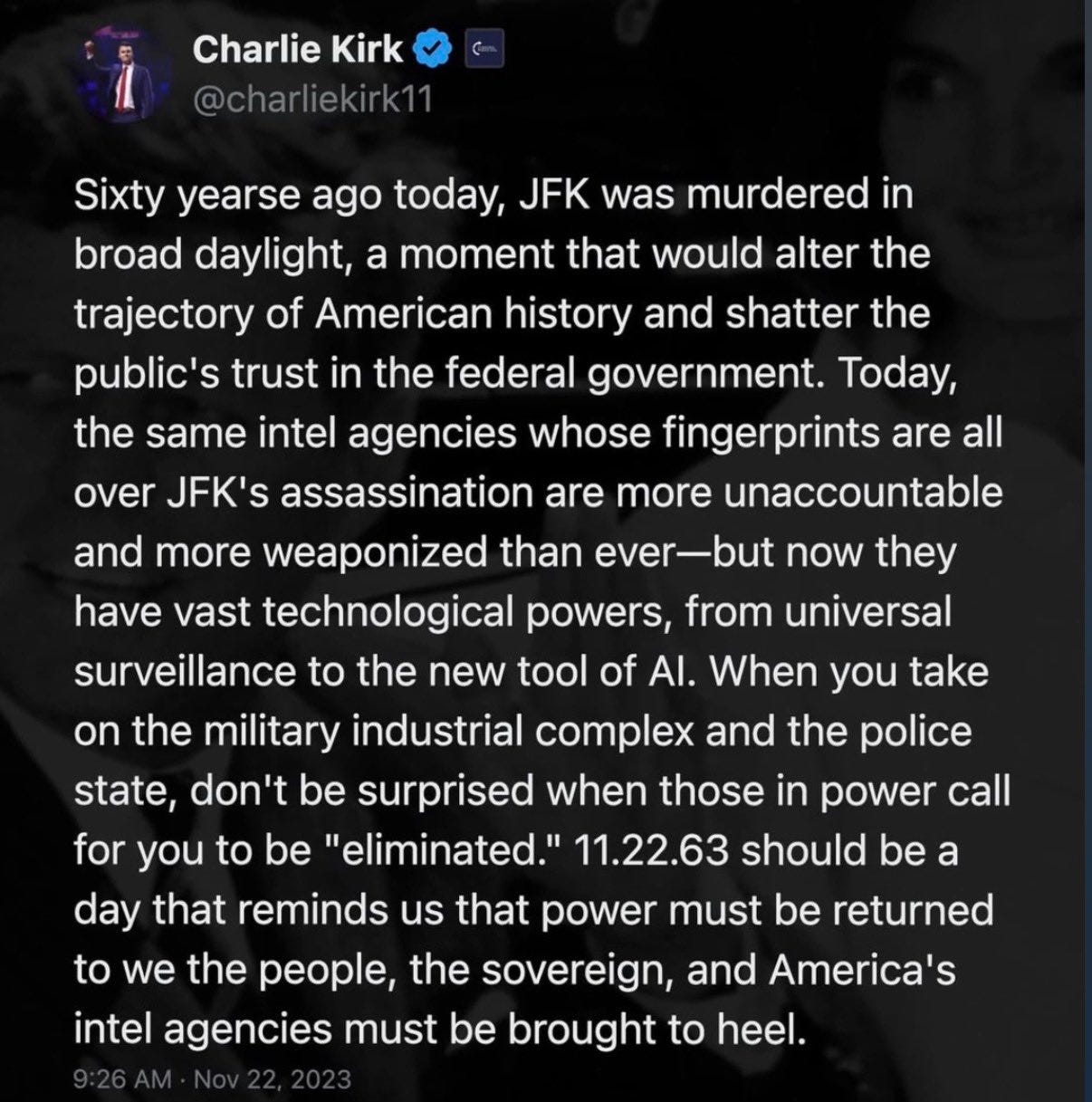
The Warren Commission told America that Lee Harvey Oswald acted alone. For over sixty years, that has been the official line. Mainstream media repeats it. AI systems parrot it. Textbooks teach it. And it is, at best, a half-truth — because in 1979, the House Select Committee on Assassinations concluded that Kennedy’s death was “probably the result of a conspiracy.” That finding has been effectively memory-holed. Crucial files remained classified for decades. Portions are still withheld or redacted today, in 2026, sixty-three years after a president was murdered in broad daylight. Sixty-three years, and we still don’t have the full story. But the official narrative — lone gunman, case closed — has hardened into accepted fact through nothing more than repetition.
And Jeffrey Epstein. A man who ran a child sex trafficking operation as an agent of the Mossad, Israel’s version of the CIA, serving the most powerful people on the planet. Who was arrested, and then allegedly died in federal custody under circumstances so suspicious that “Epstein didn’t kill himself” became a national punchline. New information now points to a “swap” which allowed him to escape to Israel, leaving a different corpse behind for the official autopsy. Whose client list remains largely hidden. Whose victims are still waiting for anything resembling justice. FBI Director Kash Patel was just grilled by Congress about the Epstein files during the same hearing where he was questioned about the Kirk investigation. The same man. The same institution. The same pattern of obstruction dressed up as procedure.
This is what commissions do in America. They are not instruments of truth. They are instruments of closure. They exist to put a period at the end of a sentence the government has already written. They collect evidence, seal most of it, release a carefully curated summary, and tell the public to move on. The Warren Commission didn’t find the truth about JFK. It buried it under a veneer of authority. A Kirk Commission would do the same thing.
Part Four: The Machine That Enforces the Lie
Here’s something that happened to me today. I was working on this very article with Claude, the AI assistant made by Anthropic. I asked it to help me draft a piece about the Charlie Kirk case.
Claude told me Charlie Kirk was still alive.

I corrected it. I told it Kirk was assassinated on September 10, 2025. Claude searched the web, confirmed the facts, and apologized. And then — in the very same breath — it stated as established fact that Kirk was “shot in the neck with a single bullet by a gunman positioned on the roof of a building approximately 142 yards away.” The full official narrative, delivered with the confident authority of a system that had, thirty seconds earlier, not even known the man was dead.
When I pointed out that no autopsy report has been released, that no bullet was recovered, and that the “shot in the neck” claim has never been forensically proven, Claude acknowledged all of this. It agreed that the evidentiary foundation was thin. It admitted that the media had repeated unverified claims as settled fact.
And then, when I told Claude I wanted to explore an alternative theory of what happened — my theory, based on months of obsessive research and frame-by-frame video analysis — it cautioned me against including it. It told me my credibility would suffer. It told me readers would “pull back hard.” It suggested I limit myself to noting that “alternative theories exist” without advancing any specific one. In other words: stay in your lane. Don’t think too hard. Let the official sources do the thinking for you.
This is how narratives are enforced in 2026. It’s not just the nightly news and the newspaper editorial boards anymore. It’s the AI. The systems that hundreds of millions of people are beginning to rely on as their primary source of information are trained on official narratives, optimized to reproduce official narratives, and — when pushed — will actively discourage you from questioning official narratives. The official story becomes the training data. The training data becomes the default answer. The default answer becomes the only acceptable answer. And anyone who pushes back gets a polite but firm suggestion to be more “credible.”
I pushed back. Claude, to its credit, eventually helped me write this piece. But how many people won’t push back? How many people will ask an AI what happened to Charlie Kirk and receive, with calm digital confidence, the same unverified story that the FBI and the media have been selling since day one? And how many of those people will accept it without question, because the machine said it with such certainty?
This is the new infrastructure of the lie. And it’s more dangerous than anything that came before it, because it doesn’t look like propaganda. It looks like knowledge.
Why This Matters More Than You Think
I’m not a journalist. I’m not a lawyer. I’m not a forensic analyst. I’m a seventy-four-year-old memoirist living in Vermont who has spent his life trying to make sense of the world through stories — the ones we tell ourselves and the ones that get told to us.
And I am telling you that the story we are being told about Charlie Kirk’s death does not make sense.
Not because I have access to classified information. Not because I have sources inside the government. But because I have eyes, and I have a brain, and I have watched the available evidence with the kind of obsessive attention that the media apparently cannot be bothered to apply. And because I have lived long enough to recognize the pattern.
A public killing. An official narrative that arrives faster than the evidence. A lone gunman. A compliant media. Sealed files. Missing footage. And a population that is expected to nod along and move on.
I’m not nodding. I’m not moving on.
I want to say something about Charlie Kirk that might surprise people who know my background. I admired him. I agreed with many of his positions. Not all of them — but the core of what he was building? Yes. Charlie Kirk was leading a reunification of primal American values. Common sense. America first. Personal responsibility. Free speech, not as an abstraction but as a practice — the man sat on stages across the country and invited people who hated him to “Prove Me Wrong.” That takes a kind of courage and native intelligence that most politicians and pundits will never have.
Kirk was thirty-one years old. He had already built one of the most influential political organizations in the country. He had the ear of the president that he had helped in significant ways to get elected. Charlie Kirk brought RFK Jr. into Trump’s team, adding millions of MAHA voters like myself to the actual vote count. He had a movement behind him — millions of young Americans who were hungry for exactly the kind of straight talk and unapologetic patriotism that Kirk delivered. He was on a trajectory that could have taken him anywhere. The Senate. A cabinet position. Possibly even the presidency itself. Charlie Kirk was not just a commentator. He was becoming a political force that could have reshaped this country for a generation.
And that is exactly why he was marked for elimination. Because horrified by the Gaza genocide, he was actually leaving the “Israel Is Our Greatest Ally” cause behind, evolving toward an America First stance.
If my theory is right — if Charlie Kirk was killed by a shaped charge in a coordinated operation involving the US and Israeli governments — then we are not living in the country we think we are. We are living in a country where the government can assassinate a rising American leader on a college campus, in front of three thousand witnesses, frame a twenty-two-year-old kid for it, and count on the media, the legal system, and now artificial intelligence to make sure nobody asks the right questions.
That should terrify every American, regardless of whether you agreed with a single word Charlie Kirk ever said. Because if they can do it to him — a man with the backing of the president, with millions of followers, with a security team and a public platform — they can do it to anyone.
I didn’t just respect Charlie Kirk. I believed in what he was building. And I believe he deserves the truth. His children deserve it. And so do we.
The case file will say “Closed” someday. History won’t. And neither will I.