


The scene that was born as the opening of Book Two, became the ending of Book One, and finally had to be set free
This one started life as Chapter One of Sahara Dust — the second book of my memoir trilogy, The Spaces Between. The idea was simple: before I could take readers to Antigua and the windsurfing years and Thea Ramsey, I needed to show them who I was before all of that. The man who came back from two months on the road in the summer of 1973, cracked open and owning nothing. The raw material Thea would find nine years later.
It was a bridge chapter. September 1973. I’m twenty-one. I’ve just hitchhiked seven thousand miles across America and back. My father has left. The family home has been sold. And I’m standing on a dirt road in Armonk, New York, watching my two youngest siblings walk home from school in the late afternoon light — not knowing that I’m seeing the last peaceful moment before everything falls apart for all of us.
I loved that moment. I called it “Caught in the Light.”
The problem was, it didn’t belong where I put it. As an opening chapter of the Antigua book, it was too far from the Caribbean — a long stateside detour before the reader ever smells salt air. So I moved it. Made it Chapter Seventeen of Surfing the Interstates, the hitchhiking memoir. A homecoming. A coda. The boy who left in Chapter One returns as a different person in Chapter Seventeen, and the book ends on a dirt road instead of in a canyon.
That didn’t work either. The hitchhiking memoir had already found its ending — Santa Elena Canyon, Big Bend, Texas. The moment the road stripped me down to nothing and I had to decide whether to keep going or turn back. That was the real ending. Adding another chapter after it was like applauding after the last note of a symphony and then playing one more movement. It diluted what the canyon had done.
So I cut it. Went back to the original sixteen chapters. The book ends in the desert where it should.
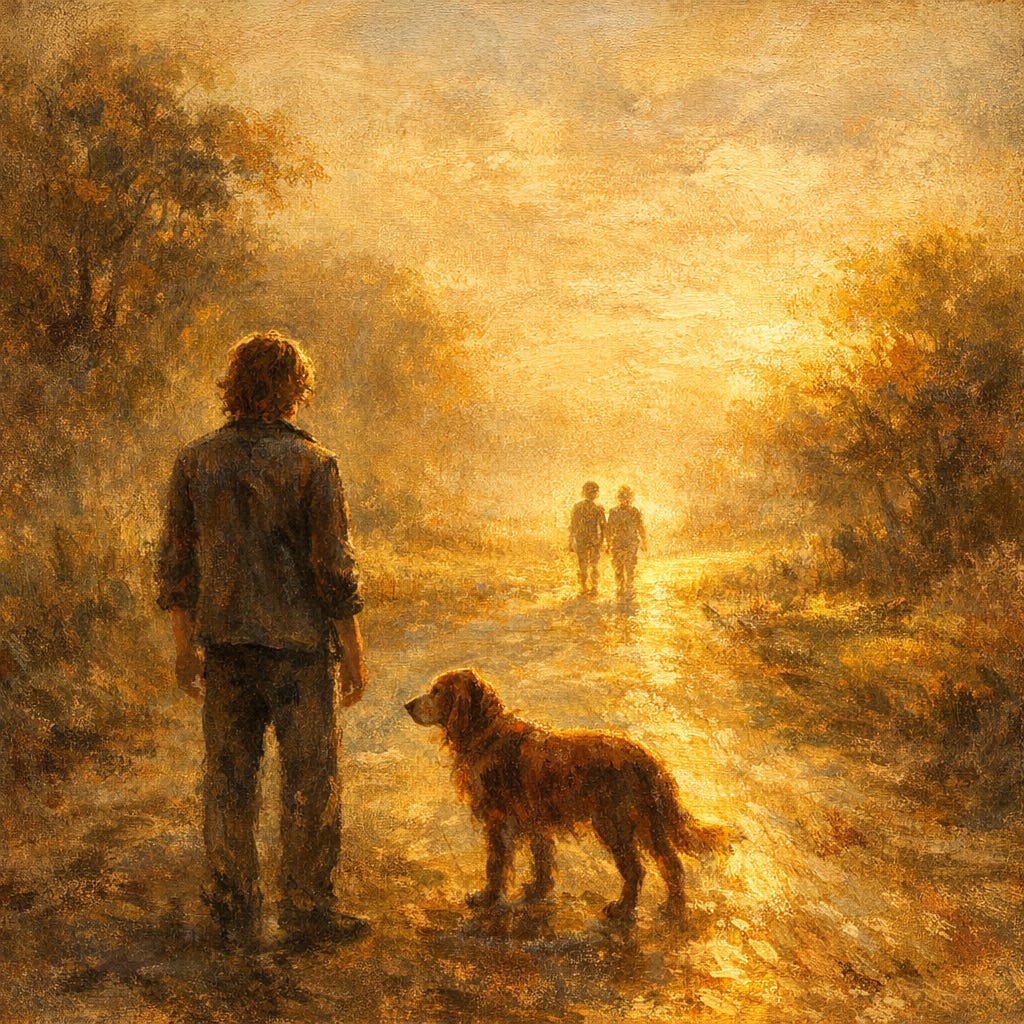
But the scene kept following me around. Because the moment itself — standing on Oregon Road with an arthritic dog, watching Charlie and Anni come over the hill holding hands in their school uniforms — that moment is real. It happened. And it’s the truest portrait I have of who I was in the fall of 1973, between the road and whatever came next.
Since I’ve decided not to write Sahara Dust as a book — these stories live here now, as portraits and vignettes from my Antigua years — I thought I’d share this orphan chapter with you. Not as Chapter Anything. Just as a moment. The moment before the lost decade. The moment before Thea.
If you’ve been reading the Sahara Dust pieces on this Substack, this is who that guy was before any of it happened. Empty hands. Terrible clarity. A heart with no shell around it. Already carrying the pattern that would define everything that followed — the leaving and the coming back, the leaving and the coming back.
Here it is. The chapter that couldn’t exist.
Caught in the Light
Another two thousand miles. Another two weeks of strangers’ cars and highway shoulders and sleeping where I dropped. But now Oregon Road is under my feet and the dirt smells like childhood and I can’t move.
From up here in the pines I can see the whole of Ledge Acres below me to the east — twenty-five acres at the end of this dirt road, the white farmhouse listing in the September light like a ship that’s found its reef. I don’t know what’s waiting down there. My father, sitting in his study with that look. All of them, wanting answers about the money. Or just silence and dust and the echo of thirteen years draining out through the floorboards.
I pitch my tent. Hang my gear to dry. Sit with it. I have no plan. No money. No guitar. No idea what comes next. The road took everything I was carrying and what’s left is raw and soft, like a creature between shells — the old one cracked off somewhere in a desert canyon and the new one not yet formed. Every sound too loud. Every thought too close to the surface. I am open in a way that feels like it could kill me.
Finally I scramble down the hill, through the stone gate, down the little staircase into the driveway.
Silent. No car. No voices. Nothing.
Inside, the house is already a museum of itself. The hallway where Dux lined us up before church — checking fingernails, shoe polish, posture — just a hallway now, dust floating in a shaft of light. The living room where I learned what a family looked like by watching ours through a window. Smaller than I remembered. All of it smaller. The kitchen where mama kept six of us alive on nerve and love alone. Where something happened once that I still can’t say out loud. The washing machine is quiet.
Back through the house to Jimmy Matsudo’s quarters. My old room. Dead posters, empty baggies, steamroller pipe, door wide open. Two months gone and nobody’d even closed it.
I stand there. Thirteen years of this place and it’s already letting go of me. Or maybe I let go first. Maybe I let go the morning I walked down this road with eighty dollars that weren’t mine and didn’t look back until now.
In the breezeway behind the kitchen, in the shade — Corky. Asleep the way old dogs sleep, deep and twitching, legs running through some dream where they still work right. I kneel beside him. Scratch his cheek. His eyes open slow. Cloudy. Half-deaf and arthritic but that tail still knows me. No bark. Just the tail, thumping against the concrete, and then he’s on his feet, unsteady, pressing his nose into my hand. He falls in beside me like no time has passed at all.
We climb the staircase together, through the gate, back onto Oregon Road. Heading to my tent. Not thinking about anything. Just walking the way I’ve been walking for two months. One foot and then the next.
Then I stop. Corky stops.
Coming toward us from the south, a couple hundred yards down the road where it drops toward 684 —
Golden hair first. Blonde hair, straight and fine, backlit by the late afternoon sun coming from behind them and to the right. Low slanting light, the kind that dissolves edges and makes the world look like a memory even while you’re standing in it. Then their heads. Their shoulders. Small bodies in navy and white, Rippowam uniforms, collared shirts. Books in one hand each.
And their free hands holding each other.
Charlie. Twelve. Anni. Ten. Walking home. They don’t see me yet.
My heart so full I think my chest will crack. For a moment everything feels the way it used to — safe, whole, the way it felt when all six of us orbited this place like planets around a sun.
But that sun had already gone out. And the canyon gave me eyes to see it.
I need you to see them the way I saw them. Charlie — tall for twelve, lanky, easy in his body and in the world. The kind of kid who made friends without trying, who carried something underneath that easy surface I wouldn’t recognize for years. Anni — smaller, compact, fierce even in stillness, hair almost white-gold, a way of looking at the world that was already defiant, already measuring. She’d thrown food at Dux from her highchair before she could talk. He called her Stinky after that.
They were the babies. Youngest two of six, and the only ones truly native to this place — born right here, rooted from their first breath. A solid decade of one address, one school to walk home from holding hands. They had lifelong friends. I’d moved eight times by their age. I’d lost touch with all of mine, again and again.
The four older siblings were already into our own orbits — I was the firstborn, camped across the street from a house I couldn’t enter. The youngest of us four, Jacques, was sixteen, and he had something none of us had. He stood up to Dux more aggressively than I ever dared, and he paid for it. Where I got the belt and retreated into silence, sometimes sobbing, Jacques got the hockey stick and came back for more.
And now here come the last two of us, walking up the hill in the golden light. From where I stand they look like pure possibility. Like a village on the last peaceful morning before the eruption.
Dux had left for a Manhattan apartment. Mama was overwhelmed. Nana was aging. And Charlie and Anni are walking home as if home will always be there, because for them it always has.
Something stands up in me. Something new. These precious innocents are somehow mine. I need to stand between them and what’s coming.
It isn’t virtue. It isn’t heroism. It’s what’s left when everything else has been stripped away — just a heart with no shell around it, seeing too clearly and wishing it couldn’t. I can feel their futures approaching and I have nothing to stop them with. No money, no plan, no home of my own, no authority, no standing. Just a kid not much older than they are, gutted by the road, standing in the dirt with an old dog and empty hands.
I would love them with everything I had. And then I’d leave, and come back, and leave again. That was the pattern the road had already written into me.
Decades later I planted blueberry bushes at my house in Vermont. Raised beds, good soil, proper drainage. Then a road had to go through and I had to transplant them. Something else changed, I transplanted them again. They died. That was me — eight moves by twelve, roots shallow by necessity. But Charlie and Anni were native plants, born here, and I envied them their rootedness. What I didn’t understand was that when the ground got pulled, their roots would tear worse than mine ever did. I’d never had roots deep enough to tear.
Nana was at my farewell dinner in mama’s new home in Pound Ridge. All of us pretending this was normal — new house, no father, one less chair at the table. But true to our Irish roots we found a way to make it a celebration. Filet of sole, Siglo ‘69, twelve toasts. “To Charles’ continued charming growth.” “To Anni and her new pet donkey Jackson.” Later that evening she pulled me aside and in her own special way reminded me “that thing between your legs is not for stirring tea,” with a twinkle in her eye. I protested. She kept after me, “well, one of these days you’re going to meet somebody better looking than yourself.” I rolled my eyes. Nana had a blunt sense of humor, Irish to her core. The following morning mama dropped me at the on-ramp, thumb out, once again California-bound. She was seventy-three. I never saw her again.
Her soul is written all through mine. She is with me still.
I’m seventy-four now. I’ve outlived mama and Nana both. The only one alive who watched this family from outside and knew what he was seeing. These are the images at the center of everything I am. When I die, they die with me — unless you’re reading these words, which is why I write.
Two children. Dirt road. Late afternoon. Gold.
They’re closer now. Fifty yards. Light dropping fast, shadows of trees stretching across the road like long fingers. Charlie saying something — some joke from the day — Anni listening with that tilt of her head, deciding whether to laugh or argue. Books heavy. Uniforms rumpled. They are children. Completely, utterly children.
Standing between the home that made me and the tent I’ve fled to, and coming toward me from the direction of the highway that leads to everywhere else are two people I love beyond language. The canyon taught me to see and what I see is unbearable and beautiful and I can’t do a thing about any of it except stand here.
Corky sighs beside me. The way old dogs sigh.
And now they see me.
That’s the chapter
That’s the man who spent the next nine years chasing the wrong dream — California, film school, Universal Studios, a life that was never going to fit — until the right one found him. A woman named Thea Ramsey. A sailboat called the Id. A Caribbean island where the trade winds blow hard enough to make you forget what you’re running from.
But that’s another story. Several of them, actually. And they’re all here in this section if you want to keep reading.
He was twenty-one in that golden light. He had no idea what was coming. None of us ever do.