

subscribe ~ e-book ~ kindle/paperback/hardcover ~ table of contents

I should clarify something about the timeline. The MCA job, the Village life, the band — these weren’t sequential chapters. They overlapped. I was working days on Park Avenue in that twelve-by-twelve screening room and living nights in Greenwich Village, commuting between two worlds that had nothing to say to each other. The corporate fourth floor and the gutted townhouse. The white leather couch and the mattress on the floor. My life had split into parallel tracks, and I was failing to thrive on either one.
I couldn’t take living with Grandmère anymore. A few months of her fossilized propriety and pointed silences about my future was enough. My father, in one of his rare acts of practical kindness, arranged for me to move into 158 West 11th Street — a micro townhouse in the heart of Greenwich Village that was being renovated. Or more accurately, had been gutted and was waiting for renovation that hadn’t begun. No kitchen. A bathroom that worked, mostly. Running water. Two floors, one room per floor. Alexander Hamilton had apparently once lived there, which gave the place a historical grandeur that its current condition did nothing to support.
Free rent while they waited for permits. I moved in with two suitcases and my guitar.
* * *
The Village was a different planet from Park Avenue. Even in 1971, years after the folk scene had peaked and Dylan had gone electric and the Summer of Love had curdled into Altamont and Manson, the streets still hummed with something. Head shops and record stores, revolutionary bookstores and coffee houses, people who looked like me — long hair, no plan, vaguely artistic intentions — drifting through Washington Square Park with instruments and ideas and nowhere particular to be.
That’s where I met them. I’d been sitting on a bench in the park, working through chord progressions on my guitar — tentatively, the way I always played, never quite committing to the notes, never quite believing I had the right to make them.
Stan Rice sat down beside me. Black, maybe twenty-five, from Harlem, with the easy confidence of someone who’d grown up making music in rooms where you had to be good or get off the stage. He had a practice pad and his hands moved across it with a casual precision that made my guitar work feel even more hesitant by comparison.
Chuck Cruz showed up a week later — heavyset guy from Queens with thick glasses and greasy black hair who played rhythm guitar like he was trying to settle a personal score with the instrument. We started jamming together in the park, then more regularly once I had a space to practice in.
We needed a name. Chuck wanted Black Hand. I didn’t like it — the mafia connotation felt wrong. Stan came up with the Rock Bottom Blues Band. “Because that’s where the best blues comes from,” he said. “Rock bottom.” We all loved blues rock — Cream, Hendrix, the Allman Brothers — so it stuck.
We never played a single gig. Not one. We practiced, we jammed, we had fun, and that was the extent of it. Looking back, I understand why. I didn’t want to perform. I wanted to hide inside the music, play lead guitar where I could float on top of everything without singing, without exposing myself, without risking the judgment that came with being seen. The band was a structure I could disappear into, same as the screening room at MCA was a box I could sit in. Different boxes, same impulse.
When the townhouse arrangement ended, I moved to a similar deal on Hudson Street — an empty warehouse space, temporary, waiting for renovation. Big enough to practice in, with those tall industrial windows that flooded the room with light. That’s where we spent most of our time as a band, Stan behind his kit, Chuck thrashing away at rhythm, me on my SG, all of us playing to an audience of zero and not minding.
Stan became a real friend — the only one from that period who did. He came out to visit me at Ledge Acres later, which meant something. A Black drummer from Harlem making the trip to suburban Westchester to see a white kid from privilege — that took a generosity of spirit that I didn’t fully appreciate at the time.
He also took me to see Parliament Funkadelic at the Apollo Theater in Harlem. I was the only white person in the building. Every eye in the place registered my presence. Stan navigated it, letting people know I was cool, and once the music started it didn’t matter anyway — George Clinton and his crew of costumed funk masters generated a force that erased everything except rhythm. The bass line hit like a physical event, and suddenly everyone was moving, everyone was together, and the color of my skin was the least interesting thing in the room.
That night at the Apollo was one of the few genuinely transcendent experiences of my time in New York. I was dancing — really dancing, not the careful shuffle of someone afraid to be noticed — and for a few hours, the noise and dirt and loneliness of the city fell away and there was only the music and the communion of bodies in motion.
It didn’t last. Nothing in New York lasted.
* * *
During this period I also worked part-time as a security guard at the Village East Theatre — the old Fillmore East, reopened under new management. For several months I worked the stage-right aisle, helping people find their seats, dealing with unruly patrons, and occasionally talking someone down from a bad trip. The irony of that last part wasn’t lost on me, even then — a kid who’d nearly lost his own mind on acid at Penn, now guiding strangers back from the edge the way Pete had guided me.
The acts that came through were extraordinary. Chuck Berry. Miles Davis. Aerosmith, before anyone knew who they were. Crazy Horse without Neil Young — just the band, raw and loud. The New York Dolls. Fairport Convention. I stood six feet from these people night after night, close enough to see the sweat and the concentration, and I was a security guard. Not a musician, not a filmmaker, not anything I’d wanted to be. Just a kid in a venue-branded t-shirt making sure nobody fell out of their seat.
After one show, I hung out with Crazy Horse backstage. They were friendly, loose, clearly wanting to extend the evening. “You know where we can score some weed?” they asked. I didn’t, which felt like the most pathetic admission possible — I was living in Greenwich Village in 1972 and couldn’t find marijuana for Crazy Horse. But that was the truth of my situation. I was adjacent to everything and part of nothing.
* * *
Somewhere in this period, I met Karin. I was riding the train between White Plains and the city — I traveled back and forth to Ledge Acres occasionally, unable to fully commit to either world — and she was there with her camera. She was a photographer from Scarsdale, from serious money. But Karin wore her privilege the way I wished I could wear mine — lightly, more interested in art than status, having chosen a camera over whatever path her family might have preferred.
We started seeing each other. It wasn’t serious in the way that word usually means — we liked each other, we slept together, she photographed the band in the Hudson Street warehouse, and we enjoyed each other’s company without pretending it was heading somewhere permanent. She had a good eye. The shots she took of Stan and Chuck and me in that raw industrial space, light pouring through those big windows, caught something I couldn’t see in myself at the time — an intensity, a hunger that the Quaaludes and casual drifting hadn’t quite extinguished.
Years later, one of Karin’s photographs ended up on the cover of my novella, “Surfing The Interstates.” She’d captured me in a denim jacket, curly hair wild, a slight smile that could mean anything. I didn’t know when she took that picture that it was documenting someone on the verge of disappearing — that within months I’d be standing on an interstate with my thumb out, everything I owned on my back. But she saw something. Photographers do.
* * *
My uncle Richard lived in the West Village with his wife and two sons. I idolized him. He was my father’s brother but seemed to exist in a different register — warmer, more human, less concerned with the rigid performance of authority that defined my father’s every interaction. When he asked me to housesit while they went away for a weekend, I was glad to help.
One night I had a few friends over. Weed and beers, nothing dramatic. The next morning, I couldn’t find the apartment keys. I tore the place apart looking — cushions off the couch, drawers emptied, every pocket checked twice. Nothing. I had to leave for work at MCA, and with no key, I left the apartment unlocked.
They came home early.
Richard’s wife never forgave me.
It was such a small thing — lost keys, an unlocked door, a minor violation of trust that in a different family might have been laughed off by the following weekend. But in my family, small things became permanent things. The keys joined the $250 — another entry in the ledger of Andre’s unreliability, another story told in rooms where I wasn’t present.
In 1972, Richard was just my cool uncle whose wife had stopped talking to me over a set of lost keys.
* * *
The Village apartment came next — the one that ended everything. After Hudson Street, I moved to a place with roommates, somewhere near Richard’s apartment. Bedrooms, a shared living space, the kind of arrangement that sounds reasonable on paper.
It wasn’t reasonable. It was a revolving door. People coming through at all hours — friends of roommates, strangers, the kind of drifters who materialized in Village apartments like dust gathering in corners. The parties started casually and got darker. Quaaludes appeared. You’d take one, wake up the next day with no memory of the intervening hours, sometimes next to someone you didn’t recognize.
I got involved in the casual sex that floated through that scene — disconnected encounters that left me feeling emptier than before. This wasn’t the free love the counterculture had promised. This was anesthesia. People numbing themselves in proximity to each other and calling it connection.
There was a guy named Sean who embodied the worst of it — a full-blown alcoholic, chaotic, eventually arrested and jailed. The kind the scene attracted and the kind who made the scene what it was becoming — less a community of artists and seekers and more a collection of damaged people keeping each other company.
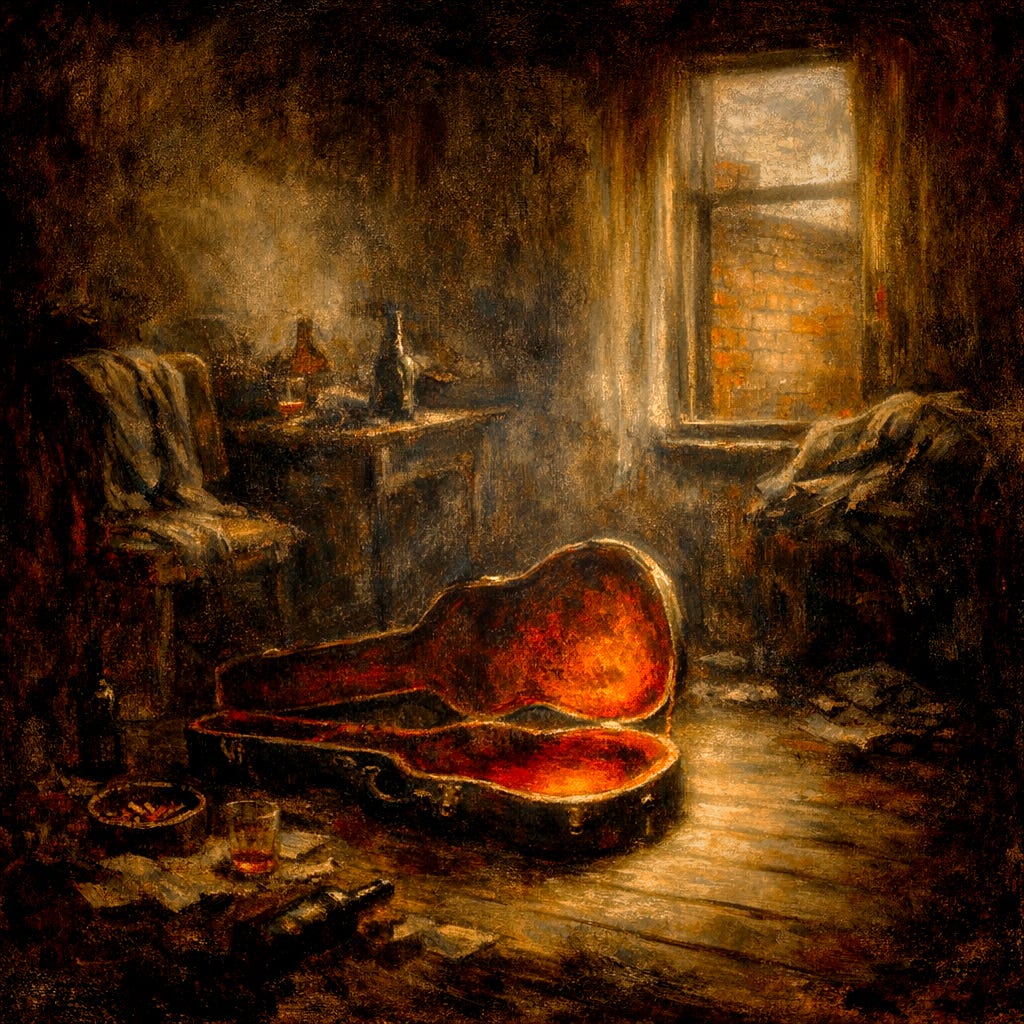
One day I came home from work and my guitar was gone. My cherry-burst Gibson SG — the instrument I’d been playing with Stan and Chuck, the thing that connected me to music, to whatever fragile sense of identity I’d been building in that warehouse with the good light. Someone at one of those parties had taken it. No way to know who. Too many strangers had passed through those rooms.
The theft felt larger than the loss of an instrument. Without the guitar, the band dissolved. Chuck disappeared back into Queens. Stan returned to Harlem. Even Karin drifted away, her interest waning as my spiral accelerated.
All in all, my life in New York was deeply unhappy. I hated the noise, the dirt, the energy, the cost of everything. I’d met too many random people and not enough real ones. The city that was supposed to offer freedom and possibility had delivered a succession of temporary rooms, a band that never performed, a guitar that got stolen, and a scene that was eating itself alive.
I was done. Completely done. I packed what little I had and went home to Ledge Acres.
* * *
Looking back, what strikes me most about the Village period isn’t the darkness — though that was real enough — but the pattern it established. I’d arrived in New York believing that geography was the answer. If I could just get to the right place, the right scene, the right people, everything would click into place. Instead, I discovered what I’d discover again and again over the next fifty years: you can’t outrun yourself. The restlessness, the inability to commit, the preference for preparation over presence — I carried all of it from Park Avenue to the Village to Hudson Street to that apartment with its revolving door. Different rooms, same occupant.
The city hadn’t failed me. I hadn’t failed the city. We’d simply confirmed what should have been obvious from the start: I wasn’t looking for a place to be. I was looking for a reason to leave.
