

I just uploaded the final files for the audiobook edition of Surfing the Interstates to ACX — Amazon’s Audiobook Creation Exchange, the platform that produces and distributes audiobooks through Audible, Amazon, and Apple Books. Sixteen chapters. Five hours and change of finished audio. All of it recorded, edited, and mastered in my home studio in Vermont. ACX is telling me it will be live on Amazon within two weeks.
I’m sharing this because if you’re an indie author thinking about narrating your own book, you should know what you’re getting into. Consider this a cautionary tale with a happy ending.
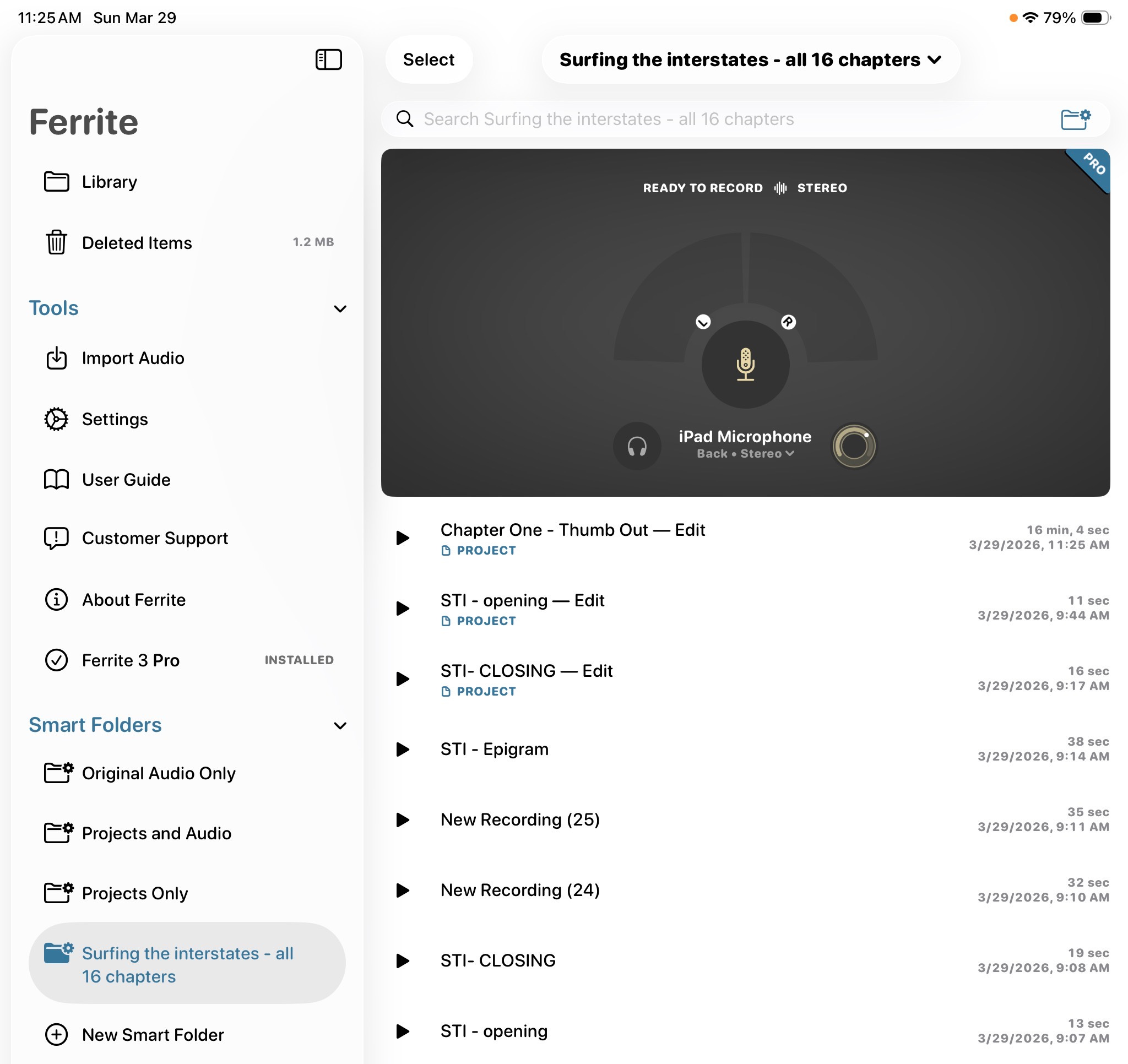
The good news first: I’m a musician. I’ve been recording at home for years. I already owned a Shure SM7B — a cardioid dynamic microphone that excels at rejecting room noise and reverb, so you don’t get that hollow, amateur sound. That runs about $400. I had a Zoom 32-bit interface feeding my iPad Pro — around $250. And I used an app called Ferrite Pro to record and edit — thirty bucks. So I wasn’t starting from zero.
But here’s the thing: even if you don’t have my background, you could put together everything you need for well under a thousand dollars, assuming you already have a computer or tablet to work with. Compare that to hiring a narrator, an audio engineer, and renting studio time. We’re talking thousands of dollars.
Now the bad news.
Two weeks. That’s how long it took to record all sixteen chapters. Two weeks of reading aloud, stumbling over sentences that looked fine on the page but turned into tongue-twisters at the microphone. Two weeks of stopping, backing up, re-reading. And then the editing — my God, the editing. Every pause. Every “um.” Every mouth click and breath in the wrong place. You don’t realize how many verbal tics you have until you’re staring at a waveform trying to surgically remove them.
But the real challenge wasn’t the recording. It was the specs.
ACX has stringent technical standards for audio. RMS levels, peak levels, noise floor — the whole nine yards. And even though I know my way around a mixing board, meeting broadcast-level specs is a different animal than laying down a guitar track.
I uploaded my sixteen chapters feeling pretty good about myself.
Four of them were rejected.
RMS and peak issues. I was discouraged enough to walk away from the whole thing for about three months. And while the project sat in limbo, I did what any restless writer would do — I went back into the manuscript itself. I shortened some chapters, fixed inconsistencies, caught typos I’d missed through a dozen previous reads. I redesigned the cover. I actually deleted the original KDP listing and replaced it with a new edition printed on cream paper instead of white. The book got better while the audiobook gathered dust.
But I was dreading the possibility that I’d have to spend another two weeks re-recording the whole thing from the revised manuscript. That thought was enough to keep the project on the shelf.
Then Claude pointed me to Auphonic — a service that analyzes your audio and adjusts the levels to meet ACX’s exact requirements. Eleven dollars for the tokens I needed. Game changer. If I could just fix the four rejected chapters and run them through Auphonic, I could upload the original audio and call it a day. The text differences between the two versions were minor enough that the audiobook could stand on its own.
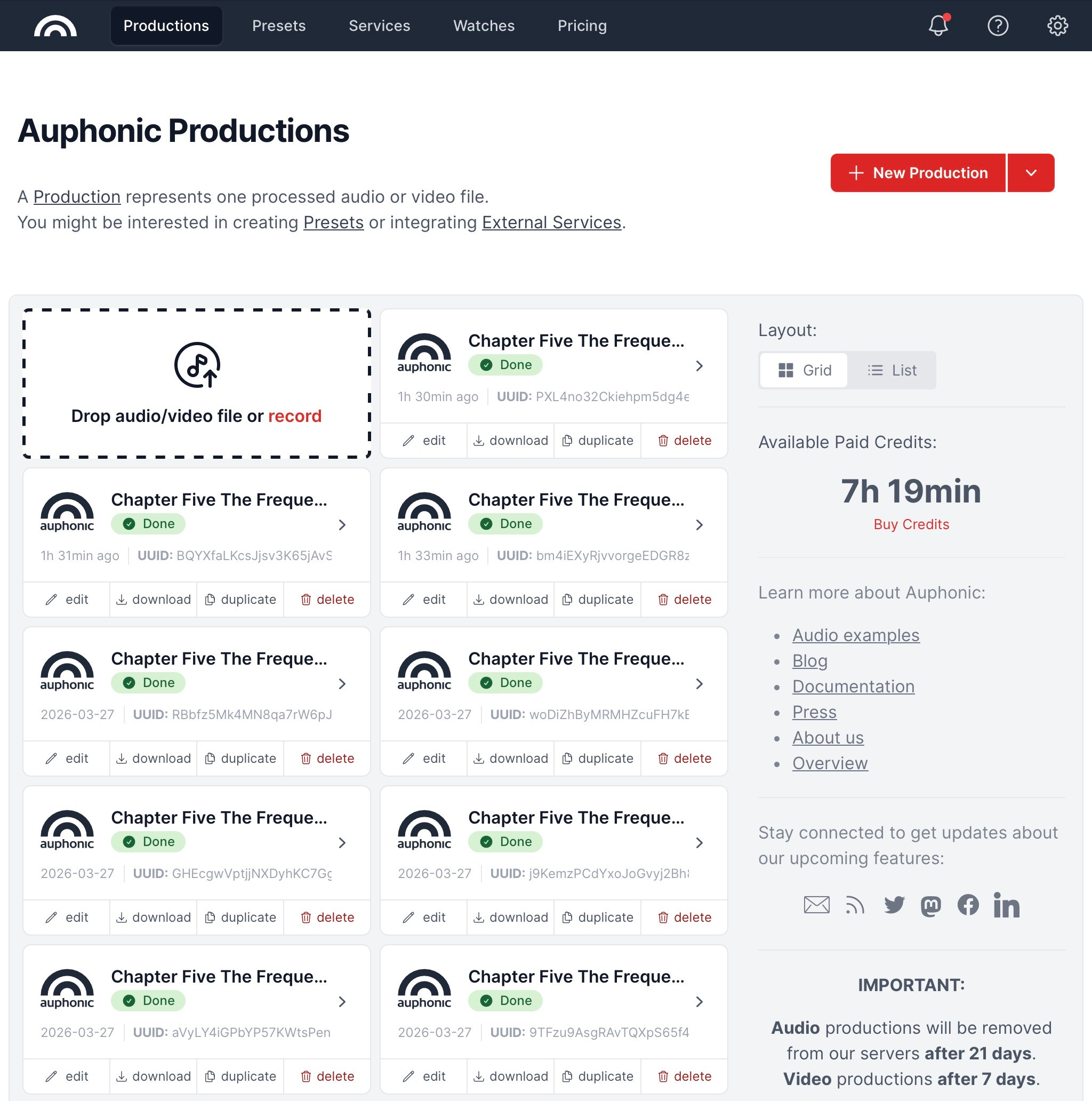
It worked. All sixteen chapters accepted.
So here’s what I’d tell anyone considering this path: if you have decent gear, a quiet room, and the patience of a monk with a head cold, you can absolutely do this yourself. But budget your time honestly. All of it is hard. The recording demands real performance — you’re not just reading words, you’re acting them, finding the emotion in every sentence. Then you’re spending hours surgically removing every pause, every breath, every “um,” every false start. And after all that, the technical specs and the back-and-forth with ACX will test whatever patience you have left.

Worth it? Every minute. There’s something right about reading your own story in your own voice. Nobody else knows where the pauses belong.