

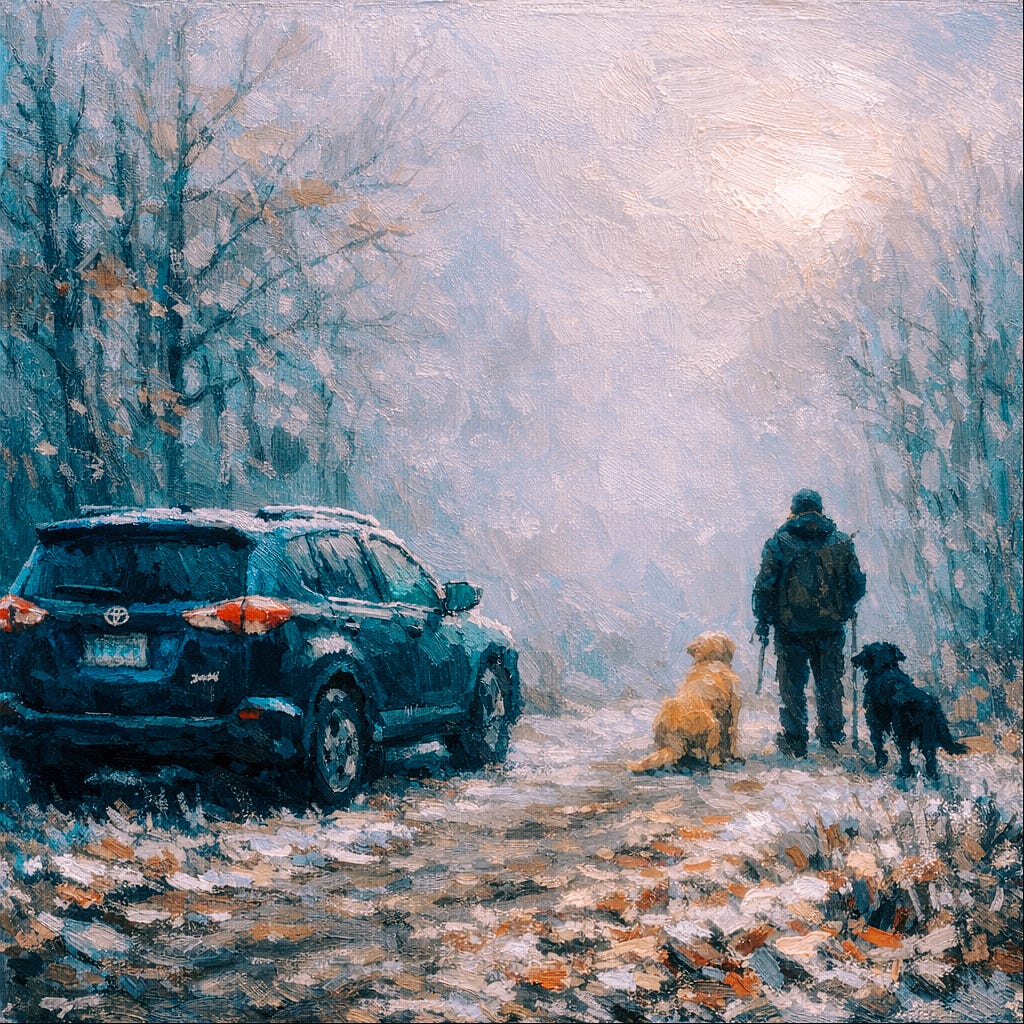
I pull onto the shoulder where I always park, where the gravel meets the frozen mud, and kill the engine. The silence is immediate. No wind. Just the tick of the cooling motor and, somewhere far off, a crow.
The fog is thick this morning, the kind that erases the tree line fifty yards out and turns everything beyond it into milk. A hard frost has locked the fallen leaves to the ground like pressed flowers under glass. The maples along the road are bare, their branches black against the white sky, and when I open the door the cold finds my lungs before my feet find the ground.
Blaze and Blue are already pressing against the tailgate, and when I pop it they pour out in that way retrievers do—not jumping, exactly, but flowing, like water finding its level. Blue shakes once, tags jingling, and looks up at me with that expression I’ve never been able to read. Not a question. More like confirmation. Blaze is already nose-down in the frost, following something only he can smell.
We start up the road.
The first stretch is what it always is. Frozen ruts, boot-prints from other walkers locked in ice, the crunch of frost under my feet and the softer padding of theirs. My breath makes clouds. The dogs range ahead, circle back, range ahead again. I know this walk the way I know the hallway to my kitchen—every curve, every root, every place where the trail narrows and the hemlocks lean in close.
But today something is different.
I notice it first in the ground. A hundred yards up, the frost thins. The leaves under my boots are no longer brittle—they’re damp, soft, the way they get in early spring when the melt is just beginning. The air shifts. Not warmer exactly, but less sharp. Like the season can’t quite hold its grip.
I stop. Blue stops with me, looks back. Blaze keeps going.
Ahead, through the thinning fog, I can see green. Not the dark green of hemlocks—a lighter green, the impossible electric green of new growth. Buds on the maples. Buds that weren’t there a minute ago, buds that have no business being here in November, but there they are, tight and shining and unmistakable.
I keep walking.
The buds unfurl as I climb. That’s the only way to describe it. Each step higher on the trail brings the season forward, as if altitude and time are the same thing. The branches overhead fill in—first the pale translucent leaves of early May, then the full dark canopy of June. The air thickens with moisture and warmth. I unzip my jacket. Somewhere a thrush is singing, that spiraling flute song that means summer in Vermont, and the light filtering through the leaves is the dappled gold-green of a world completely alive.
That’s when I see the first one.
A flash of mahogany, moving through the ferns at the trail's edge. Long-legged, elegant, ears like silk curtains. An Irish setter. She steps onto the trail ahead of us and looks at me, and I know her the way you know a face in a dream—not by logic but by something deeper than logic. Tara. My mother's dog. Stolen sixty years ago.
She doesn’t run to me. She falls in with Blaze and Blue as if she’d been walking with us all along, and Blaze noses her once, gently, and that’s that.
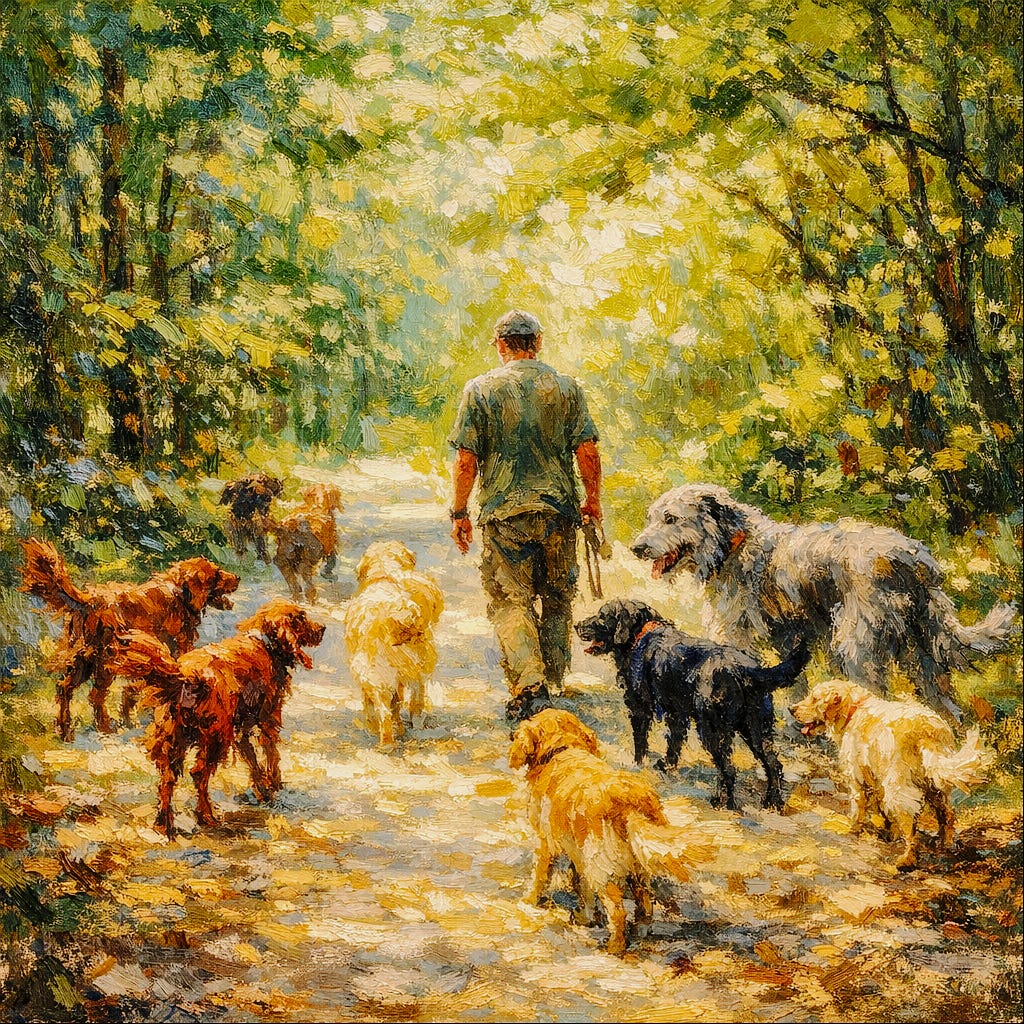
A quarter mile later, Cashel appears. The Irish wolfhound, massive and gray, my mother's pride and joy, loping out of a stand of birches with that hitch in her stride she carried ever since the neighbor's beagle ripped her chest open — dozens of stitches, and the vet said she was lucky to survive. Then Rusty, the Irish setter, a copper flash in the green light, moving with that effortless ranging stride I remember from the woods behind Ledge Acres — my first dog, my deepest dog love, who ran free across square miles of forest and once dragged a deer leg home like a trophy. And Brer—my first golden retriever, the one who couldn’t come with me to Antigua and ended up living with my mother for four years.
Each one appears without announcement. Each one joins the pack as if this were the most natural thing in the world. Blaze accepts them all. Blue plays with each new arrival, his tail a metronome of joy. I’m walking now with six dogs, then seven, and the trail is wide with summer and I am not afraid.
I should be afraid. Some part of me knows this. But the part of me that knows it is very far away, like a voice from a room I left a long time ago.
The leaves begin to turn.
It happens the way it does in Vermont—first the swamp maples go scarlet, then the sugar maples catch fire, orange and gold and a red so deep it looks like it’s lit from inside. The light changes too, taking on that September slant, that golden clarity that makes everything look like a painting of itself. The air sharpens. The trail steepens.
And now it’s not just dogs.
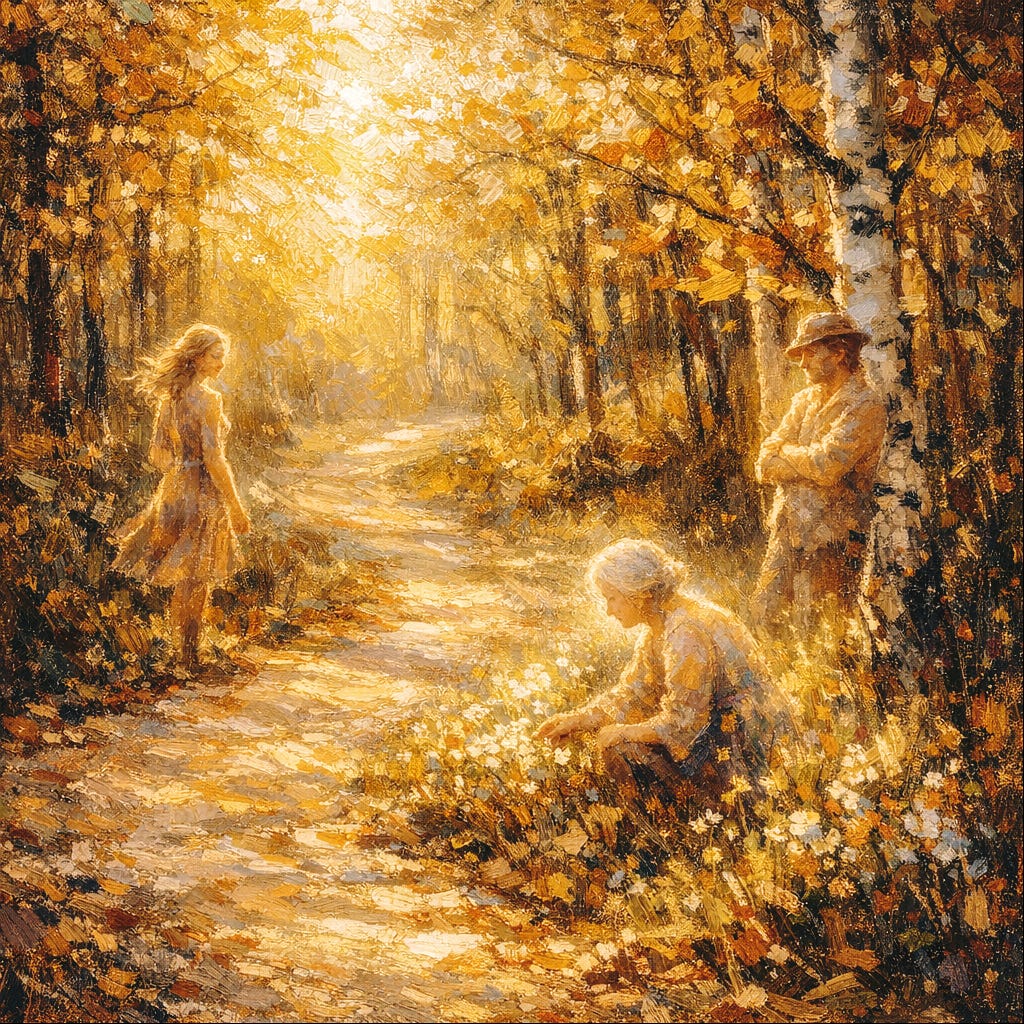
She’s standing at a bend in the trail where the birches cluster, leaning against one with her arms crossed the way she always stood—weight on one hip, chin slightly raised, that half-smile that meant she knew something you didn’t. Her hair is loose. She’s wearing the white tank top from the beach. She looks exactly as she did in Antigua, exactly as she did before the dust came, and she doesn’t speak but she watches me pass and I feel something break open in my chest that I didn’t know was still sealed.
Thea.
Further up, my mother is kneeling beside the trail, examining something in the moss. She doesn’t look up. She doesn’t need to. I can see the way her hands move—careful, precise, the way they moved in the garden at Ledge Acres years before the lung cancer crushed her before she could even get Medicare. I want to stop. I want to kneel beside her and ask what she’s found. But the dogs keep moving and I keep moving with them, and she stays where she is, content in her looking.
At a clearing where the trail switchbacks, a young man sits on a fallen birch, one leg crossed over the other, watching the valley below. Dark eyes, dark hair, that quiet intensity he brought to everything. Fred. My classmate at Exeter, the one who directed my senior film, who saw the world through a lens the way I did. He'd tried to end his life after they kicked him out, and survived. A year later, a horse threw him and finished what he'd started. He doesn't look up as I pass, but I see his hands — still, relaxed, at rest in a way they never were when he was alive.
Others appear along the trail as the leaves fall and the light fades. I don’t name them all. Some I recognize from behind—a posture, a way of walking, a coat I haven’t seen in decades. Some turn to me and smile. Some don’t. They’re all exactly as they were when I loved them most, which is to say they’re all younger than me, which is to say they’re all as I remember them, which is to say they’re mine.
The trail narrows. The trees thin. I can feel the altitude in my legs now, that familiar burn in the calves that tells me the bridge is close. The dogs are all around me—I count eight, nine, too many to count—and they move through the falling leaves like a river, golden and black and russet and gray, and I am at the center of them, carried upward.
The first flakes come sideways.
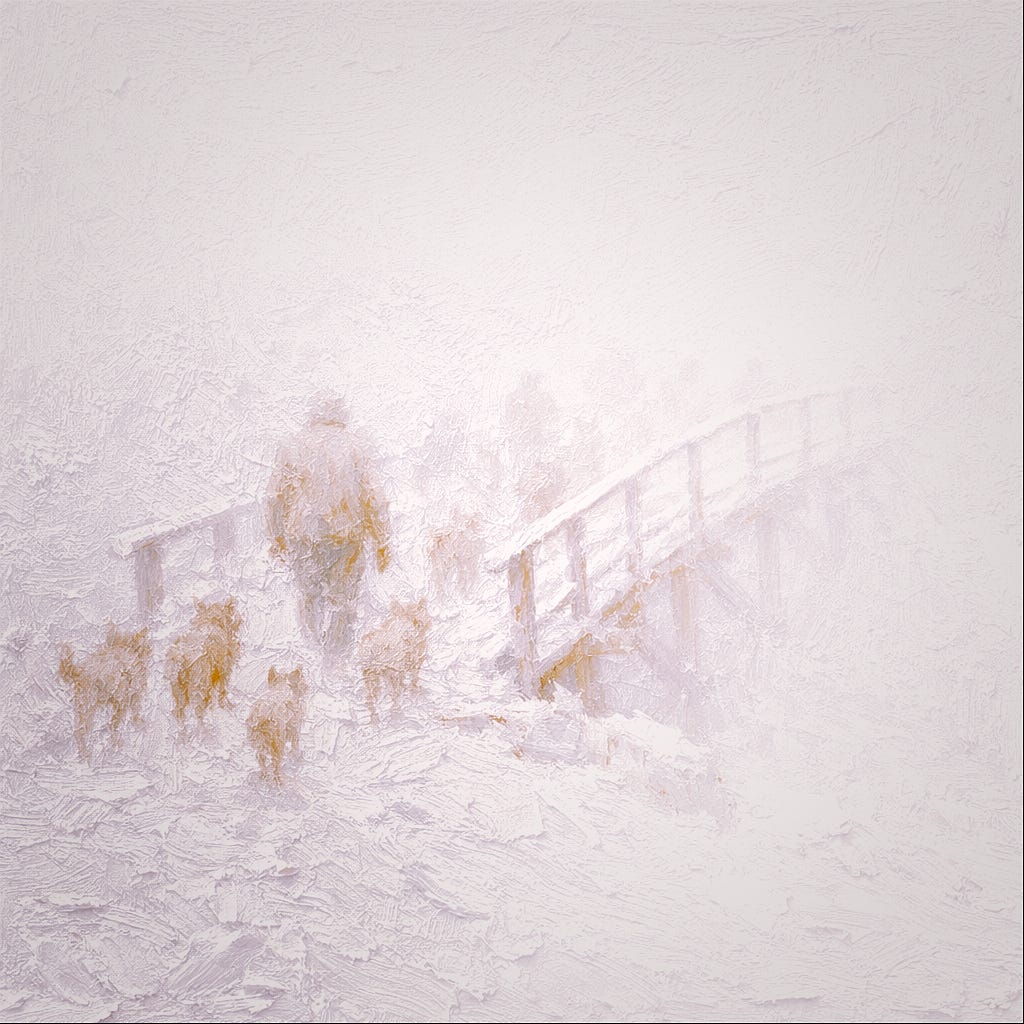
Snow, hard and small, the kind that stings your face. Not the fat lazy flakes of a Christmas card—the real thing, driven by wind, turning the air white. In fifty steps the trail disappears. In a hundred, the trees disappear. The world is contracting around me, pulling itself closed like a drawstring, and all I can see are the shapes of the dogs moving through the white and, ahead, the dark line of the gate.
The gate is open.
I’ve never seen it open. In all the years I’ve walked this road, in all the times I’ve stood at this gate and decided whether to go on or turn back, I have never once found it open. But today it swings wide on its hinges, snow collecting on the crossbar, and beyond it the bridge is barely visible—a gray shape in the white, the railing posts like fence pickets in a blizzard.
The dogs don’t hesitate. Tara goes first, then Cashel, then Brer and Rusty. One by one they cross the bridge and dissolve into the white on the other side, their shapes softening, fading, becoming part of the snow until they’re gone. Blue follows, the black lab, his drummer tail beating one last rhythm against the white, and then he's gone too.
Blaze stays.
He stands at the foot of the bridge and looks back at me, snow settling on his broad head, his amber eyes steady. He doesn’t bark. He doesn’t whine. He just waits, the way he’s waited at every door, every trailhead, every threshold of every walk we’ve ever taken together. Waiting for me to go first, or to tell him it’s okay.
I put my hand on his head. The fur is warm under the snow.
“Okay, boy,” I say.
We step onto the bridge together.
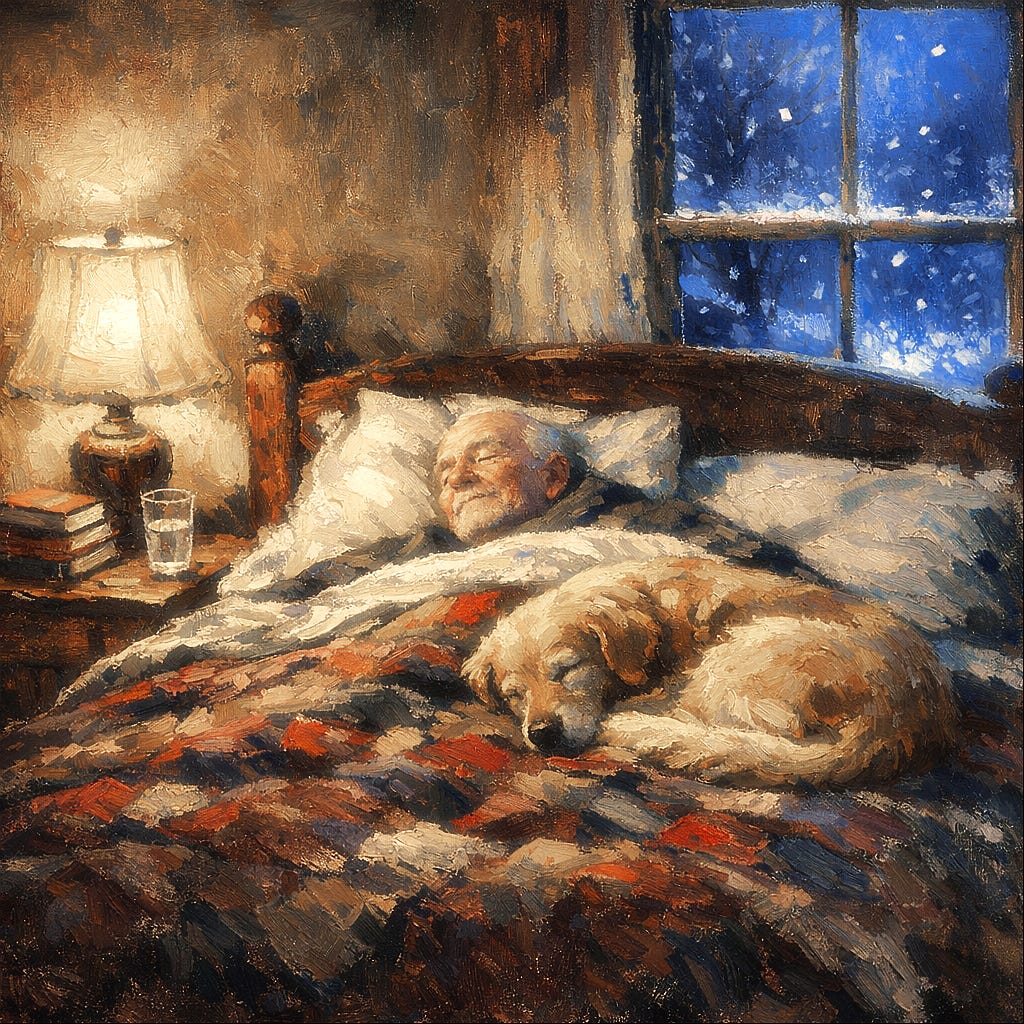
The bedroom is quiet. Snow ticks against the window. The lamp on the nightstand throws a circle of amber light that reaches the edge of the quilt and no further. Outside, the bare maples of Collins Hill stand black against a white sky, and the fog that has been sitting in the valley all day has not lifted.
The man in the bed is still. The dog beside him is still. Somewhere in the house, Veronica is already awake, beginning her day. He had almost lost her once, over something small that felt enormous at the time. He never made that mistake again. The memoir on the nightstand is bookmarked to a page he will never finish. The glass of water catches the lamplight and holds it.
Somewhere on Reservoir Road, the gate swings shut in the wind. The snow covers the trail. By morning there will be no footprints, no paw prints, no sign that anyone walked this way at all.
Just the white. Just the quiet. Just the bridge, waiting at the top of the hill, the way it always has.