

subscribe ~ e-book ~ kindle/paperback/hardcover ~ table of contents

I wasn’t ready. Everyone knew it except the one person whose opinion mattered.
I was thirteen when my father pulled me out of Whitby Montessori School and sent me to the Phillips Exeter Academy. A year early, to save a year of tuition — the kind of calculation that made perfect sense on paper and no sense at all inside the life of a boy who’d just begun to find his footing. Paul Czaja, who’d taught me to sit with a photograph and let words come from the silence, thought it was a mistake. My other teachers agreed. The boy needed another year. I had friends now, or the beginnings of them — girls in Greenwich I couldn’t see outside of school because they lived thirty minutes away and I didn’t have a car, but still. The architecture of a social life, just starting to take shape.
My father didn’t care. Exeter was Exeter. The name carried weight. The boy would adjust. He had gone from Choate to Harvard.
I didn’t, not really. I survived. Learned to perform well enough on tests, made a few friends, discovered marijuana and Bergman films and the liberating possibilities of a Bolex H16 camera with a three-lens turret. Senior year I made a forty-five-minute film called “BWATUL” — prep school slang for going into the woods to get high — about a kid mesmerized by drugs and rock music, frustrated by the impossibility of integrating into institutional life. Shot it in dark black-and-white, Gothic, clearly the work of someone who’d been watching “Persona” too many times. It won the school’s arts prize. My father never watched it.
* * *
That same year, my father drove me to West Point for an interview. I sat in the passenger seat of the Oldsmobile Delta 88, watching the Hudson Valley scroll past, saying nothing. West Point was his fantasy — the son as officer, serving with honor, embodying the martial tradition he romanticized from the safety of his study where he listened to German marching music and moved toy soldiers across maps. I had about as much interest in a military career as I had in dental surgery, but he hadn’t asked. He rarely asked.
The interview was a formality. I answered questions with the bare minimum of enthusiasm required to avoid outright rudeness, and we drove home in silence. Another box checked on someone else’s list.
What I wanted — the only thing I wanted — was film school. USC, UCLA, NYU. Places where people made movies, not war. I’d been making films since Paul Czaja put that Bolex in my hands, had felt something click into place behind the viewfinder that I’d never felt anywhere else. Cinema was the one language that made sense to me.
My father said no. Flatly. Absolutely. If I wanted tuition money, I would study philosophy. A real education. Something that built the mind, prepared a man for serious work. Film was a hobby, not a career. Not for a Saint Phalle.
* * *
That summer, Woodstock happened an hour from Ledge Acres. I begged to go. The argument went on for days — not a discussion, never a discussion, but an escalating series of appeals met with escalating refusals until my father issued a flat decree. No. End of conversation. Half a million people gathered on a farm in Bethel to witness the defining cultural moment of their generation, and I listened to it on the radio in my bedroom, close enough to have ridden my bicycle.
The irony would take fifty years to become visible. My father was right about philosophy — just wrong about the route and the timeline. I’d get my philosophical education, but it would take the open road, not a lecture hall. The curriculum would be strangers’ cars and campfire conversations and a hundred hits of acid flushed down a dormitory toilet. But none of that was knowable yet. In 1969, all I knew was that the door I most wanted to walk through had been locked by the one person who held the key.
* * *
So I went to Penn. Not because I wanted to, but because Ivy League was the minimum my father would accept, and I was still, at eighteen, a boy who needed his father’s approval even as I was learning to hate needing it.
Steve Ferry showed up in my life the way most important people do — without announcement, sideways, through some ordinary door. We were both freshmen in the fall of 1969, assigned to rooms in the same corridor of the Quad. Steve was from Glenrock, New Jersey. His father ran an advertising agency on Madison Avenue. “Sells America to itself,” Steve said once, with a bitterness that suggested dinner-table arguments that had ended badly.
We recognized something in each other immediately — not friendship exactly, but a shared frequency. Both smart enough to be there, both suspicious of why we were. Both carrying fathers who’d mapped futures for us that felt like someone else’s life.
Steve had a collection of film canisters that he labeled with names from the old anti-marijuana propaganda film “Reefer Madness” — MURDER, INSANITY, DEATH. He thought this was hilarious. He kept his best weed in INSANITY. He played guitar, argued about Clapton versus Hendrix, and had a cynicism about institutional life that I found both thrilling and slightly frightening. Steve had already decided that the system was broken. I was still trying to figure out whether the system existed at all.
The acid came early. First semester. I’d bought a hundred hits of purple Owsley from a connection — tiny barrels, supposedly the purest LSD on the market. The trip went sideways almost immediately. Whether the barrel-making machine had been faulty or I simply wasn’t prepared for what pure psychedelics could do to a mind that had spent eighteen years under my father’s rigid control, the dose hit like a freight train. Ego dissolution. Terror. The boundaries of self liquefying into something vast and incomprehensible.
Pete, from down the hall, talked me through it. He was one of those people who radiated calm the way some people radiate anxiety — a natural steadiness that you didn’t fully appreciate until you needed it. Hours in a garden somewhere on campus, the world fractured into kaleidoscopic geometry, Pete’s hand on my shoulder, Pete’s voice cutting through the chaos: “You don’t need to hold on. Let go. That’s what you’re supposed to do.”
I let go. And what I found on the other side was, for a few luminous hours, the most profound experience of my life. The universe as a single breathing organism. A glimpse behind the curtain of ordinary consciousness that left me shaking and transformed and desperate to explain it to someone who might understand.
Looking back now, I understand that Pete may have saved my life that night. Not dramatically — no ambulance, no stomach pump — but in the quieter way of keeping a mind from tipping past the point of return.
The next morning, my father was at the door.
Knocking. Not a polite knock. The knock of a man who has taken the train from New York at dawn because someone has called him about his son.
The door opens. My father in a dark suit. Tie knotted. Face tight.
“Dad!” A surge of joy — irrational, leftover from the trip, the residue of cosmic love still coursing through me. “You’re here! I have so much to tell you —”
“Where are they?”
“Where are what?”
“The drugs, Andre. The hundred doses.”
And still, still riding the afterglow, still lit up with the conviction that what I’d seen was real and important and worth sharing: “Dad, if you tried it, just once, you’d understand —”
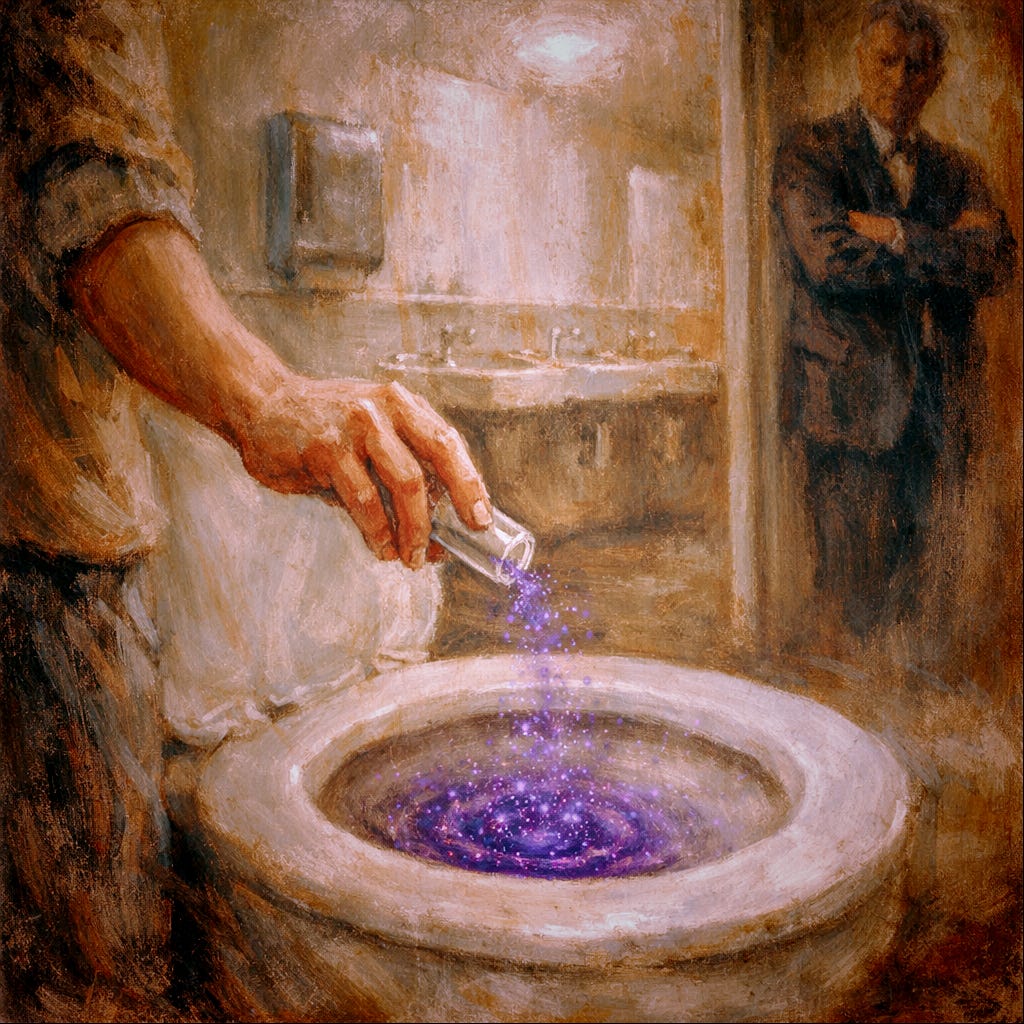
He takes me by the arm. Down the hall to the bathroom. Forces me to tip the vial over the toilet. One hundred purple barrels swirl and disappear.
One flush. One hundred dollars. One conversation that never happens.
He checks his watch. “I have to get back to New York.”
And leaves. No discussion. No curiosity. No attempt to understand what I had experienced or why it mattered. Just disposal and departure. His only visit while I was at Penn.
* * *
It would be easy to make this a story about a cruel father and a sensitive son. It’s not that simple. The man who flushed those hits was carrying his own damage — a childhood shaped by a father who’d been taking amphetamine cocktails from Dr. Feelgood while preaching self-discipline to his children, a family marked by suicides and the kind of secrets that would eventually surface publicly. He’d learned early that feeling too much was dangerous. He’d put his heart, as his own mother once said, in the deep freeze.
So when his son stood before him radiating psychedelic wonder, talking about cosmic unity and dissolved boundaries, what he saw wasn’t revelation. He saw the family curse surfacing in another generation. He saw chaos threatening the order he’d spent his whole life constructing. He did the only thing he knew how to do: eliminate the problem and leave.
I didn’t see any of this at nineteen.
But there’s another layer, one that took even longer to surface. What would I have done with a hundred hits of the most powerful LSD available? I’d already nearly lost my mind on what may have been a double or triple dose from a faulty barrel. I was nineteen, reckless, convinced of my own invincibility the way only nineteen-year-olds can be. I might have taken more. I might have ended up like Pete’s roommate, who took STP at a festival in Florida and ended up in a mental hospital for months. I might have sold them and been arrested, a federal drug charge that would have followed me forever.
My mind reels now, fifty years later, to think of how close I came to disaster — and to recognize that my father, in his clumsy and brusque way, may have saved me from it. Pete and my father. Two acts of rescue, neither one understood at the time.
* * *
On December 1, 1969, we gathered around the television to watch the first draft lottery since World War II. Representative Alexander Pirnie reached into a glass container and drew capsules, each one containing a birthday. Each birthday a fate.
Steve’s came first. July 9th. Number one.
The room went silent. Number one. Not figuratively bad — literally the worst possible outcome. First birthday drawn, first to be called, certain deployment. Vietnam.
I watched my friend’s face drain of color and understood, in a way I hadn’t before, that this was not abstract. This was not politics or philosophy or protest signs. This was my friend’s body being requisitioned by the government to go kill people or be killed in a jungle on the other side of the world.
Steve stood up and walked out. I found him later with a bottle of bourbon, already working on a plan. There was a psychiatrist on campus, a Dr. Frei, who was sympathetic. Steve would build a case for psychological unfitness. He would make himself officially crazy, because the alternative was officially dead.
Steve got his 4-F. But something shifted in him after that — a hardness that wouldn’t leave.
My lottery came seven months later, in July 1970 — the second lottery, for birthdates in 1952. I drew number 200.
Two hundred sounded high. It wasn’t high enough to be safe, not then, not when nobody knew where the cutoff would fall. For weeks, maybe months, I lived in a particular kind of limbo that no one who hasn’t experienced it can fully understand. Every time I tried to imagine myself in Vietnam — the heat, the rifles, the possibility of killing or dying — my mind simply refused the picture. It was like trying to visualize my own death. The image wouldn’t form.
I was 100 percent certain of one thing: I would not go. Not as an officer, which my father had pushed — “You might as well go as a lieutenant rather than some buck private in the mud” — and not as anything else. Canada. A psychiatric deferment like Steve’s. Whatever it took. The war was wrong, and dying in it, or killing in it, was not something I was willing to do for a country that couldn’t explain why it was asking.
When the final numbers came — they drafted through 160, stopping forty short of my birthday — the relief arrived not as joy but as a slow unclenching. A fist that had been closed for months gradually opening. I was safe. Steve was safe, through different means. But the experience left a mark on both of us, a shared understanding that the institutions we’d been raised to trust — government, university, family — would feed you into a machine without hesitation if the machine required it.
The last year at Penn felt like watching a building condemned.
The war kept escalating. Protests grew larger and angrier. Professors cancelled classes. Some joined the demonstrations. Others retreated into their subjects with a kind of desperate irrelevance — me sitting in a seminar on Kant’s Critique of Pure Reason while outside the windows, students marched and chanted and occasionally bled.
* * *
One night, a commotion echoed through the labyrinthine hallways of the Quad dorms. I came out of my room and followed the noise, walking two hundred yards through the connected corridors toward whatever was generating that particular frequency of excited male voices. When I found the source — a line of at least six guys outside a door, some adjusting their clothes, some bouncing on their heels — I asked the nearest one what was going on.
“There’s a girl in there taking all comers,” the guy said, grinning. “No questions asked.”
I turned around and walked the two hundred yards back to my room. I did nothing. Said nothing. Filed no report, told no authority.
* * *
There was a girl named Holly who lived in one of the high-rise dorms they’d thrown up on the edge of campus — the ones we called the skyscrapers, all glass and concrete optimism. We were friendly in that borderline way that never quite became anything. She had a good laugh and an easy way about her, and then one semester she was just gone. No goodbye, no explanation. People disappeared like that then. You didn’t chase it down.
Years later, when the Ira Einhorn story broke — the counterculture guru, the trunk, the body — I learned the victim’s name was Holly. For a long moment I went cold. Then I pieced it together. Wrong Holly. Wrong timeline. The Holly he killed had come to Penn after my time there.
But the cold feeling didn’t entirely go away. Because the truth was, it could have been. Einhorn had been floating around that campus like a planet with its own gravitational field, pulling people into his orbit — especially young women who were drawn to the counterculture and its promises. I’d seen him. Everyone had. He was hard to miss — big, bearded, magnetic, absolutely certain of his own importance. The kind of man that era had no antibodies against.
My Holly disappeared the ordinary way. I never knew why and never asked. That was the thing about that time and that place — the not asking had become a kind of culture. The girl in the Quad hallway. Holly in the skyscraper. You looked away and kept moving.
I stopped caring about grades. The classes my father had arranged — philosophy, French literature — felt like obligations from a world that no longer existed. The one course I’d chosen for myself, a film class, was the only thing that still engaged me. But even that seemed small against the scale of what was happening outside.
In the spring of 1971, the campus shut down. Anti-war protests had reached a pitch that made normal academic operations impossible. Finals were cancelled. Everyone passed. The administration essentially threw up its hands and sent us home.
I don’t remember how I left. I was living off campus by then, in an apartment I can picture but whose exit I cannot. I must have packed a bag — a few clothes, maybe the guitar — and gotten on a train. My stuff stayed behind. Books, records, the accumulated debris of two years. I wouldn’t come back for months. When I did, it was just to collect what was left, the way you’d clear out a room after someone had died.
Not in anger, exactly, and not in triumph. More the way you leave a party that stopped being fun hours ago — quietly, without saying goodbye, already thinking about what comes next.
What came next was the question. I was twenty years old, had no degree, no plan, no money of my own, and a father whose vision for my future — Harvard, graduate school, politics or the Church — had been so thoroughly rejected that the two of us could barely sustain a phone conversation.
I went home to Ledge Acres. But home, I was beginning to understand, was a word that had started to mean less and less. The house was the same. The people in it were coming apart.
→ Next Chapter: Fish Out Of Water
