


I had a plan. Three books. Three geographies. Three acts of a life spent in motion.
Book One: Surfing the Interstates—the 1973 hitchhiking odyssey from New York to California and back. A young man running from a family that was falling apart, with a notebook and a thumb and no idea what he was looking for.
Subscribe to read · Get Kindle edition · Order paperback · Download PDF
Book Two: Sahara Dust—the Caribbean years. Building a windsurfing business in Antigua in the 1980s with the woman I loved. Trade winds and tropical light and a story that ended the way tropical stories sometimes do.
Book Three: Green Mountain Flash—Vermont. The landing. Learning, after decades of running and building, how to stay in one place.
Together they formed The Spaces Between: a memoir trilogy spanning fifty years of American geography and one man’s long education in loss, love, and the stubborn business of making a life.
I finished Book One. It took the better part of two years. It was inspired by the fiftieth anniversary of that 1973 journey, and it was made possible by an unlikely collaboration with an AI named Claude, who helped me organize fifty years of memory into something coherent. I’m proud of the book. I enjoyed the creative license I took—compressing timelines, combining events, reimagining moments—while staying true to what actually happened. The hitchhiking book is a good book. It tells the truth about who I was at twenty-one.
And now I’m retiring the trilogy.
The reasons are practical and personal, and I’m not interested in dressing them up.
I turn seventy-four next month. My time is becoming more limited—not in the dramatic, cinematic sense, but in the daily, ordinary sense. Energy. Focus. The hours in a day that belong to deep work. I have a music studio in my basement that’s calling to me. I have photography I want to pursue. I have a wife, two dogs, and a life in Vermont that deserves more of my attention than the past has been getting.
But the bigger reason is this: too many people who appear in Books Two and Three are still alive. And no matter how carefully I write, no matter how much I change names or compress characters or soften edges, those people will recognize themselves. Some will be hurt. Some will be angry. Some will threaten legal action. I know this because I’ve already had a taste of it with Book One—and that book was the easy one, the one where almost everyone is dead or distant enough not to care.
The Caribbean book would require me to write about my late partner Thea, about her family, about the people of Antigua who shaped those years—people I loved, people who scared me, people whose stories are tangled with mine in ways that can’t be neatly separated. The Vermont book would require me to write about my marriage, my stepchildren, my neighbors, my health. These are not stories I can tell without consequence.
I mailed twelve copies of Surfing the Interstates to people I thought might care. Family members, old friends, people who appeared in the pages or whose lives intersected with mine during those years.
Not one of them has responded.
I don’t say this for sympathy. I say it because it clarifies something. I’m not writing for an audience. I never really was. The audience I imagined—the family who might finally understand, the friends who might remember alongside me—that audience doesn’t exist. Or if it exists, it isn’t interested.
This Substack is my mausoleum. I don’t mean that morbidly. I mean it practically. A man approaching seventy-four, organizing his artifacts. Leaving something behind that says: I was alive. This is what I saw. This is what I built. This is what it cost.
One paying subscriber. Virtually no comments. No viral posts, no book deals, no recognition. And I find that I don’t mind. The harvest is mine. The work itself was the point—the remembering, the shaping, the making sense of a life that often made no sense while I was living it.
I’m not abandoning writing. I’m abandoning the architecture. The trilogy was a framework that served its purpose: it got me through Book One. But frameworks can become prisons, and I’d rather spend my remaining creative years making music, taking photographs, and writing whatever wants to be written—a Substack post here, a song there, maybe a short memoir piece when a memory insists on being told.
I want to experiment without expectation. I want to play.
I finished one book. It’s a good book. It tells the truth about who I was at twenty-one, and in telling that truth, it illuminates who I became.
One book is enough.
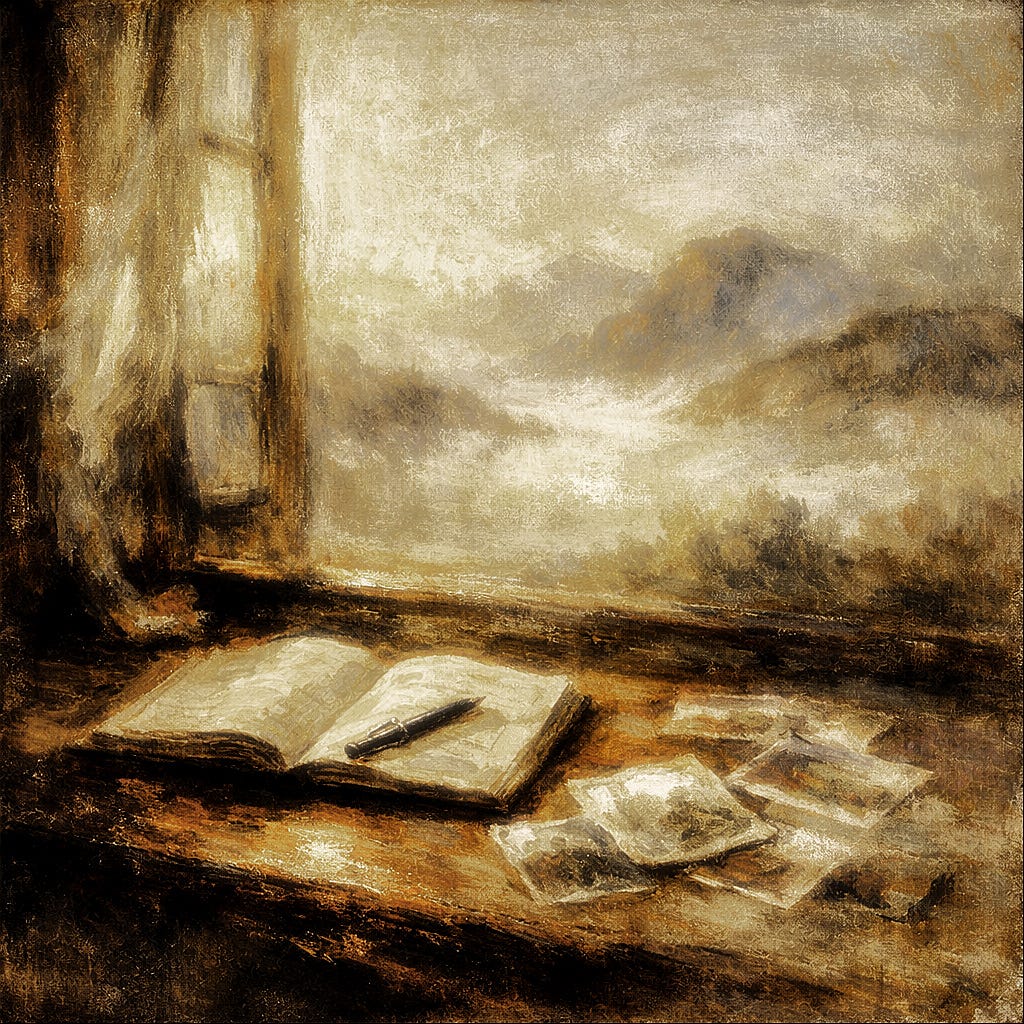
The pen rests on the open journal. The photographs fade into abstraction. Through the window, the mountains emerge from mist, or maybe they’re dissolving into it—hard to tell which direction the day is moving.
I’m still here. Still writing, in my way. Still making sounds in the basement studio. Still watching the light change over these Vermont hills that somehow became home after all the running, all the building, all the years.
The journal stays open. The story continues—just not in the shape I once imagined.
I thank you for your comment and encouragement.
I know not much about your story, your book except for the three or so posts I've been able to read since I subscribed a while back. As a matter of fact, only this post actually made me realize your age. 😅
Not all readers are writers, and that's okay, as long as all writers keep writing. ❤️