

subscribe ~ e-book ~ kindle/paperback/hardcover ~ table of contents

They put me in the ready room.
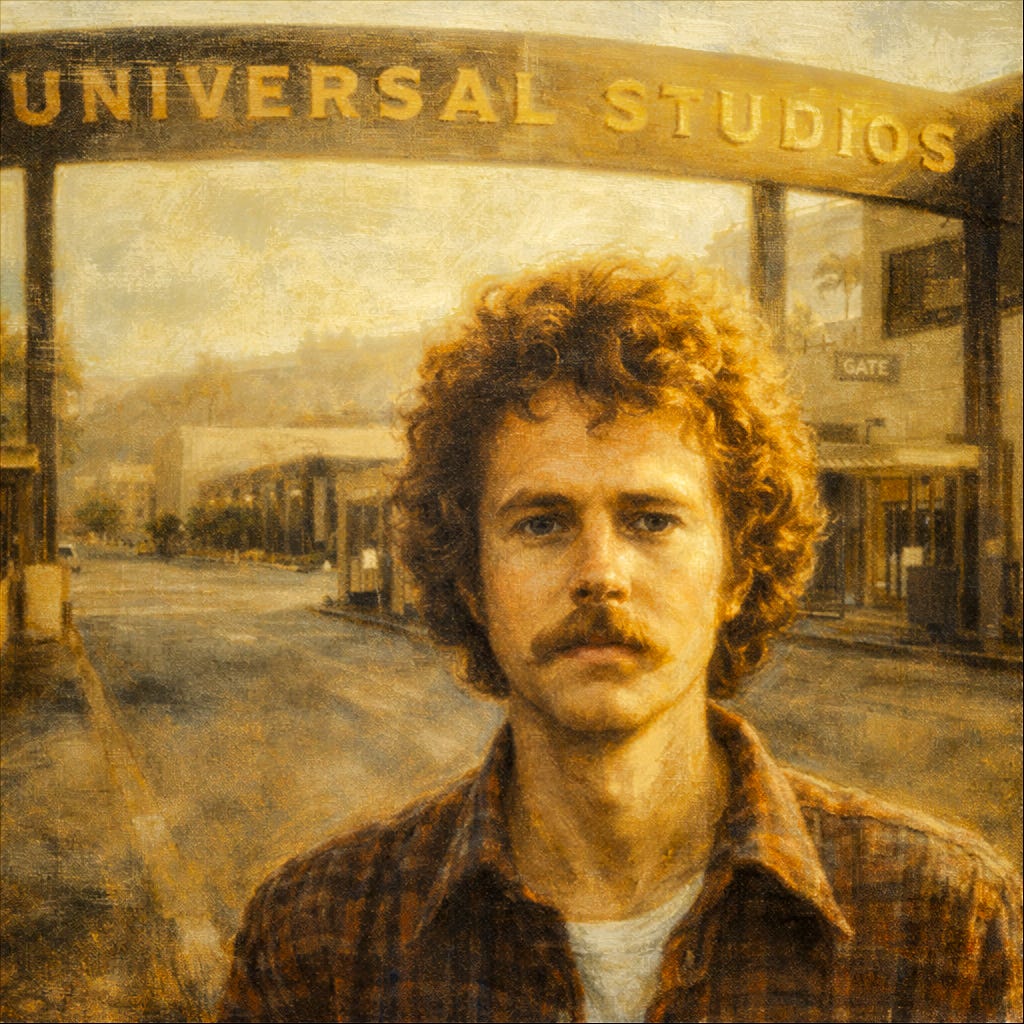
It was a glorified storage closet — floor-to-ceiling racks of 35mm film in a windowless room deep inside the editorial building at Universal Studios, Studio City, California. Each ten-minute segment of a TV show or feature film could generate a dozen or more reels. Picture reels, dialogue reels, dialogue replacement reels, sound effects reels, music reels. They all had to be organized, tracked, and delivered. The ready room was the hourglass between the editing suites and the sound dubbing stages — everything passed through us. When a reel had all its components, we called the stage, loaded the heavy cans onto a specially made hand truck, and wheeled them down the hallway. About half a dozen apprentices worked there. It was the bottom of the food chain. But it was inside the gates of a major Hollywood studio, and I was twenty-six years old, and I had the job because of a union card I’d gotten almost as an afterthought when I was a nineteen-year-old projectionist sitting on a white leather couch at MCA’s headquarters on Park Avenue.
I kept thinking about that. How a nothing job in New York — three bucks an hour, watching the clock, smoking joints with Abby from the mailroom in the stairwell — had led, six years later, to this. The IATSE card was just a formality in 1971. Now it was the only credential I had that actually opened a door.
* * *
The editorial building was its own world. Long hallways, fluorescent light, gray filing cabinets lining the walls like library stacks. Each cabinet contained small rolls of 35mm magnetic sound film — catalogued, indexed, cross-referenced. If a scene needed rain on a window, a car door slamming, a horse on gravel, chances were somebody had already recorded it and filed it away years ago. You could pull the roll, thread it up, and there it was. It was a beautiful system. Decades of accumulated sound, organized with the kind of care you’d expect from a Smithsonian archive, all in service of making a car chase sound slightly better on Quincy, M.E.
Down the hall was the Foley stage — a big room with playpens of gravel, sand, wood, tile, and various other materials arranged on the floor for generating and recording sounds. Footsteps, horse hooves, doors, punches, glass breaking, whatever a scene needed. A Foley artist would watch the picture on a screen and perform the sounds in real time, matching them to the action. The famous story — and everybody at Universal told you this story within your first week — was that the knife attack sounds for Psycho were created by hanging a slab of raw meat on a rope and stabbing it repeatedly. I never verified that, but it was the kind of legend that circulated through the building like gospel. It made you feel like you were somewhere that mattered. Like the walls themselves held something sacred.
I loved the Foley stage. I loved the filing cabinets. I loved the idea that every sound had a home and every reel had a purpose and somewhere upstairs someone was assembling all of it into something that would eventually flicker in the dark in front of an audience. This was what I’d wanted since I was seventeen — to be inside the place where the thing got made.
The problem was I wasn’t making anything. I was wheeling film cans down a hallway.
* * *
But I was inside the gates. That phrase meant something at Universal. The studio lot was its own small city — soundstages, back lots, office buildings, the commissary, the Black Tower where the executives sat. Outside the gates was Lankershim Boulevard and the Valley and the smog. Inside was another universe. You had a badge. You had parking. You could eat in the commissary where the actors ate, though you sat at different tables and everyone knew who belonged and who was just passing through.
The first time I saw Cary Grant, I understood the geography of the place in a way no orientation session could have explained.
He held court regularly in the open-air patio outside the commissary. Tall, tan, impeccably dressed — white hair, posture like a man who’d never once doubted his right to occupy space. He always attracted a small crowd. Not tourists — there were no tourists inside the gates. These were industry people, producers, directors, executives, and they gathered around him like courtiers. He’d say something and they’d laugh. He’d pause and they’d lean in. He was seventy-four years old and still the most magnetic person in any room he entered, even when the room had no walls.
You didn’t approach Cary Grant. You observed him, the way you’d observe a painting in a museum with a velvet rope around it. I watched him from a distance several times. He never once looked in my direction. There was no reason he should have.
Alfred Hitchcock arrived at the studio in a chauffeur-driven Rolls-Royce. He sat in the back seat with his sour face, looking exactly the way you’d expect Alfred Hitchcock to look — like a man profoundly irritated by the existence of other people. The car would pull up, someone would open the door, and he’d emerge slowly, as if the effort of being vertical was beneath him. Then he’d disappear into his office and you wouldn’t see him again.
I saw Hitchcock’s Rolls several times. I never spoke to him. Nobody I knew ever spoke to him. He existed at a frequency that didn’t include people like me.
* * *
Stallone was a different story.
There was a receptionist in his office — a nice woman, friendly, and I’d gotten into the habit of stopping by to chat with her a couple of times a week. Just conversation. She was one of the few people in the building who’d talk to you without first calculating your position in the hierarchy.
One day Stallone walked in.
“What the hell are you doing here? Who the hell are you?”
He threw me out. Not physically — he didn’t need to. The voice did it. Rocky Balboa telling a nobody to get the hell out of his office. I left.
A few days later I was walking through the lot and saw Stallone in a brand-new Porsche — top of the line, gleaming, the kind of car that costs more than most people’s houses. He was grinding the gears like he’d never driven a manual transmission in his life. The car lurched and bucked and whined. Rocky Balboa couldn’t work a clutch.
I didn’t say anything. But I enjoyed that more than I should have.
* * *
Valerie Bertinelli was on the lot shooting One Day at a Time. She was young, beautiful, famous. I tried to talk to her once — I don’t remember what I said, probably something innocent and stupid. She looked through me like I was made of glass. Not rude exactly. Just absent. I didn’t exist in her world, and she had no interest in adjusting her field of vision.
In fairness, I didn’t exist in anyone’s world at Universal. That was the thing I was starting to understand. You could be inside the gates, eating in the commissary, walking the same hallways as the people who made the shows and the movies that the whole country watched — and you were still invisible. The badge got you through the gate. It didn’t get you seen.
* * *
There was one exception.
Lynette Pawlak was a secretary in the music editorial department. We’d run into each other in the hallways and stop and talk. Nothing romantic — just two people who seemed to recognize each other as actual human beings in a building where that was rare. She’d ask how I was doing. I’d ask about her day. We’d talk for a few minutes and then go back to our respective corners of the machine.
I looked forward to those conversations more than I want to admit. In a place where everybody was performing their position — editors with their gold chains, executives with their stares, actors with their force fields — Lynette was just a person being a person. That shouldn’t have been remarkable. At Universal, it was.
* * *
One night Sinatra was playing the Universal Amphitheatre, which was walking distance from where I worked. I didn’t particularly care for Sinatra. He wasn’t my generation. He wasn’t my music. He was an earlier generation’s music — the voice of a world I’d spent my whole adult life trying to escape. But the show was right there, and I had nothing else to do, which was the story of most of my evenings in Los Angeles.
I snuck in through the back. Found a spot high up behind the last rows. An outdoor venue, under the Southern California stars. Looked down.
He was extraordinary.
I hadn’t expected that. I’d expected competence, maybe some Vegas charm, a man coasting on reputation. What I got was an artist at the peak of his powers — and Sinatra in concert was something entirely different from Sinatra on a record. The way he moved through the songs, the way he held the audience in his hand, the way he could make three thousand people feel like he was singing directly to each one of them. All the great ones — he sang them all, and he owned every note. The band was tight, the sound was immaculate, and there was a quality to the whole thing that I’d never experienced before and wouldn’t experience again for a very long time.
This was what it looked like when someone did the thing they were born to do, at the highest level, with nothing wasted and nothing faked. No credential. No system. No ladder. Just a man and a microphone and forty years of knowing exactly who he was.
I stood there alone, up in the back at the top of the amphitheater, looking down, and for the first time since I’d walked through the Universal gates, I was in the presence of something real. It was the one genuine artistic experience I had during my entire time at that studio. And I experienced it the way I experienced everything in Los Angeles — alone, from the outside, looking in.
It was a moment.
I walked back to my car in the dark, and the lot was quiet, and the San Fernando Valley spread out below with its grid of lights, and I thought about what I’d just seen. A man who had found the thing and done the thing and become the thing. And here I was, twenty-seven years old, inside the gates of a dream factory, and I hadn’t found any of it. Not the thing. Not the doing. Not the becoming.
But I’d seen it. And that was something. Even if I didn’t know what to do with it yet.
→ Next Chapter: The Factory Floor
