

I remember the cough.
A little cough. Persistent. My mother had been feeling pretty good, actually—losing weight without trying, which she took as a bonus. But this cough wouldn’t quit. It reminded me of another cough, years earlier—Thea’s cough, the one that I soon learned was caused by her cystic fibrosis. None of us connected the dots when it came to my mother’s cough. She had just turned 65 and was excited to finally qualify for medicare and social security.
Her doctor said it had been a while since they’d done a lung X-ray. The X-ray led to the biopsy. The biopsy led to the diagnosis. Stage 4B non-small cell lung cancer. Six months to live.
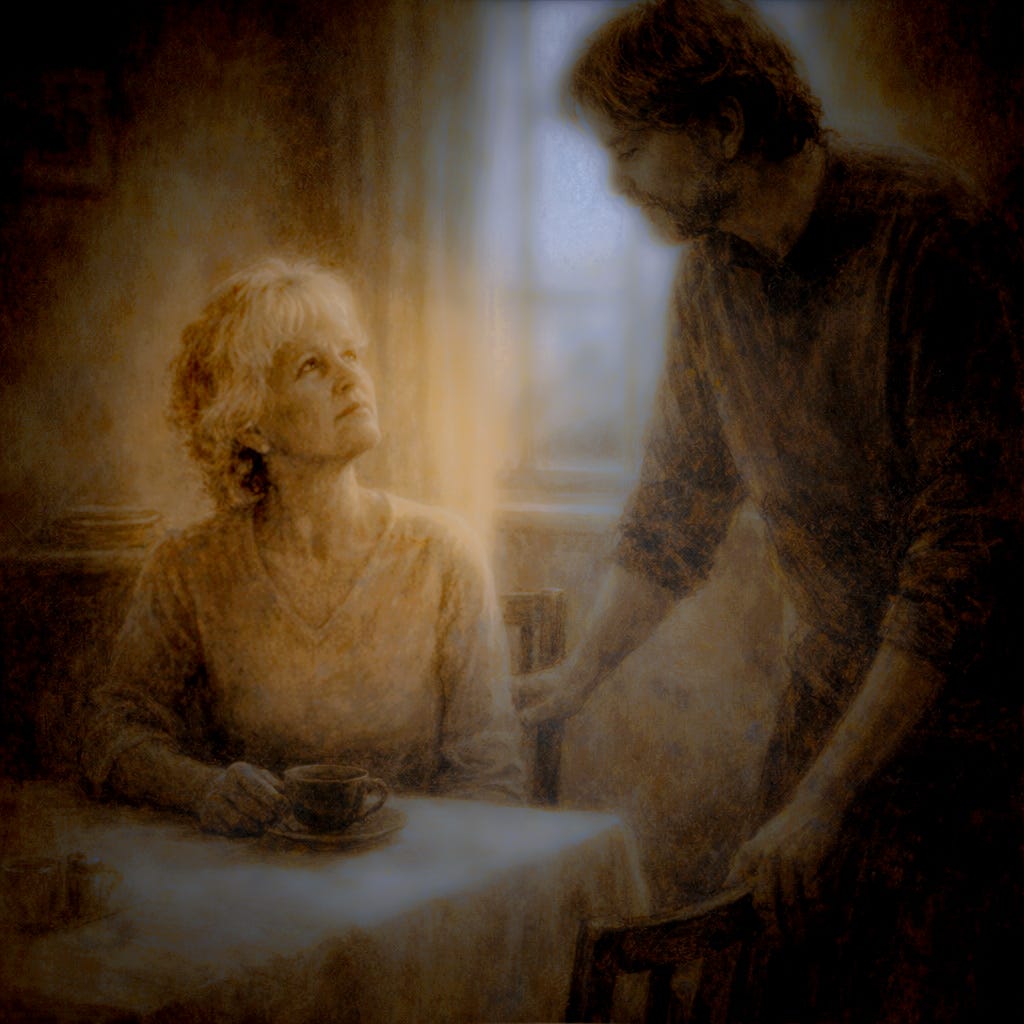
It was the fall of 1996. I was with her at her house in Pleasantville, a simple place where she and Bill had lived for nearly twenty years. Bill had become like a second father to me. My actual father had been missing in action since 1973.
We were sitting at the dining room table. Just the two of us. Tea getting cold. And I said what seemed like the obvious thing: “I guess we should tell Dad.”
She didn’t hesitate. Absolutely not.
I asked why.
“Because he might take some pleasure in it.”
I don’t think I’ve ever heard a sentence that rearranged me so completely. I wasn’t angry. I wasn’t even surprised, exactly. I was thunderstruck at her truth. At the depth of it. Twenty-three years after the divorce and this was what remained—not indifference, not even hatred, but the bone-deep certainty that the man she’d given six children would find satisfaction in her dying.
We never know what other people carry. That moment at her table was like a glimpse into deep space. A void where I’d imagined some residue of love might still persist. That maybe time had softened things. But no.
• • •
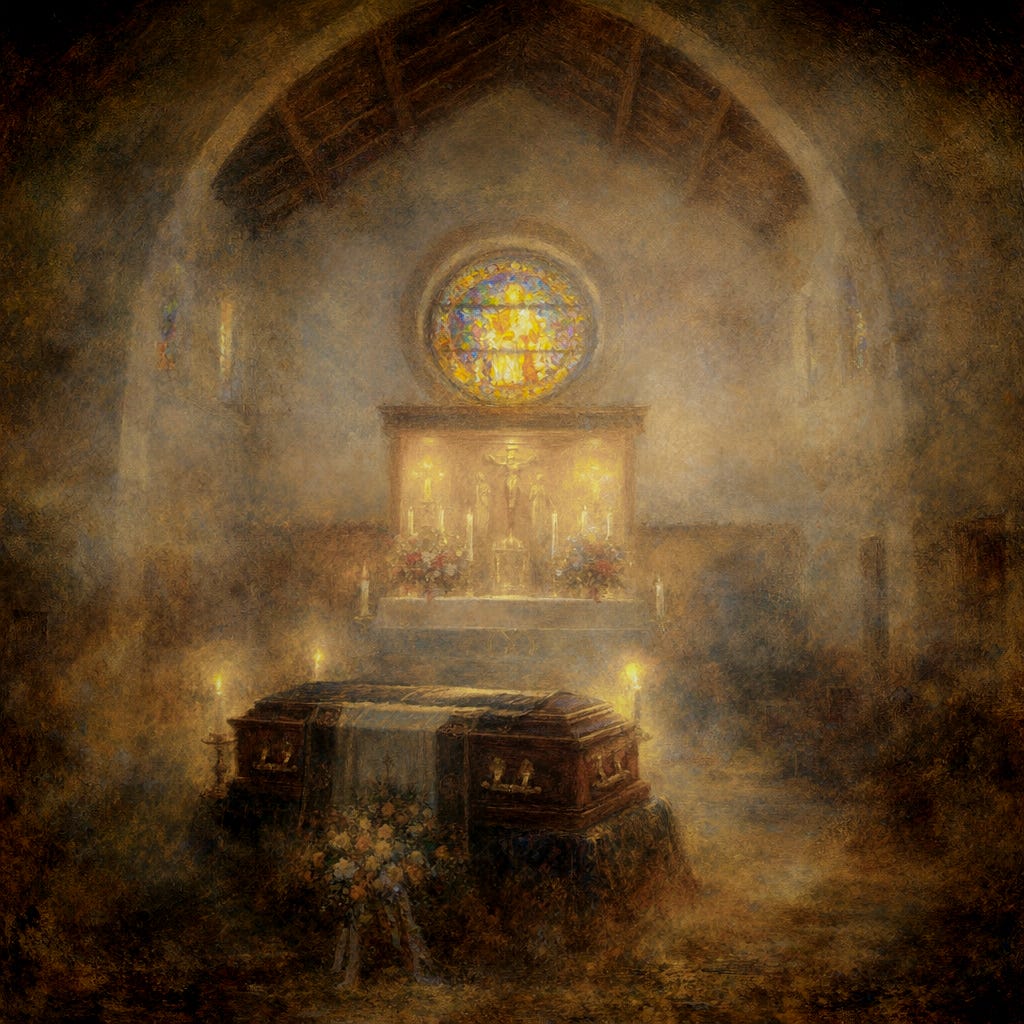
Six months later, mid-January 1997. Her funeral mass at St. Patrick’s—the same church where I’d taken my first holy communion, where I’d served as an altar boy, where my brother would later be married, where his two daughters would one day be baptized. The whole arc of a family’s sacraments in one building.
My father attended. He was a peripheral figure, standing off to the side. The towering, scary man of my childhood now looked shrunken and frail. Whatever power he’d held over all of us had left his body.
After the burial at Middle Patent Cemetery, I walked over to him. Put my right arm around his shoulder and leaned in. Choked with emotion, barely holding it together, I said the thing I needed him to hear.
“She loved us all.”
I wanted to share with him the same fantasy my mother had shattered at that dining room table. I wanted it to be true badly enough to say it out loud.
He gave me a quick, sad look. Said nothing. We parted.
That was the last time I ever saw him in person.
• • •
Twenty-five years passed.
He died in Florida in June of 2022, at ninety-four. Only his second wife still in his life. None of his six children had been down much, if ever. She arranged for his body to be flown up to New York. One of my sisters was going to have him buried without any ceremony—just put him in the ground. But my youngest sister intervened and organized a full funeral mass at St. Patrick’s.
The invitations went out. Jacques, 3,000 miles away in California, didn’t come. He said it was too painful, though he’d made the trip to Florida a year or two earlier to sit with our father. I think he cared more about the man than the rest of us, in his own complicated way. ZaZa didn’t come because Charlie would be there, and she was estranged from Charlie over his daughters. My stepbrother Bob didn’t attend either.
So there I was. In the same church. At the same pulpit where priests had baptized us, confirmed us, married us. Delivering a eulogy for a man I hadn’t laid eyes on in a quarter century.
I’d told Jacques years before that I didn’t think I could attend my father’s funeral. That what he’d done to me was too much. I never dreamed the roles would reverse—that Jacques would be the one who stayed away, and I’d be the one standing at the microphone.
Charlie had helped me with the eulogy. He read my early drafts and told me they read like I had a chip on my shoulder. He was right. So I scrubbed it clean. Made it about the people in the pews, not the man in the box. I listed every one of the twenty living descendants by name. I gave my father the church, the faith, the horses and dogs, the wicked sense of humor. I closed with John Prine.
So if you’re walking down the street sometime and spot some hollow ancient eyes, please don’t just pass ‘em by and stare, as if you didn’t care. Say hello in there. Hello.
“So Dad—hello in there. And now, sadly, it’s time to say goodbye.”
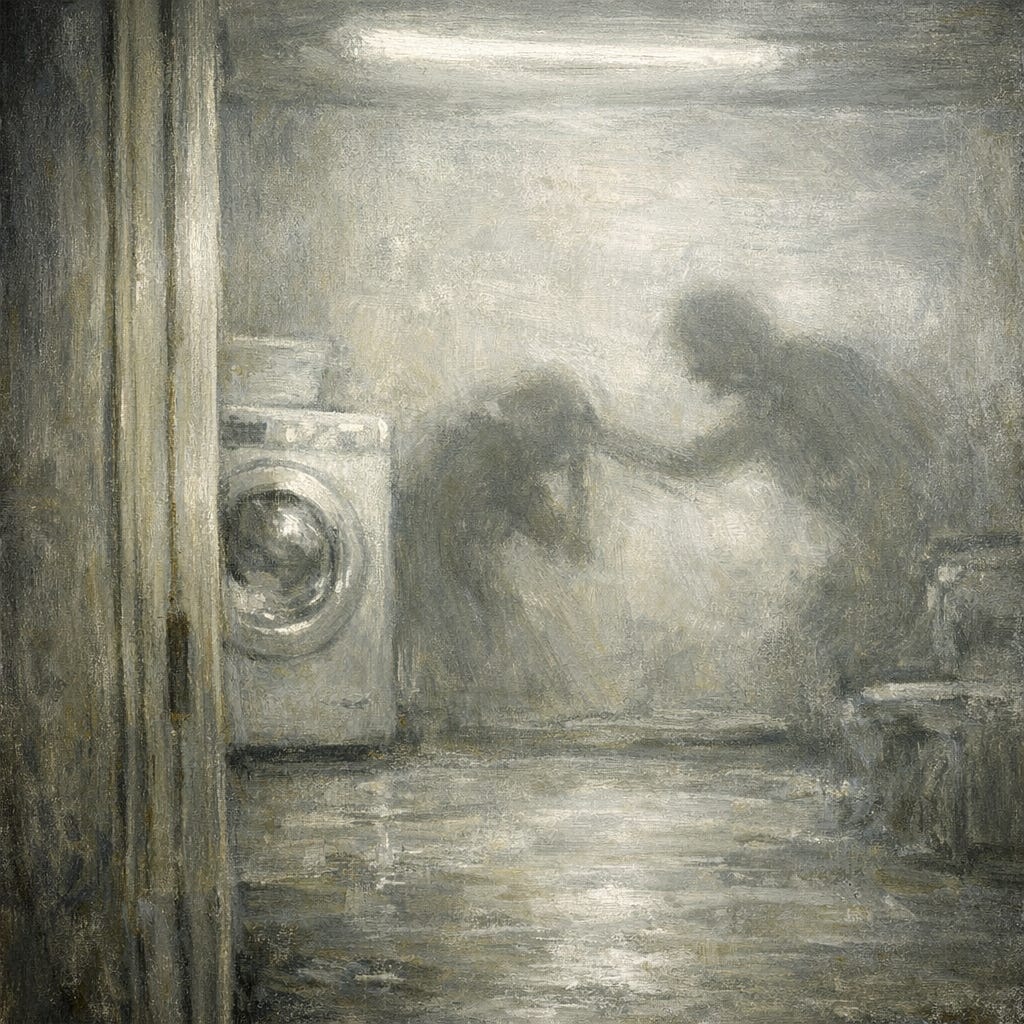
Standing up there felt like I’d become the priest he always wanted me to be. It also felt like an out-of-body experience. I couldn’t connect the box in front of the altar with the man who’d blocked my dreams, slapped my mother against the washing machine, demanded control over every breath his children took. It was just a box.
• • •
Afterwards, the reception. Thirty or forty people. And this is the part that stays with me.
Nobody talked about my father.
Not one story. Not one memory. Not a single “remember when he...” It was a garden party. People catching up, making small talk, refreshments on a table. The man who’d loomed so large in all of our lives—who’d controlled everything, demanded everything, withheld everything—had become a void. An atomic crater that everyone walked around the edges of, careful not to look in.
I stood there holding a drink I wasn’t tasting, watching these people who’d come out of duty or curiosity or family obligation, and I felt the full weight of what a life adds up to when you choose control over connection. When you freeze the people who love you until they stop trying.
The last time I saw any of my siblings in person was that day. Four years ago.
• • •
Over the next three years I managed to write the first book of a planned memoir trilogy. It covers two months in the summer of 1973—the summer I hitchhiked across America at twenty-one. My father appears in the first chapter. Three pages in, there’s a scene where I witness him slapping my mother across the face. It’s brief. It’s factual. It’s what happened.
During the initial development, I reached out to my youngest brother and sister to ask if they’d be willing to share their memories. They both said no. My brother was especially adamant. The past is the past, he said. He’s focused on the future. My other brother asked that he not appear in anything I write.
I honored every request. The siblings barely appear. The youngest two weren’t even born yet in 1973. One brother is three years old in footie pajamas. I changed nothing, invented nothing, dramatized nothing.
It didn’t matter. I think if any of them even bothered to read it, they put the book down on page three.
Not because I named them. Not because I exposed their secrets. But because I broke the silence contract. Every family built on repression has one. You don’t talk about what happened behind closed doors. You don’t acknowledge what you saw. You move forward and you never, ever look back.
I looked back.
My mother told me not to tell my father about her cancer because he might take pleasure in it. That’s not bitterness talking. That’s a woman who understood exactly what twenty years of marriage to that man had cost her, and she was right enough about it to say it out loud while dying.
My brother medicates the same wound with opiates. My sisters married their way out or built careers sturdy enough to wall it off. I wrote it down.
Six kids, six survival strategies. None of us wrong. All of us damaged. And the man at the center of it—the one nobody talked about at his own reception—he died the way he lived. Surrounded by silence.
So why write this? Why share it?
Because of Paul Clement Czaja. My grade school teacher—my guru, really—who taught a room full of kids to close their eyes, go inside, and meditate. Then he’d pass around a tray of photographs. Choose one, he said. A frozen moment. Inhabit it. Go with the feelings. Pour your swollen heart into explaining what you see.
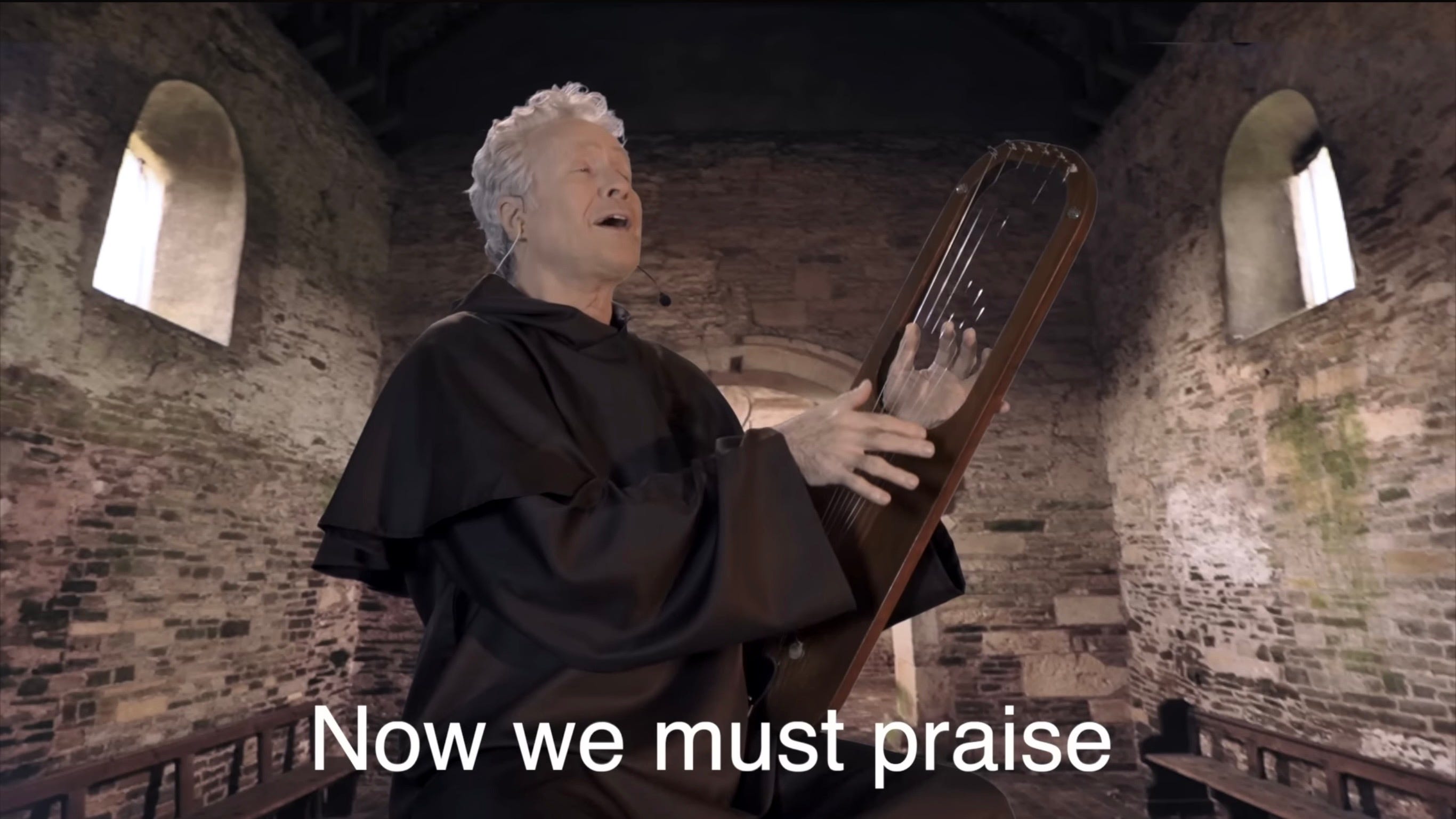
Our creative magazine was called Caedmon, after the first British poet. A seventh-century cowherd who couldn’t sing, until one night he dreamed a voice that told him to. And he did.
This is what I’m supposed to be doing. I know that now. My father wanted me to be a priest—to go beneath the surface, find out what it all meant. He was right about the calling. Just wrong about the collar.
Writing has become my priesthood. Not the kind he envisioned. But the kind Paul Czaja planted in me sixty years before I had the courage to answer it—standing over a tray of memories, learning that a single frozen moment, honestly witnessed, can break you open and inside that moment are the gifts of clarity, understanding and growth. Peace in my own heart, if not on earth.
Hello in there.