

subscribe ~ e-book ~ kindle/paperback/hardcover ~ table of contents

My grandmother’s apartment at 785 Park Avenue was a museum where all the exhibits watched you back. Every square foot filled with antiques, every conversation an interrogation disguised as concern.
“What exactly does a projectionist do?” she asked over breakfast, her tone suggesting she already disapproved.
Grandmère was my father’s mother — Jacqueline, the woman who’d once told me my father had “put his heart in the deep freeze.” She would know. She’d watched her own children scatter and self-destruct. Living with her meant inhabiting a fossilized worldview where popes and kings set the standard for human behavior and a grandson without a degree or a plan was a specimen to be studied with polite alarm.
I couldn’t have lasted more than a few months. But during those months, I found the job that would define the next year of my life — a classified ad in the New York Times, placed by Career Blazers: “Projectionist wanted. MCA Universal. Experience preferred but not required.”
* * *
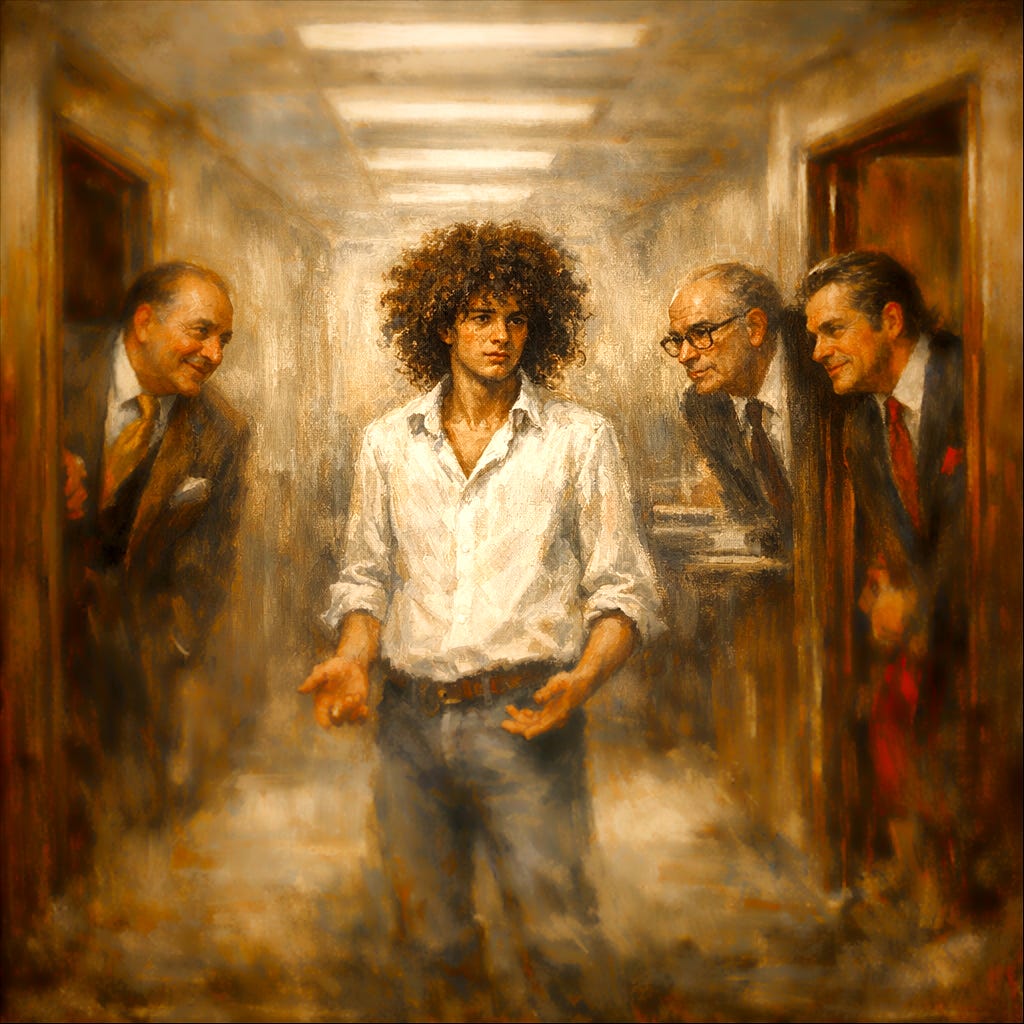
The address was 445 Park Avenue. Seventeen blocks south of my grandmother’s apartment, same side of the street. I think that’s why they hired me — a kid from Park Avenue applying for a job on Park Avenue. It suggested a certain pedigree, even if the kid in question was wearing jeans and a white dress shirt with no tie and had a white man’s afro exploding from his head.
The job paid three dollars an hour, a hundred and twenty-five a week. It got me into the IATSE union, which at the time seemed like a formality but would turn out to be a golden ticket years later when I needed to get into Hollywood. I had no way of knowing that. I had no way of knowing anything about where my life was going. I was nineteen years old, sitting on a white leather couch in a twelve-by-twelve screening room on the fourth floor of an office building, waiting for executives who never came.
The room was a strange little capsule. White leather couch, built-in wooden side tables with matching dimmable lamps, and what looked like a bookcase — but behind the cabinet doors was a bar and a rear-view sixteen-millimeter projection system. You’d open a door, a screen would swing out on a hinge, and inside sat a projector aimed at a series of mirrors that bounced the image onto the screen so it appeared correct. There was a telephone that never rang.
The whole setup existed so syndication sales executives could show off their television products — Ironside, Marcus Welby, the shows that were about as far from the films I wanted to make as you could get. But these executives did ninety-nine percent of their selling on the road, traveling to TV stations across the country. The screening room was a prop, and I was the prop’s custodian.
I sat on that couch and waited for a year.
Three vice presidents took an interest in me, each in his own way. Louis F., whose office was closest to my door, tried to steer me toward sales. “You’ve got the pedigree for it,” he said — a word my father would have used. Pedigree. As if I were a horse to be assessed for breeding potential.
Next door, Hal C., vice president of advertising, decided I should be a copywriter. “You speak well, you write well. You could write copy — words about shows that make people want to buy them.” I told him that was about as far from what I wanted to do as I could imagine.
Third door down was a guy named Selznick, some spawn of David O. Selznick, probably one of the most legendary Hollywood producers of all time. He wasn’t around much. But one day he was there with his girlfriend, and they called me into the office and closed the door.
“How would you like to be in a film?”
My heart jumped. Really?
“We’re shooting this weekend. Westchester mansion. You’d ride up on a Harley-Davidson. Go inside. Have sex with two beautiful women.”
I was twenty years old, incredibly inexperienced, bashful to the point of paralysis when it came to sex. They kept working on me. I kept saying no. The last thing I wanted to do. But I remember the particular cruelty of the offer — dangling the word “film” in front of someone who’d wanted nothing else since he was thirteen, then revealing it was pornography. Three executives, three pitches, and not one of them had anything to do with who I actually was or what I actually wanted.
* * *
One night I woke up on the fold-out bed with my crotch on fire. Itching like I’d rolled in fiberglass. I crept to the bathroom, flipped on the light, and there they were — tiny white things moving through my pubic hair. Crabs. I’d been celibate for months. Hadn’t so much as held a girl’s hand since Penn. But here they were, at one in the morning, in my grandmother’s Park Avenue bathroom, scurrying around like they owned the place.
I rode the elevator down in a cold sweat, found an all-night pharmacy on Lexington, and explained my situation to a pharmacist who’d clearly heard worse. He handed me a bottle of Pyrinate 2000 without comment. Back in the apartment, I sat on the edge of the bathtub at two a.m., applying lice shampoo to my pubic hair while Grandmère slept down the hall dreaming of popes and kings. I never figured out where they came from. My best guess, even now, is the men’s room at MCA.
* * *
Mr. F.’s secretary sat right outside my door. She was vivacious, slightly plump, strawberry blonde with freckles — a really wonderful woman who commuted in every day from Queens on the F train. One morning she came in crying.
She’s trying to clean her jacket. A little hip-length fur, the kind a secretary saves for months to buy. She’s scrubbing at it with paper towels, mascara streaking her face.
“What happened?”
“On the train... it was so crowded.” She struggles with the words. “Some creep... he... on my coat. I didn’t realize until I got here and took it off.”
The violation hangs between us. She’d felt something happening in that sardine-can subway car but hadn’t understood until she found the evidence. Semen on the back of her fur jacket.
“I’m so sorry,” I say. Useless words.
“It’s this city,” she whispers. “Sometimes I hate this city.”
I thought of Westchester, of family dinners where the live-in maid served courses in silence, of Sunday Mass where my father’s donations ensured front-row seating. My life had been hermetically sealed against the world this woman navigated every day. Three dollars an hour, same as me, but she earned hers by crossing through a city that could assault you on your morning commute and leave you scrubbing the evidence off your nicest coat.
* * *
The one person on that floor who existed in the same universe as me was Abby. Puerto Rican, worked in the mail room on the back side of the elevators along a windowless corridor. My age, my frequency. One day he appeared and asked the question that would define our friendship.
“You smoke?”
“Cigarettes?”
His grin told me everything.
We’d meet in the stairwell between floors, suspended in concrete limbo, share a joint, talk about music and the lives we imagined for ourselves, then go back to work blitzed. Nobody seemed to care or notice. That was the extent of it — occasional co-conspirators in corporate purgatory. But Abby had something I lacked: the instinct to act on impulse rather than just dream about it.
* * *
During this period I enrolled in a poetry writing course at the New School for Social Research. Grandmère had given me two hundred and fifty dollars as a gift — my money now, to use as I saw fit. My father had a standing offer: if I went to school and earned a B or better, he’d reimburse the tuition. So I paid for the course, did the work, got the grade, and collected his reimbursement. As far as I was concerned, the deal was clean. A gift is a gift. What I chose to spend it on was my business.
Then my father had dinner with his mother. He was bragging about the arrangement — how his son was finally showing initiative, how he’d kept his word and reimbursed me. Grandmère told him she’d given me the money.
From that moment, my father believed his son had conned him — taken a gift from Grandmère, spent it on tuition, then collected reimbursement for an expense that had cost me nothing. The fact that the gift was mine, that I could have spent it on anything, that I’d chosen to invest it in education and honored every condition he’d set — none of that mattered. The story became fixed in the family record. Another data point in the emerging portrait of Andre as someone who couldn’t be trusted with money. Truth is no match for a story that confirms what people already want to believe.
* * *
Steve Ferry came back into my life on a lunch break. He’d dropped out of Penn after freshman year, moved to California, was back east visiting someone. He called the office and suggested we grab something to eat.
We left the building, headed north on Park Avenue toward 56th Street.
A crowd gathering on the south side of 56th. Something pulling people toward an apartment building with a canopy that extends ten, twenty yards from the entrance. We push through.
A woman on the pavement. Beautiful. Blonde hair fanned out. She’s wearing what looks like a slip. She’s come through the canopy from high above — the canvas slowed her just enough to leave her face intact. Arms and legs at odd angles. No blood that I can see. She’s very pale.
I stand there. Steve stands there. Neither of us speaks.
Then we went to lunch. Steve told me about California — Santa Rosa, wine country, a converted chicken coop on an old prune ranch. Fifty dollars a month. Beautiful country, real people, no pretensions. He’d read Kerouac, we’d both read Kerouac, and here he was living it.
“You should come out,” he said. “The offer stands.”
I told him I’d think about it. But the image of that woman on the pavement stayed with me longer than Steve’s pitch. She’d chosen to leave a building the fastest way possible, and the city had gathered around her body with the same hungry curiosity it brought to everything — spectacle as entertainment, tragedy as a thing to see on your lunch break.
* * *
The VisitUSA passes were Abby’s idea. Everything good that happened at MCA was Abby’s idea.
“I got a hold of these two air passes,” he told me in the stairwell one afternoon. “VisitUSA. The bearer travels anywhere in the country for twenty-one days, free. Participating airlines only — smaller carriers, so you can’t just jet from New York to San Francisco. You take a bunch of legs. But it’s free.”
“What’s the catch?”
“You’re Almali Medeiros. I’m Nair Fares.” He grinned. “Two Brazilian guys who had to go home early. My cousin works at the airline.”
“They don’t check ID?”
“They don’t check. Long as you have the ticket, you get on the plane.”
“What about work?”
“Call in sick.”
In 1972, this was possible. Airport security was a man at a desk who glanced at your ticket and waved you through. No metal detectors, no body scanners, no photo ID requirements. You could fly across the country under someone else’s name and nobody blinked.
We met at LaGuardia the next morning, called in sick, and boarded the first of what would be four flights chasing the sun west. LaGuardia to St. Louis. St. Louis to Denver. Denver to Las Vegas. Vegas to San Francisco.
On the leg into Sin City, Abby befriended a guy who took us to his air-conditioned house in the desert — sixty-eight degrees while it was over a hundred outside. We smoked his weed, listened to his stereo, and made our flight to San Francisco.
True to form, Abby had chatted up a woman on the plane — attractive, older than us, traveling alone. By the time we landed, we had a place to stay. Her apartment in North Beach, wine, weed, music. Abby and the woman disappeared into her bedroom. I slept on the couch.
The next day, I wanted to visit my friend Gary who was going to Stanford. We rented motorcycles — Abby’s idea — and rode down to Palo Alto. Gary sold us a quarter pound of excellent weed, we caught up on life since Penn, and on the ride back Abby and I were going about five miles an hour on a quiet secondary road, talking to each other across our handlebars, when the handlebars locked and we both went down.
It was a slow-speed tangle, nothing serious — a couple of bruises and some road rash on my pride. But the image stays: two guys from Park Avenue and the Bronx, flying around California on stolen airline passes under Brazilian aliases, wiping out on rented motorcycles with a quarter pound of weed in their bags. If my father could have seen us.
We spent another night at the woman’s apartment — Abby enjoyed her company again, I enjoyed the couch again — and the next morning started the return trip. San Francisco to Vegas, Vegas to Denver, Denver to St. Louis.
In St. Louis, we checked in for the final leg to LaGuardia. Sat down. Waited for boarding.
The PA system crackled.
“Would Almali Medeiros and Nair Fares please report to the ticket counter?”
We looked at each other.
At the counter, an airline agent stood beside a man in a dark suit. Federal Sky Marshal. He interviewed us one at a time in a small room. Asked for ID. We couldn’t prove we were who was on the ticket, obviously, because we weren’t.
He searched my bag. I was sweating through my shirt because I had two ounces of Gary’s finest California weed in my suitcase. But it was a cursory search — weapons, not drugs. He didn’t feel it, didn’t find it, didn’t mention it.
“What you’ve done is fraud,” he said. “But I’m going to let you off with a warning. Now get out of here.”
And there we were. Two guys with suitcases and two ounces of weed, stranded in St. Louis with no money and no ride home.
So we hitchhiked.
Two guys in a Mustang with a killer sound system picked us up first, heading east, just cruising. They passed a bottle of Southern Comfort around. We hit some weed, had some laughs, and they let us out somewhere on I-70 as night was falling. Then nothing. Nobody stopping for two long-haired kids — Abby’s magnificent afro, my white-boy version, both of us tall and lean and looking like exactly what we were.
Hours passed. It was getting depressing, then worrying. And then, improbably, a brand-new motorhome pulling an identical copy behind it eased to a stop a hundred yards ahead. We ran to catch up.
“Where you headed?”
“New York.”
“That’s where I’m delivering these. Hop in.”
The motorhome was luxurious — kitchen, bathroom, beds sealed in plastic for the dealership. “Don’t unwrap anything,” the driver said. “Just lay on top if you’re tired.”
We were tired. We crashed on plastic-wrapped mattresses and slept like the dead while America scrolled past in the darkness. Woke up the next morning to the Manhattan skyline.
Monday morning, we were both back at our desks.
“How are you feeling?”
“Much better, thanks. Must have been a twenty-four-hour thing.”
That trip cracked something open. Not just the adventure of it — though flying across the country under false names and hitchhiking home from St. Louis with a bag full of weed was certainly an adventure. What it showed me was that the road was real. Not just a Kerouac fantasy, not just Steve Ferry’s postcard promises, but an actual thing you could do. You could leave. You could move through the country and meet strangers who’d let you sleep in their refrigerated houses or their brand-new motorhomes, and most of them would be decent, and you’d survive.
Abby knew this instinctively. I had to learn it. The VisitUSA passes were my first lesson.
→ Next Chapter: The Band That Never Played Out
