

subscribe ~ e-book ~ kindle/paperback/hardcover ~ table of contents

The canyon released me eventually. The vision faded by degrees, and then I was a hungry young man with a backpack and no guitar, walking out of a national park in West Texas.
I don’t remember much of the next two weeks. I made it to Austin, found Geoff and Jason at Gary’s house on Manchaca, ate food that had texture again, slept on a floor. Lucy and Jade from Colorado turned up, and whatever was about to happen on the couch got interrupted by Tom walking in — one of those moments you remember exactly because it didn’t quite happen. Then I stood on on-ramps all the way up through the South, and the rides came and came, and I kept heading north, because north was still whatever was left of home.
* * *
I’d left Ledge Acres in July — twenty-one years old, a college dropout, a disinherited rebel who’d “borrowed” eighty dollars from his mother’s closet and put his thumb out on 684. New York to the Rockies to the Redwoods to San Francisco to Big Sur to Big Bend to Austin and back. I’d watched Steve unravel and get killed by the police. Had my guitar stolen. Dropped peyote in the redwoods. Fasted five days in Santa Elena Canyon until stones turned to doves in my hands and my dead friend sat across from me and told me to find someone who moves like water. The road had cracked me open the way that canyon cracked the earth, and what poured in was a kind of seeing I hadn’t had before. Not wisdom. Just clarity. The terrible clarity of someone who has looked at death and come home to find the living still moving through their days.
I pitched my tent in Meyers pine groves, across the road from the house. Hung my gear to dry. Then I went down to see what was left.
The divorce was final. The estate was under contract. Twenty-five acres of rolling Westchester countryside — the stone walls, the barn, the meadow where we’d played football, the long gravel driveway lined with maples — all of it about to belong to strangers. I knew this before I left. Knowing it and standing in it were different things.
The house was empty. Silent. My old room in Jimmy Matsudo’s quarters was exactly as I’d left it — Dead posters on the walls, empty baggies, the steamroller pipe, door wide open. Two months gone and nobody had even closed it. I found Corky asleep in the shed area and had to call his name three times before he heard me. Last of our Irish setters, arthritic and half-deaf, too old to bark at anything. He lifted his head, recognized me, and came over. No fuss. Just the quiet acknowledgment of an old dog who’d outlasted most of the household. He followed me down the driveway the way he always had.
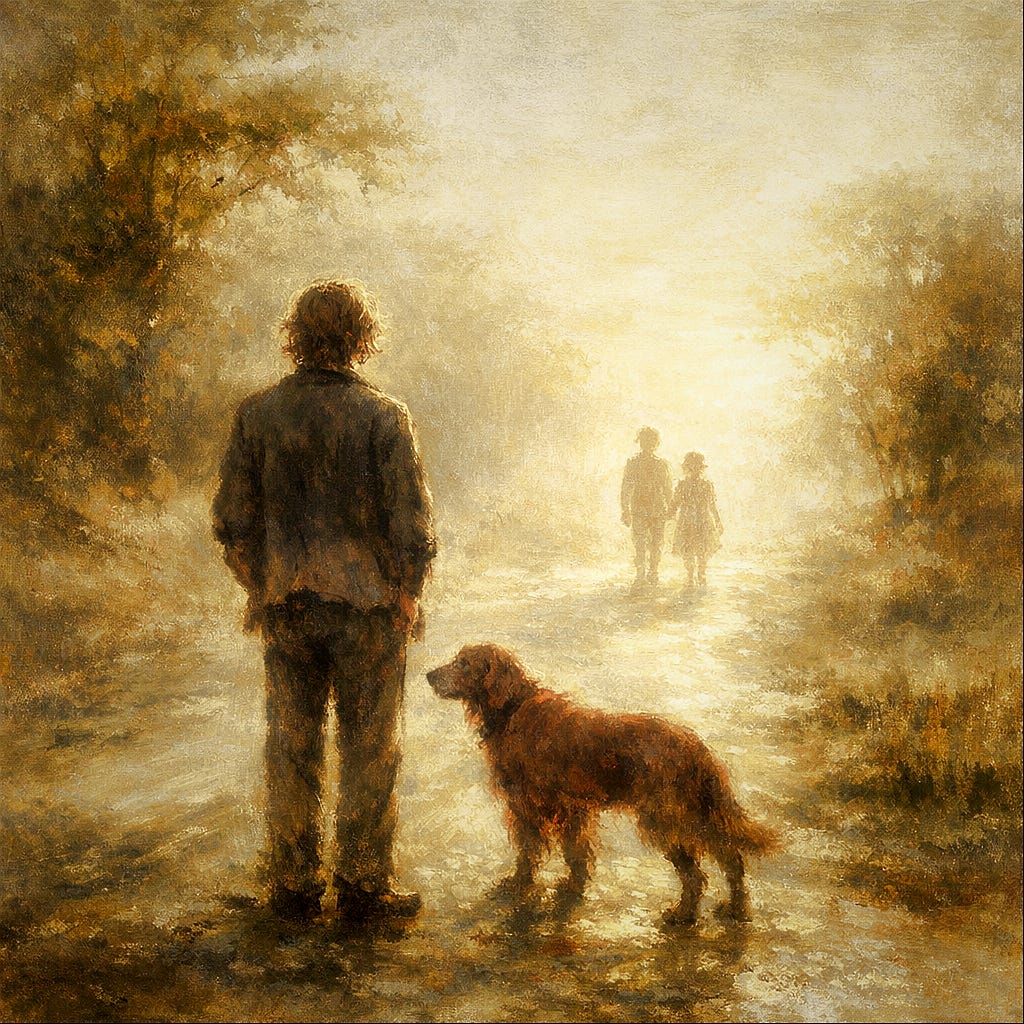
The two of us stood in the middle of the road, looking south.
And coming toward us from the direction of 684, over the crest of the next hill — golden hair first. Blonde and straight and fine, backlit by late afternoon sun. Turner light — low, slanting, the kind that dissolves edges and makes the world look like a memory even while you’re standing in it. Then their heads. Their shoulders. Small bodies in navy and white, Rippowam uniforms, collared shirts. Books in one hand each.
And their free hands holding each other.
Charlie. Twelve. Anni. Ten. Walking home from school.
They were the babies. Youngest two of six, and the only ones truly native to Ledge Acres — born at Northern Westchester Hospital, rooted in this place from their first breath. A solid decade of one address, one school to walk home from. They had lifelong friends. I’d moved eight times by their age and lost touch with all of mine.
Charlie was tall for twelve, lanky, easy in his body. The kind of kid who made friends without trying, who wanted everyone to get along. Anni was smaller, compact, fierce even in stillness, hair almost white-gold. She’d thrown food at Dux from her highchair before she could talk. He called her Stinky after that. She had a way of looking at the world that was already defiant, already measuring.
They didn’t see me yet. Charlie was saying something — some joke from the day — and Anni was listening with that tilt of her head, deciding whether to laugh or argue. Light dropping fast, shadows of trees stretching across the road. They were completely, utterly children. And something stood up in me and said: these precious innocents are somehow my responsibility now. They need protection.
It wasn’t virtue. It wasn’t heroism. It was the raw instinct of someone who had just spent two months learning that the world breaks people, and the only thing worth doing is trying to keep it from breaking the ones you love. I could feel their futures approaching the way you feel weather coming, and I had nothing to stop it with. No money, no plan, no home of my own. A twenty-one-year-old with a backpack, camped across the street from his own house.
Corky sighed beside me. The way old dogs sigh.
And then they saw me.
* * *
The rest of us were already spinning off into our own orbits. I was the firstborn, the project, my father’s blueprint for the future he’d wanted for himself — the golden boy who’d rejected the gold. The girls had always gotten different rules. They stayed home while I got packed off to Exeter at thirteen, then a school in Rennes for a year, then back to Exeter, then off to a college I didn’t want to attend.
But Charlie and Anni — they’d had something none of the rest of us ever did. Stability. One house, one school, one set of friends, year after year. I envied them that rootedness even then. What I didn’t understand was that when the ground finally got pulled out, their roots would tear worse than mine ever did. I’d never had roots deep enough to tear.
* * *
Within weeks, all of us relocated to my mother’s new house on Trinity Lane in Pound Ridge. Four acres instead of twenty-five. A modest en-suite master bedroom upstairs with three tiny children’s bedrooms with one shared bath. There was an attached, one story mother-in-law apartment — large cathedral ceilinged living room and kitchen, separate bedroom with its own bathroom, screened porch, private entrance. That was Nana’s. My mother had chosen the house specifically for that apartment.
Six kids. Three bedrooms. It was claustrophobic from the first day, though the population was already thinning. Jacques was at boarding school. The girls were finding their own exits. Charlie and Anni settled into their rooms. And I stood in the middle of it knowing I didn’t belong there.
I’d already reached the end of my rope in Westchester County earlier that year. I’d tried everything available to me, which wasn’t much without a degree or a plan or any money. The hitchhiking trip had been my answer to that dead end, and now I was back at the same dead end, only the scenery had shrunk. Ledge Acres had at least given you room to disappear into — meadows, woods, the long dirt road where you could walk for miles without seeing the house. Pound Ridge closed in on you. The walls were closer. The ceilings were lower. Everyone’s business was everyone else’s.
* * *
December 6, 1973. My last night at Pound Ridge.
I’d called my father that afternoon, reluctantly, to tell him I was heading back to California. He wished me well. Sounded sincere — sort of. Man to man, vaguely. Bad vibes nevertheless. He did not ask me what my plan was. And I really didn’t have one anyway.
My mother made filet of sole. I opened a bottle of Siglo ‘69. There were four of us at the table — me, mama, Nana, and Charlie. My oldest sister ZaZa was upstairs tending Anni, who had the flu. It was a small dinner in a small house, but mama and Nana had a gift for making occasions out of ordinary evenings. They’d always had that.
We made twelve toasts. I don’t remember all of them. “To Charles’ continued charming growth.” “To Anni and her new pet donkey Jackson.” “To the plants in the house.” Each one a small declaration that life was still worth celebrating, even in reduced circumstances, even with the family scattered and the father gone and the big house sold. Twelve toasts with a bottle of Spanish wine on a Thursday night in December.
Nana pulled me aside after dinner, the way she did. She had her own special way of getting to the point. She reminded me, with a twinkle, that “the thing between your legs is not for stirring tea.” I protested. She said, well, one of these days you’re going to meet somebody better looking than yourself. I rolled my eyes. Nana was blunt, Irish to her core, and she could make you laugh about things you didn’t want to discuss.
The next morning my mother drove me to the 684 North on-ramp. I told her I was worried about Charlie and Anni. She told me they’d be fine. She pressed a hundred dollars into my hand. Thumb out. California-bound.
She’d been driving me places my whole life. When I was seven or eight, I served 7 AM mass at Saint Patrick’s as an altar boy, and for a stretch of months my mother and I would make that early drive together — just the two of us, before the rest of the house was awake. Afterward she’d take me out for breakfast. I always got pigs in blankets and tomato juice. It was our thing. A small, private ritual in a household that ran on my father’s rituals. I loved those mornings.
Now she was driving me to an on-ramp, and I was leaving again. My only plan was to return to Sonoma County and find myself somehow, this time without a guitar.
→ Next Chapter: Together Brothers
