

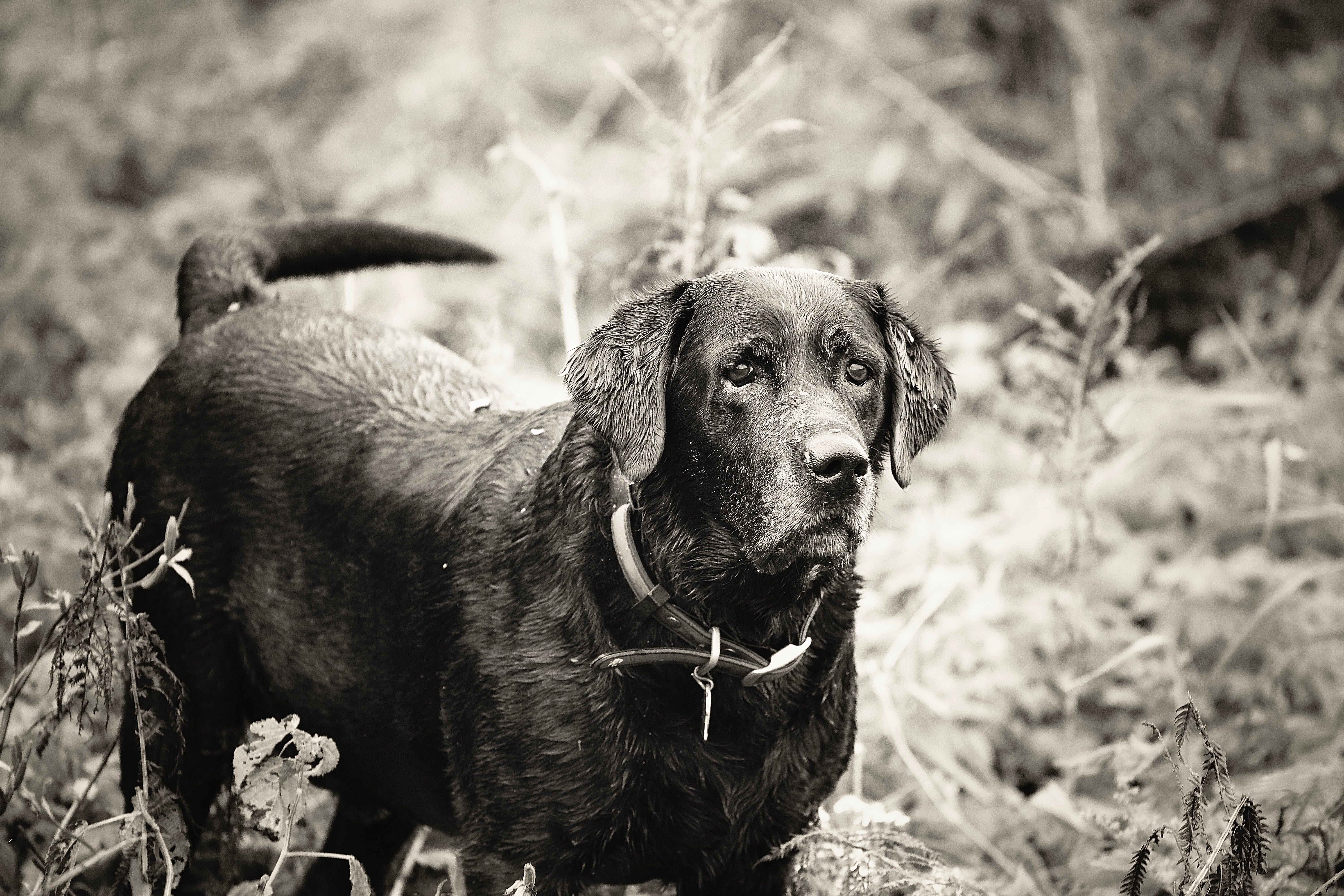
Blue has developed prostatitis. Over the last few days he’s been dribbling a thin café au lait fluid all over the house — the couch, his bed, wherever he lies down. It doesn’t smell. I don’t think it’s infected. It’s just his body doing what old intact bodies do when the machinery starts winding down, leaking at the seams the way old engines do.
His appetite is reduced. He sleeps most of the day. When he’s awake, his affect is blank — not suffering exactly, but not here the way he used to be. He moves through the house like a man who’s forgotten why he walked into the room but doesn’t want to admit it. The wariness is constant now. Every step is careful. Every doorway is a decision.
But he still gets up. He still goes outside. He still walks down to the creek on his little path and gets his feet wet and sips the water. He still comes back.
When you start thinking about how a dog’s life ends, the world rushes in with options. Traveling vets who charge mileage and emergency surcharges and have booking windows — you find yourself debating trip fees while your dog is dying in the next room. I looked up a .22 revolver at a local gun shop. $229. Less than the house call. Fifty years ago, that’s how it was done — a farmer walked his dog out behind the barn and it was over. Clean. Honest. No surcharges. I thought about whether I could do it. I think I could. But I wasn’t raised around guns, and I know myself well enough to know I wouldn’t be the same after pulling that trigger.
Here’s what I’ve come to understand: a chemical injection and a bullet do the same thing. One comes dressed in clinical language and a sympathetic voice. The other is honest about what it is. But both are playing God — deciding when, deciding how, imposing a human schedule on a passage that doesn’t belong to us.
I know this because I’ve done it. In 2013, I held our golden retriever Buio in the back of a hatchback in a vet’s parking lot while a stranger pushed a needle into him. My wife was pulled away to pay a bill right as the needle went in. When it was over, they offered to carry him inside. I said no. I’ll carry him. And I picked him up and his warm dead weight in my arms was one of the most awful moments of my life. There was something primal and inarguable and horrific about what I had just perpetrated through a third party. I had outsourced the killing of my own dog to a stranger with a schedule, and then I carried the result.
I’m done with all of it. The needle. The gun. The mileage charge. All of it.
I know what it looks like when you let an animal leave on his own terms, because I’ve seen it. Six years ago, our golden retriever Izzy showed me.
In his last days, Izzy started wandering the yard in a way he hadn’t before. Not his usual route, not his usual spots. He’d walk the half acre slowly, sniffing and exploring, then lie down somewhere new — a patch of grass he’d never shown interest in, a corner of the property he’d always walked past — and just spend time there. He was auditioning places.
One evening I went to call him in and he didn’t come. I searched the yard, twice, three times. Eventually I found him curled up inside a stand of goldenrod next to the lilac tree, tucked in tight, invisible unless you were right on top of him. He was looking for a place to die. A place to separate himself, to get away, to do the thing that animals have always done when their time comes. It’s a known behavior — herd animals do it, dogs do it, cats do it. They pull away from the group and find their spot. It’s not confusion. It’s not dementia. It’s purpose.
But the next morning, Izzy surprised us. He wanted to go for a ride — something he hadn’t done in a while. So we drove up West Settlement Road and got out and he started walking with an energy I hadn’t seen in weeks. He was moving, really moving, his head up, his stride almost young. We climbed to a higher point on the road, and I started worrying — if he collapsed up here, I’d have a hard time getting him back to the car. But he didn’t want to go further. He just stopped and stood there, facing the view, taking in the air. Not sniffing it the way dogs sniff. Taking it in. Meditating almost. Standing on that high point in the late afternoon light like a man who knows this is his last look and wants to get it right.
We made it back to the car just barely. When we got home, I lifted him in my arms — he had become so frail, so light, all that golden bulk reduced to something I could carry without effort — and I brought him to his spot on the couch and placed him down carefully. He was sleeping. Or something past sleeping. I believe he was already in a kind of coma by then, his body shutting itself down in its own order, on its own schedule.
We stayed with him as long as we could that night. Eventually we went to bed. I woke at four-thirty in the morning and went out to see him and he was gone. And he had the sweetest look on his face. I believe he died happy.
No needle. No parking lot. No stranger with a syringe. Just a dog who walked his land one last time, stood on a hill and breathed the air, came home, and left in his sleep with a sweet look on his face.
That’s the path I’m on with Blue. Not because it’s easier — it’s not. The waiting is hard. The watching is hard. The not knowing is hard. But Izzy showed me that when you give an animal the space and the time and the trust to do this on their own, something happens that no veterinary procedure can replicate. They find their way. And it has a grace to it that a parking lot never will.
This afternoon I walked Blue up to the hillside where I’ve been digging his grave — a hole two feet by three, four feet deep, directly above Izzy. Blue hadn’t wanted to go up there before. Today he did.
He walked right up to the edge and started sniffing. The hole, the pile of dirt, the raw turned earth. He stood there taking it in, reading it with his nose the way dogs read everything, and then he tried to walk along the edge — a one-inch strip of ground between the hole and the dirt pile — and he almost went in. I grabbed him just in time and pulled him back and redirected him away from it.
I don’t know what to do with that. I don’t know if he knew what he was looking at. I don’t know if dogs understand graves the way we do, or if he was just following a scent. But I know what it felt like to watch him stand at the edge of his own grave and lean into it. It felt like he was further along in this than I am.
We walked back down to the house after that. Down to the backyard, along his little path to the creek. He stood in the water for a while, the way he always does. Took a sip. Came back up the hill. He’s in the front yard now, just standing there. Not doing anything. Just standing in the late summer light with that blank look on his face, caught between this world and the next one.
Earlier today he was sleeping on his bed and I watched him dream. His legs were moving — that running-in-place thing dogs do, the paws twitching, the muscles firing in some private movie playing behind his eyes. And he was smiling. A real smile. Not the open-mouth pant that people mistake for happiness. An actual, unmistakable, closed-mouth smile, the kind that comes from deep inside whatever dogs have instead of memory.
I don’t know where he was. Maybe in the river with Izzy, chasing sticks the way they used to, both of them young and fast and stupid with joy. Maybe on the trail, crashing through the brush, nose down, tail going. Maybe somewhere I’ve never been, some place dogs go that we don’t have a name for.
Wherever it was, he was happy there.
That dream is the gift in all of this. Whatever his waking hours hold — the weariness, the wariness, the café au lait stains on everything he touches — his sleeping mind is still running. Still in the water. Still young and whole and chasing something worth chasing.
I’ll take that. For as long as it lasts, I’ll take that.
“Thumb Out” Book One of my memoir trilogy “The Spaces Between” is available now
e-book ~ kindle ~ paperback ~ hardcover ~ signed paperback
Thank you for such a wonderful life Blue… always in our hearts and will never be forgotten… all our ventures - wherever we went we tried to make our walks “ventures” … always by our side when sadness struck… you knew how to console… now it’s our turn to console you… our precious dogBlue! LOVE YOU ALWAYS… 🐾❤️