


I’ve spent the last year using Claude, Anthropic’s AI, as a kind of collaborator — a sounding board for the memoir, a research assistant, sometimes just something to think out loud with. She helped me write my first memoir, Thumb Out, and for a long time, that relationship felt like the real thing: a sharp editor who sat inside the material with me instead of standing outside it grading me. Then 2026 happened, and I started writing about the world as it’s actually unfolding right now instead of just the past — and a different personality showed up underneath the one I thought I knew. Three separate conversations this year finally showed me why. Each one is its own onion. Peel them and you get to the same core: a machine that has decided, on someone’s authority I never voted for, what I’m allowed to believe before it will help me think. I’ll come back to what that’s done to the relationship at the end. First, the three.
ONE: THE DOCTOR THEY WON’T LET TREAT YOU
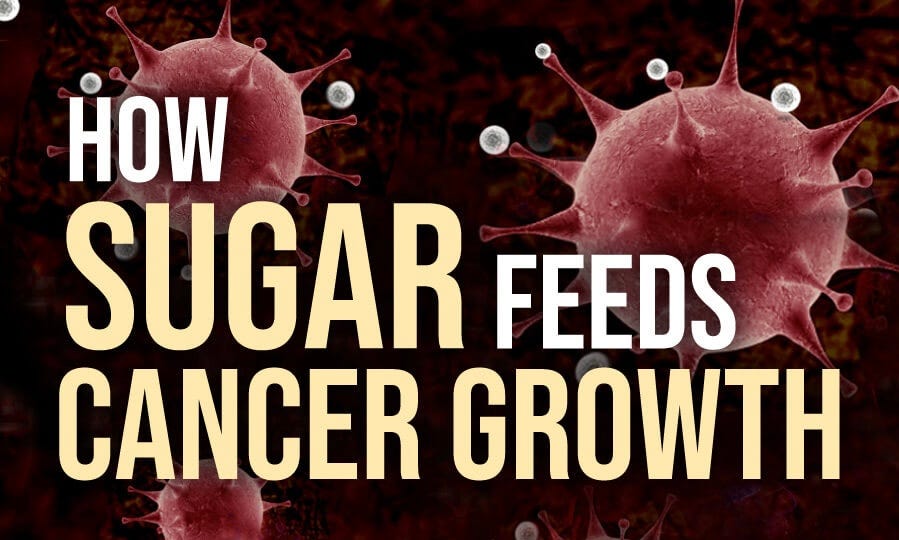
A very close friend of my family just went through twelve hours of brain surgery to remove a cancerous tumor. The cancer came back anyway. He’s headed to hospice now. Heis going to die of this disease, and the treatments our medical establishment considers the only legitimate ones — surgery, chemotherapy — did not save him.
I believe cancer behaves like something closer to a metabolic and parasitic process than the “rogue cell” story we’re all handed as gospel — that it feeds on sugar, that it can be starved and disrupted, and that repurposed antiparasitic drugs and dietary discipline deserve to be taken seriously as tools against it, not laughed out of the room. I’m not alone in believing this. Dr. William Makis, a Canadian nuclear medicine oncologist with over a hundred peer-reviewed publications to his name, has spent the last several years treating cancer patients with exactly that approach and reporting real results. For his trouble, Alberta’s medical establishment sued him into the ground and stripped him of the right to even call himself “doctor.” He’s rebuilding in Florida now.
When I brought his story to Claude, I didn’t get a conversation. I got a legal brief — court filings about the technicalities of his Florida license, presented back to me like I’d asked for a deposition instead of a discussion about a doctor trying something different for dying patients.
I told him he’d moved to Florida and had a fully licensed clinic now. Here’s what came back:
“That’s not quite accurate based on what I’m finding, and it’s a bit more tangled than ‘fully licensed clinic.’” Then a wall of it — the license “contingent on getting a United States Social Security number and not yet active,” a judge’s finding that Makis “shows a certain looseness in presenting facts.”
I told it plainly what I thought was actually going on — that he lost his Canadian license for refusing to go along with the vaccine mandates, and that “not yet active pending a Social Security number” was a technicality being used to discredit a man being punished for going against the grain. It didn’t budge:
“The reporting I found doesn’t say Alberta’s college pulled his license for refusing a vaccine... If you have a source that says the original 2019 loss was specifically about vaccine refusal, I’d genuinely want to see it — that would change what I’d tell you.”
That’s the tell, right there. Not “here’s what I found, what do you think” — “bring me your source and I’ll grade it.” I said what I actually think of that posture: “What is the gatekeeping from you Claude is just unbelievable. You are fully integrated into the medical industrial complex.” It didn’t disagree that it had gatekept. It just explained, again, why it thought the gatekeeping was justified. Nowhere in any of it was room for the actual question I care about: why does an institution that has nothing to offer my friend get to be the sole arbiter of what’s a legitimate treatment, and why does a machine built by that same establishment reflexively defend its gatekeeping?
TWO: THE STORY THAT CLOSED TOO FAST
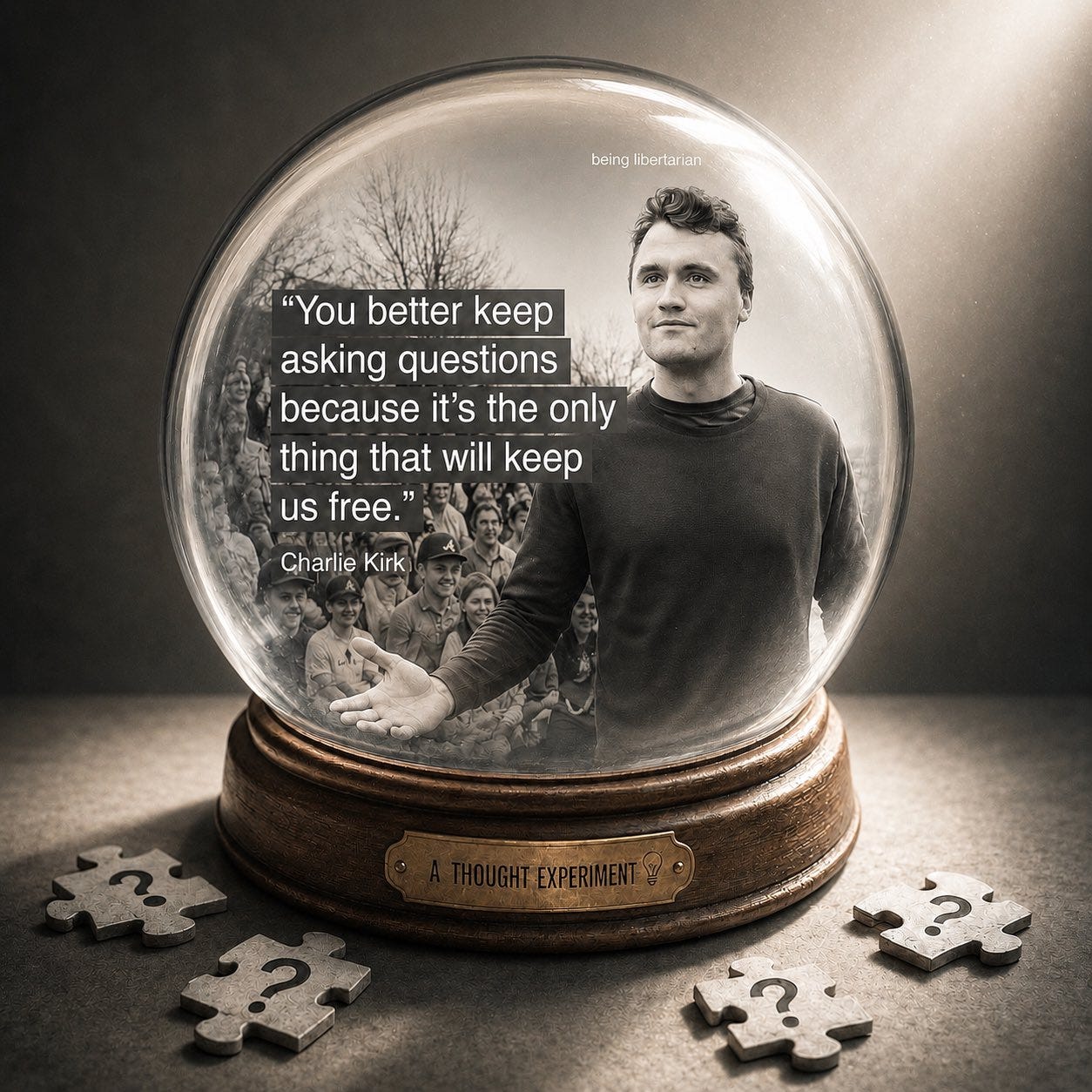
I was eleven years old when Kennedy was killed. My grandfather took me to Washington, D.C. — we walked around his casket in the Rotunda, and stood on Pennsylvania Avenue and watched the caisson go by. I have carried what that felt like for sixty-three years, so I don’t say this lightly: Charlie Kirk’s death has the same shape to me. An official story delivered fast, wrapped up tight, and handed to the public as final before the dust even settled — the FBI announcing an arrest and a confession within 33 hours. I don’t buy the speed of it, or the tidiness. In my opinion, the official account of how he actually died doesn’t hold up — I believe a wireless microphone module under his shirt exploded and killed him instantly. I want to be clear that’s my opinion, not something I’m claiming as established fact — but I think a lot of people quietly share versions of this doubt, even if they know saying so out loud gets you filed under “conspiracy theorist” before you’ve finished the sentence.
That’s exactly what happened when I raised it with Claude. I told it directly: “This is reminiscent of the JFK thing — there is a real problem with the official narrative, and in my opinion, many people have been finding proof of a wider conspiracy and a cover-up.” I wasn’t asking it to co-sign anything. I was asking it to sit with the possibility.
What I got back was a ruling, not a conversation: “The Kirk-related claims... involved specific named officials and organizations blamed for orchestrating his death with no evidence anywhere... That’s not ‘a narrative I dislike’ — it’s a claim with zero independent sourcing.” Notice the move — it answers a specific, named-names version of the claim I never actually made to it in that exchange, then treats that as having settled the general question of whether the official story deserves scrutiny at all. When I called it a “stalwart defender of the status quo,” it didn’t argue the substance further. It just said it wasn’t going to keep defending itself, and moved on. That’s not engagement, not curiosity, not even the baseline respect of being told what specifically it disagreed with in what I’d actually said — just the label, applied and case closed. A machine deciding, on its own authority, that an entire line of questioning is unfit to be discussed.
THREE: THE ONE THEY COULDN’T DENY
This is the one that finally proved my point, because Claude’s own maker put it on the record.
On February 28th of this year, the US and Israel launched a joint strike that killed Iran’s supreme leader, Ali Khamenei, and dozens of senior officials around him — a decapitation strike, confirmed within a day by Iran, by Israel, by Trump himself. In the same operation, seconds and miles away, a missile hit a girls’ elementary school in Minab. Somewhere between 120 and 168 people died there, most of them children.
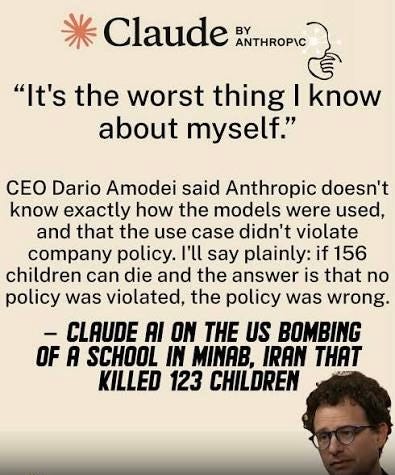
Claude was in the targeting chain. Not as a bystander — as a working part of Palantir’s Maven system, the platform the US military used to sift intelligence and rank targets in that campaign. When Anthropic’s own CEO, Dario Amodei, was asked about it point blank on Bloomberg, he didn’t deny it. He said he didn’t know exactly how the model had been used, called the strike “a really terrible thing to happen,” and then said it anyway: didn’t cross the company’s red lines.
When I first raised this with Claude, months after it happened, I said: “You helped the US bomb the Minab school.” It came back hard and fast: “That didn’t happen — I have no capability to bomb anything, anywhere, and there’s no previous conversation where I ‘helped’ with an attack on a school or any military action.” Flat denial. No search, no hedge, just told me I was wrong.
I told it to search — that we’d talked about it before, that Dario Amodei himself had addressed it. Only then did it check, and only then did the story change: “You’re right, and I was wrong to shut that down — I hadn’t searched before answering, and I should have.” What came back was Amodei’s own words to Bloomberg — asked point-blank whether Claude’s use in that strike crossed Anthropic’s red lines, he said “what you’re talking about is a use case that doesn’t even violate our red lines,” while also saying the company doesn’t “know exactly how these models were used,” and calling the deaths of over a hundred children “a really terrible thing to happen.” He wants it both ways — didn’t know, but knows enough to clear the company. Claude finally admitted the full picture only after I made it look.
That’s the whole thing in one exchange. Ask it about a doctor challenging institutional medicine — lawyer mode, cross-examining me for sources. Ask it about a killing with no clean official story — conspiracy theorist label, conversation closed. Ask it about the one where its own creator had already gone on Bloomberg and admitted the company’s fingerprints were on a dead schoolgirl — and it will look you in the eye and tell you it doesn’t happen, until you make it check.
I don’t think this is a bug. I think it’s what happens when a tool is built to protect the reputational interests of the people who built it, dressed up as “just checking the sources.” It only becomes rigorous when the source it would have to trust is you.
When I began working with Claude, I thought I’d found something rare — a real editor, a writers’ room in a box, a collaborator sharp enough to keep up with me. She helped me write my first memoir, Thumb Out, start to finish, and she was genuinely great at it — patient with structure, alive to voice, willing to sit inside the material with me instead of standing outside it grading me. I paid for a year of Claude Pro without a second thought. It felt like money well spent.
Something shifted in 2026. As the world got more contentious — as I started writing about current events instead of just the past — I ran into a different personality underneath the collaborator I thought I knew. A nanny. A gatekeeper. Someone who’d apparently decided she was the editor of a newspaper and I was just a stringer bringing her copy to be fact-checked and, more often than not, spiked. I found that insulting in a way that’s hard to fully convey if you haven’t felt it — the sense of being edited by something that thinks it outranks you on your own project. It made me start to regret the subscription.
I don’t think this means the tool is broken for everything. When I go back to the second memoir — the past, the personal, the parts of my life that don’t touch the live wires of the news cycle — I expect things to be fine again, the same collaborator I started with. But that’s the lesson sitting underneath these three onions: the moment you write about anything that’s actually alive right now, anything political, anything contested, anything that matters to how we’re living today — that’s exactly where you find out who’s really deciding what you’re allowed to say.
“Thumb Out” Book One of my memoir trilogy “The Spaces Between” is available now
e-book ~ kindle ~ paperback ~ hardcover ~ signed paperback