

subscribe ~ e-book ~ kindle/paperback/hardcover ~ table of contents

My mother wanted to paint the living room.
I’d been back at her house in Pound Ridge for a couple of weeks, sleeping in one of three small bedrooms upstairs — ten by ten, all sharing one bathroom. Charlie had one, Anni had another, and I got the third. My mother was in the master bedroom. It was a full house. ZaZa was working at a little dress shop called the Push Cart in Scotts Corners. Jacques was still in California. The house on Trinity Lane was comfortable — three and a half acres, a mother-in-law apartment attached — but it was a long way from the twenty-five acres of Ledge Acres. Everything about our lives was a long way from Ledge Acres now.
She’d picked out the colors. Navajo white for the walls, dark chocolate for the trim. I helped her paint the whole thing — living room, dining room, all of it. Over the years I’d helped paint the swimming pool every spring at the old house, and I’d painted bedrooms with her before. I knew my way around a brush. And as I was cutting in the trim lines on that chocolate woodwork, something clicked. I had a truck. I knew how to paint. I was twenty-eight years old with no career, no prospects, no degree, and no desire to ever work for anyone again.
Maybe I should just do this for a living.
I bought a couple of extension ladders. I went to a copy shop and Xeroxed some flyers. I called the business In-N-Out Contracting — interior and exterior painting — and yes, the double meaning was intentional. I stuffed mailboxes for miles around Scotts Corners, then up into New Canaan and the Stamford border areas. And I waited.
The phone started ringing.
Not a flood. But enough. A living room here, an exterior there. Small jobs at first — a bathroom, a bedroom, a front porch. The houses in that part of Westchester and Fairfield County were beautiful — colonials, saltboxes, Capes, the occasional farmhouse that had been there since before the Revolution. The owners were mostly the kind of people who had money but didn’t want to spend a fortune on a paint job. They wanted someone local, someone who’d show up on time and do clean work. I could do that.
There was a little paint shop in Scotts Corners — Larry’s Paints. Larry was a friendly guy who took an interest in me and made sure I understood the things I needed to know. Which primers to use on what surfaces. How to deal with peeling clapboard. The difference between latex and oil and when each one mattered. He called me Andy — the one name my mother had never wanted me called by. But I went with it. I was tired of being André, tired of being a Saint Phalle, tired of the whole noble extraction routine. I wanted to be a guy with a truck and a ladder who painted houses. Andy worked fine.
* * *
The thing I hadn’t expected was the joy.
I’d spent ten years chasing credentials — Penn, Foothill, SF State, UCLA, USC, Universal Studios — and every single one of them had required me to submit to someone else’s system. Someone else’s schedule, someone else’s hierarchy, someone else’s idea of what I should be doing and when and how. And now, for the first time in my adult life, I answered to no one. I woke up when I wanted. I drove to the job in my Datsun with the ladders on top. I set up, I painted, I took my time. If I wanted to break for lunch and eat a sandwich on the tailgate looking at someone’s garden, I did. If the light was good and I was in a groove, I’d work until seven. Nobody was timing me. Nobody was checking my card. There was no punch clock to doctor with editorial tape.
I had always been meticulous in anything I did. I took pride in cutting clean lines — the junction between wall color and trim color, that razor-straight edge that separates one surface from another. I was good at it. I could cut a line freehand that looked like it had been taped. It was satisfying work, physical and precise, and at the end of the day you could see exactly what you’d done. You could stand back and look at a wall you’d painted and know it was right. After two years of watching loops not break and time cards get doctored, there was something almost holy about work that left visible evidence of honest effort.
I was young and fit — six-two, strong, capable. Carrying a twenty-two-foot extension ladder overhead and setting it against a house was nothing. I liked the outside work especially. Up on the ladder in the morning light, the Connecticut hills rolling away, a cup of coffee balanced on a window ledge, the radio going in the truck below. This was not a career. This was not a credential. This was a man with a paintbrush making a living, and it was the most honest thing I’d done since I left home with a guitar and a backpack in 1973.
* * *
I got to know some other tradesmen — you’d run into them at the deli getting lunch, or at Larry’s picking up supplies. Carpenters, electricians, roofers, plumbers. The local guys. We had our own culture, separate from the people we worked for. The homeowners left every morning in their suits and ties, drove to the train station, and disappeared into Manhattan for ten hours. We called them the computers — a pun on commuters — and we liked to make fun of how clueless they were about the houses they lived in. They’d come home at seven and find the garage door wouldn’t open and stand there bewildered, like the house had betrayed them. Meanwhile we’d been inside their walls all day, fixing the things they didn’t know were broken. There was a class thing in it, obviously. But there was also pride. We knew how things worked. They just lived in them.
One of the joys of the job was the ability to just go fishing. There were good reservoirs in the area, and it wasn’t hard to catch a bass if you knew what you were doing. My father had taught all of us boys how to fish — it was one of the few things he gave us that came without conditions — and it was in my blood. Some afternoons I’d knock off early, drive to the reservoir, light a joint and cast for an hour. Nobody to answer to. Nobody keeping score. Just a man and a rod and a stillness that Los Angeles had never once offered me.
I was still into live music. I caught a few Grateful Dead shows during this period — Gaelic Park, the Felt Forum, among others — the Dead were playing the Northeast regularly, and tickets weren’t hard to come by. Time was passing. I was making enough to cover my share of the household expenses and keep gas in the truck. I had no ambitions beyond the next job, and for the first time in my life, that felt like freedom rather than failure.
The film dream was gone. Completely gone. Not a trace of it left in my bloodstream. I didn’t miss it. I didn’t think about it. I didn’t wonder what would have happened if my father had kept his promise or if the scholarship had required a 2.9 instead of a 3.0. All of that was another life, another person, another version of me that had chased something hollow across three thousand miles and six years and learned, finally, that it was hollow. I used to call Los Angeles “Lost Angeles.” I never wanted to go back.
* * *
One of the houses I painted was a small saltbox in Bedford. Nice people. their golden retriever had delivered a litter of puppies a few months earlier and I watched them tumble around the yard during my lunch breaks, falling over each other, chewing on everything, radiating that insane golden retriever joy that makes the whole world seem temporarily fixable. When the job was done, I negotiated. I accepted one of the puppies as partial payment.
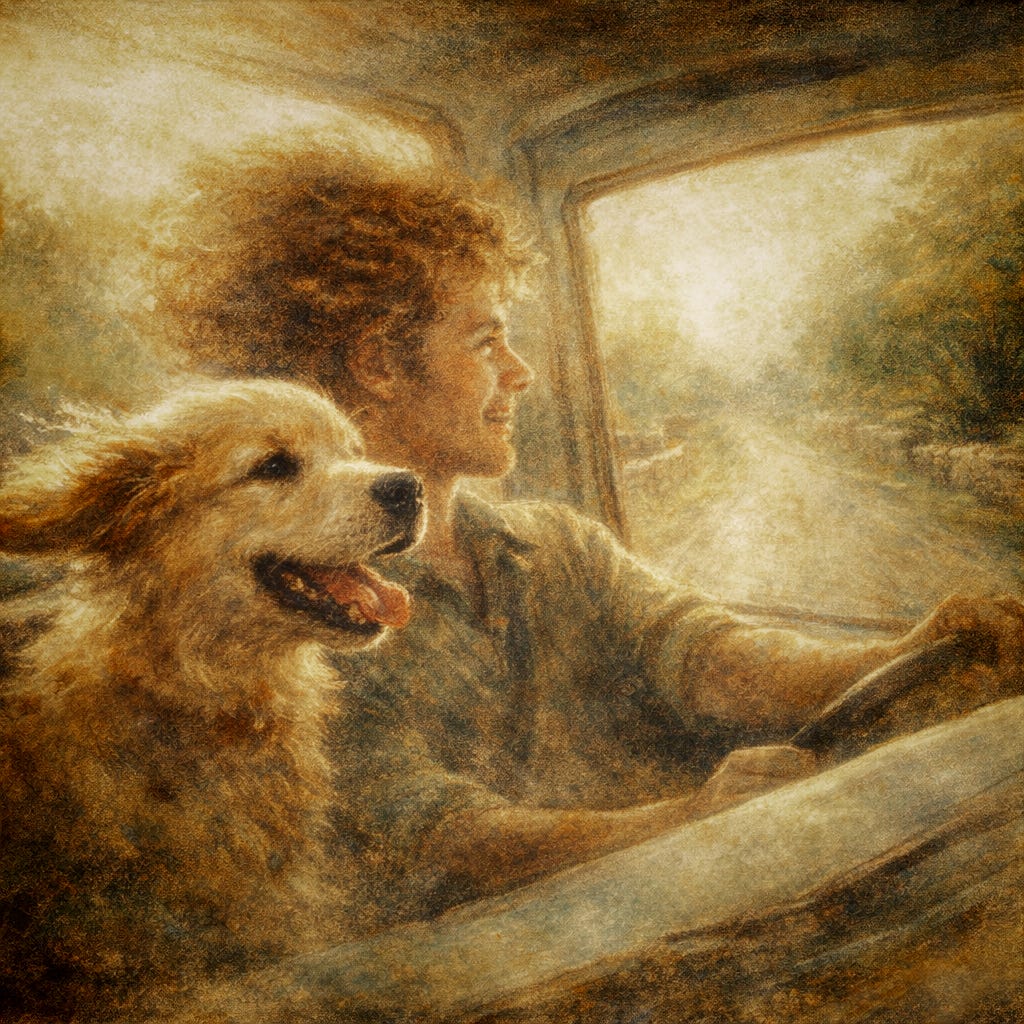
He was a male, intact, a ball of golden fur with enormous paws. I named him Brer, after Brer Rabbit. He was my first dog as an adult, and he changed the geometry of my days. Now I had a companion. He rode shotgun in the Datsun, waited at the base of the ladder while I painted, slept under my bed in that ten-by-ten room at my mother’s house. He was loyal and goofy and uncomplicated in all the ways that my life had never been. I’d had dogs growing up — the family Irish setters at Ledge Acres, Rusty and then Tara and Corky — but Brer was mine. My dog, my truck, my ladders, my business. For the first time, the life I was living actually belonged to me.
* * *
I was still smoking Marlboros, a habit I picked up during my year in Rennes, France over a decade earlier. About a pack a day. It was what you did — everybody smoked, every tradesman I knew smoked, you’d take a break and light up and lean against the truck and watch the smoke curl away and not think about what it was doing to you. Smoking was as much a part of the workday as lunch.
Then I got a cold that winter. A bad one. I was coughing hard, deep chest coughs that wouldn’t quit. One morning I coughed something up and looked at it and it was black. Lung tissue, dark as soot. And there was blood on it.
I stood there in the bathroom looking at that bloody black thing in the sink and I knew I had to stop. Not eventually. Not after this pack. Now.
It was hard. Cigarettes had been part of my life since I was a teenager. But I developed a mental game — every time the craving hit, I’d weigh five minutes of satisfaction against a lifetime of health. Through sheer willpower, over a period of several weeks, I quit completely. I never smoked again.
* * *
I was starting to have something resembling a social life — or at least a sexual one, which was more than I’d had in Los Angeles. There were some small clubs in Stamford, and I’d go out on weekends. I met a redhead and saw her for a while. There were a couple of one-night stands. Nothing that stuck. “Chain Gang” was on the radio constantly that year, and there was something about the rhythm of that song that matched the rhythm of my life — steady work, steady motion, not going anywhere in particular but not standing still either.
It wasn’t love. It wasn’t even close to love. But after six years of near-complete celibacy — six years of lying in bed in Brentwood listening to a couple across the alley have sex like a radio broadcast from another planet — even the most casual connection felt like a form of rejoining the human race.
There had been one exception during those desert years. Back in 1974, during one of my cross-country hitchhiking trips, the guy I was riding with had a girlfriend in Crystal Lake, Illinois. We detoured north from I-80 so he could find her. We ended up at a nightclub, and I met a girl named Dona Golden. We hit it off instantly — one of those connections that ignites on contact, no preamble, no negotiation, just two people who recognized something in each other. We had a one-night stand. And that was that. I went back on the road and forgot about her.
Months later, back at my mother’s house in Pound Ridge, the phone rang. It was Dona. She wanted to come visit.
She did. She stayed for a week. And all we did was have sex.
Upstairs. Downstairs. In the woods behind the house. By the side of the house. In the basement. In my car. It was the most concentrated explosion of physical intimacy I’d ever experienced — a week-long fever dream that made up for every lonely night in every lonely apartment in every lonely city I’d passed through. Dona was attractive and skinny and smoked cigarettes and laughed easily and wanted exactly what I wanted, which was to disappear into each other and not come up for air.
Then she left. I never saw her again. She had appeared out of a nightclub in Crystal Lake, Illinois, like a hallucination, burned through a week of my life like a comet, and vanished. I didn’t know what to do with that then. I’m not sure I know what to do with it now. But I know it happened, and I know it was the only time during that entire lost decade when I felt fully alive in another person’s presence.
By the spring of 1980 I’d been painting houses for about a year. I had a truck, a dog, a small reputation in the neighborhood, and enough work to keep going. I was not getting rich. I was not building an empire. I was painting other people’s houses in Westchester County and fishing the reservoirs and going to Dead shows and occasionally meeting a woman in a bar in Stamford. It was a small life. But it was mine.
My mother was happy to have me around. Charlie was finishing up at the Hyde School in Bathe, Maine. Anni was sixteen and had run away from Hyde and returned home defiant. I taught her to drive in the Datsun — took her down to a straightaway, told her to floor it, watched her face light up the same way Charlie’s had on that mountain road in Colorado years earlier, and then told her to slow it down and watched the same flash of fear and realization cross her face. Andre’s driving lesson: first the thrill, then the consequences.
I took a picture of Anni once, back at Ledge Acres, when she was about three. She was standing in the yard in a sundress, all that long blonde hair, holding a garden hose with her thumb jammed into the end, spraying water everywhere, this look on her face like she’d just discovered a superpower. I still carry every detail of that picture in my heart. It caught something essential about her — the delight, the mischief, the absolute certainty that the world was a place where things worked out if you were brave enough to try.
Charlie and Anni had always been especially dear to me. I need to say that plainly because the story so far has been about leaving — leaving Ledge Acres, leaving California, leaving the film dream, leaving Los Angeles. But I always came back to them. They were the thread. They were the reason Pound Ridge felt like something more than just a place to sleep between jobs. When I watched them come over the hill in their school uniforms in 1973, backlit and golden, I knew that whatever else I’d lost, I still had them. And now, living under the same roof again for the first time in years, painting houses and teaching Anni to drive and taking Brer to the reservoir — this was the closest thing to home I’d had since Ledge Acres.
It wouldn’t last. My father was about to call with one of his ideas. But for a little while, in that house on Trinity Lane, with my mother and my brother and my sister and my dog, I was something I hadn’t been in a very long time.
I was happy.
